NRIDA and IIM Kolkata Study on PMGSY-IV and PM-JANMAN
Source:PIB ↗
Why It Matters
Understanding the role of empirical impact assessment studies on major rural infrastructure and tribal welfare schemes like PMGSY-IV and PM-JANMAN is critical for evaluating inclusive growth, last-mile connectivity, and effective governance in India.
Summary
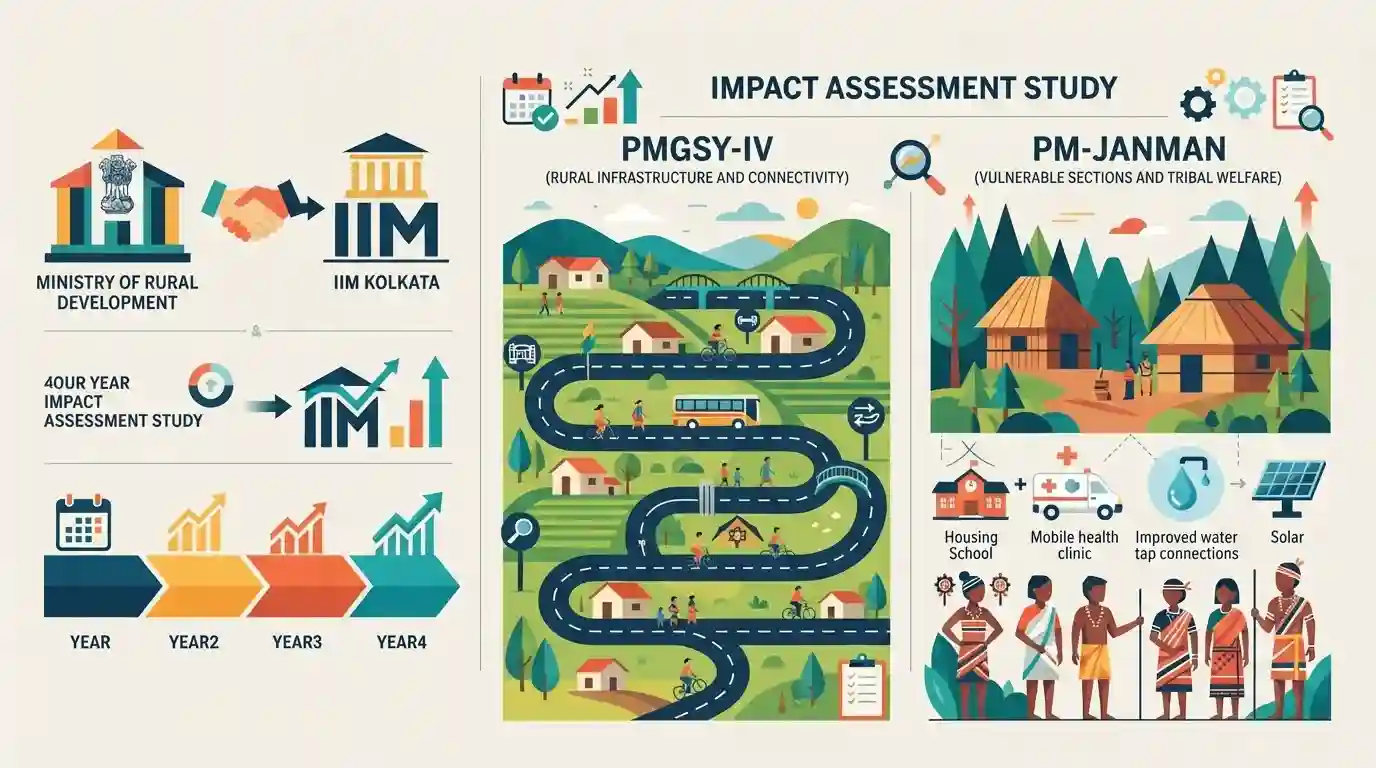
The National Rural Infrastructure Development Agency (NRIDA) under the Ministry of Rural Development has partnered with IIM Kolkata to conduct a comprehensive four-year impact assessment study of PMGSY-IV and PM-JANMAN schemes, focusing on rural infrastructure, connectivity, and tribal welfare.
Key Points
- NRIDA and IIM Kolkata signed an MoU for a four-year impact assessment study of PMGSY-IV and PM-JANMAN.
- PMGSY-IV focuses on providing all-weather road connectivity to eligible unconnected habitations in rural areas.
- PM-JANMAN aims at holistic development and saturation of critical interventions in Particularly Vulnerable Tribal Groups (PVTGs) habitations.
- The study will evaluate socio-economic impacts, infrastructure development, livelihood generation, and access to basic services in rural and tribal regions.
Important Terms
PMGSY-IV

The fourth phase of the rural road connectivity scheme aimed at constructing thousands of kilometers of all-weather roads and connecting unconnected habitations using advanced construction practices.
UPSC context
GS Paper III (Infrastructure - Rural Connectivity). Tests understanding of government interventions for rural infrastructure development and connectivity enhancement.
PM-JANMAN
A targeted mission launched for the socio-economic development of Particularly Vulnerable Tribal Groups (PVTGs) across India, providing basic amenities like housing, roads, and water.
UPSC context
GS Paper II (Vulnerable Sections - Tribal Welfare). Tests governance, social justice, and welfare schemes for PVTGs.
NRIDA
An agency under the Ministry of Rural Development providing technical and managerial support for the implementation of rural road infrastructure programs like PMGSY.
UPSC context
GS Paper III (Infrastructure / Governance). Tests institutional frameworks governing rural infrastructure delivery and scheme execution in India.
Static Concepts Connected
What are the key criteria and implementing frameworks for Particularly Vulnerable Tribal Groups (PVTGs) in India?
- Identification Criteria: Pre-agricultural level of technology, declining or stagnant population, extremely low literacy, and subsistence economy.
- Demographic Spread: 75 groups officially identified across 18 States and 1 Union Territory (highest in Odisha).
- Nomenclature Shift: Originally known as Primitive Tribal Groups (PTGs) before being renamed PVTGs in 2006 by the Government of India.
What are the primary targets and funding architectures of Pradhan Mantri Gram Sadak Yojana (PMGSY)?
- Core Objective: Central sector and centrally sponsored elements aimed at providing all-weather road connectivity to unconnected rural habitations.
- Financing Mechanism: Funded through a dedicated cess on high-speed diesel, supplemented by multilateral loans from the World Bank and ADB.
- Implementation Agency: Implemented by the National Rural Infrastructure Development Agency (NRIDA) under the Ministry of Rural Development.
Cross-Topic Patterns
PVTG Saturation Meets Rural Infrastructure Mapping
PM-JANMAN connects tribal welfare with spatial infrastructure mapping, intersecting the Vulnerable Sections syllabus with rural engineering metrics.

PM-JANMAN (75 PVTGs) + PMGSY-IV criteria likely to appear as a matching or multi-statement Prelims question.
Linked PYQs · 2
Linked PYQs · 2
- 2021MainsGS3
“Investment in infrastructure is essential for more rapid and inclusive economic growth.” Discuss in the light of India's experience.
- 2022MainsGS2
The Gati-Shakti Yojana needs meticulous coordination between the government and the private sector to achieve the goal of connectivity. Discuss.
