Labour Codes Implementation and Shram Samvad Outreach Initiative
Source:PIB ↗
हे का महत्त्वाचे आहे
This article highlights grassroots-level outreach and capacity building for the implementation of India's four new Labour Codes, which represent a major overhaul of the country's labor market framework by balancing ease of doing business with worker welfare.
सारांश
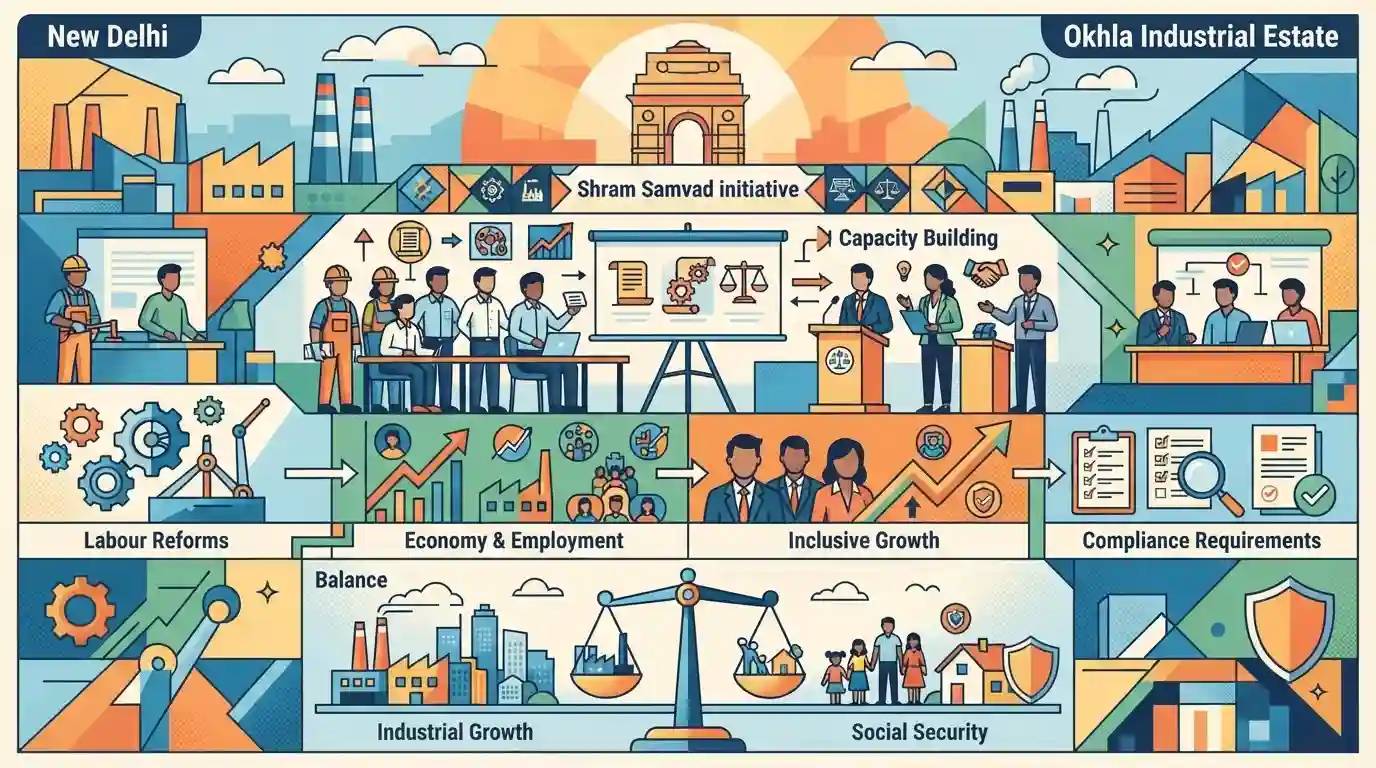
A District Capacity Building and Awareness Programme on Labour Codes was conducted at Okhla Industrial Estate, New Delhi, under the Shram Samvad initiative. The workshop aimed to educate stakeholders, employers, and workers about the upcoming implementation, compliance requirements, and welfare provisions of India's four new Labour Codes, balancing industrial growth with social security.
मुख्य मुद्दे
- A District Capacity Building and Awareness Programme on the new Labour Codes was held at Okhla Industrial Estate, New Delhi, as part of the 'Shram Samvad' initiative.
- The programme aims to enhance awareness and capacity of local stakeholders, industries, and workers regarding the provisions, compliance mechanisms, and benefits of the consolidated Labour Codes.
- Focuses on streamlining multiple labor laws into four simplified codes to improve ease of doing business while safeguarding worker welfare and social security rights.
- Emphasizes dialogue and collaborative implementation between government authorities, employers, and employees.
महत्त्वाच्या संज्ञा
Shram Samvad Initiative

A nationwide awareness campaign launched by the Ministry of Labour and Employment to educate stakeholders, employers, and workers across hundreds of districts about India's four new Labour Codes.
UPSC context
UPSC Prelims/Mains (GS Paper II/III): Tests government governance, administrative outreach, and labor welfare policy implementation.
Labour Codes
A comprehensive legislative overhaul consolidating 29 central labor laws into four codes covering wages, industrial relations, social security, and occupational safety.
UPSC context
UPSC GS Paper III (Economy/Inclusive Growth): Tests legal reforms in labor markets, ease of doing business, and worker welfare provisions.
Ministry of Labour and Employment
The central government ministry responsible for formulating labor policies, ensuring worker safety and welfare, and administering labor laws and social security frameworks in India.
UPSC context
UPSC GS Paper II: Important ministries and statutory bodies responsible for social sector welfare and regulatory execution.
संबंधित स्थिर संकल्पना
What are the four consolidated Labour Codes in India and their core objectives?
- Legislative Scope: Consolidation: Merges 29 central labour laws into four distinct codes namely Wages, Industrial Relations, Social Security, and OSH.
- Inclusion Focus: Universalisation: Extends statutory minimum wages and social security benefits to unorganised, gig, and platform workers.
- Ease of Business: Compliance: Simplifies returns, registers, and licensing to boost ease of doing business and attract investments.
आंतर-विषय नमुने
Labour Codes & Formalisation Metrics
The Okhla workshop highlights how easing compliance directly intersects with expanding formalisation metrics under PLFS and EPFO payroll data.

Expect a statement-based prelims question on the 4 Labour Codes covering gig worker coverage, floor wages, and consolidated central laws.
संबंधित PYQ · 1
संबंधित PYQ · 1
- 2024MainsGS3
Discuss the merits and demerits of the four 'Labour Codes' in the context of labour market reforms in India. What has been the progress so far in this regard?
