Government Borrowing Plan: H2 Fiscal Deficit and Debt Management
Source:PIB ↗
Why It Matters
Understanding government borrowing plans, fiscal deficits, and debt management instruments (like dated securities, T-Bills, and WMA) is essential for aspirants tracking macroeconomic stability, public finance management, and monetary-fiscal coordination in India.
Summary
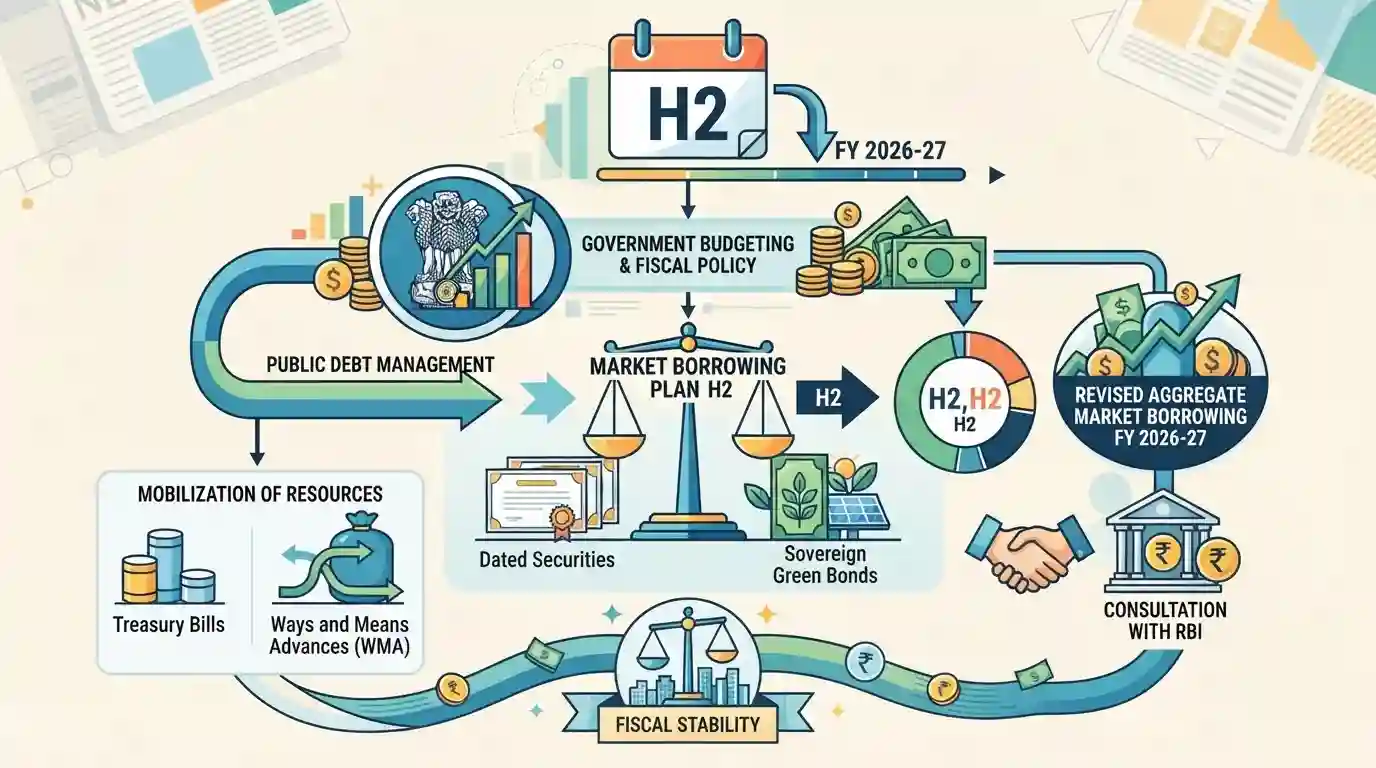
The Ministry of Finance announced the government's borrowing calendar for the second half (H2) of FY 2026-27, detailing a market borrowing plan of ₹7,86,000 crore through dated securities and Sovereign Green Bonds in consultation with the Reserve Bank of India. The revised aggregate market borrowing for the fiscal year stands at ₹15,99,506 crore, alongside provisions for Treasury Bills and Ways and Means Advances (WMA) limits.
Key Points
- The Government of India, in consultation with the RBI, announced a borrowing plan of ₹7,86,000 crore for the second half (H2) of FY 2026-27.
- Total market borrowing through dated securities for FY 2026-27 is projected at ₹15,99,506 crore, lower than the initial Budget Estimates of ₹17,20,000 crore.
- H2 market borrowing includes Sovereign Green Bonds (SGrBs) worth ₹15,000 crore across tenors ranging from 3 to 50 years.
- Ways and Means Advances (WMA) limit for H2 FY 2026-27 has been fixed by the RBI at ₹50,000 crore to manage temporary cash flow mismatches.
- Treasury Bills (T-Bills) worth ₹23,000 crore per week are scheduled to be issued during Q3 of FY 2026-27.
Important Terms
Sovereign Green Bonds (SGrBs)

Government debt instruments issued to mobilize funds for green infrastructure and projects aimed at reducing the economy's carbon intensity, part of the overall market borrowing program.
UPSC context
Important for GS Paper III (Environment and Economic Development/Mobilization of Resources), testing sustainable finance mechanisms and fiscal policy.
Ministry of Finance
The central ministry responsible for formulating India's fiscal policy, framing the Union Budget, managing public debt, and announcing government borrowing calendars in consultation with the RBI.
UPSC context
Important for GS Paper II and III (Government Budgeting, Fiscal Policy, and Polity), testing institutional roles in economic management.
Reserve Bank of India (RBI)
India's central banking institution that manages public debt on behalf of the government, conducts bond auctions, and regulates monetary and credit policy.
UPSC context
Important for GS Paper III (Indian Economy, Monetary Policy, and Public Debt Management), testing the central bank's operational functions.
Prelims Trap
Ways and Means Advances (WMA) constitute long-term sovereign market borrowings used to finance the annual fiscal deficit.
Aspirants often confuse Ways and Means Advances (WMA) with permanent market borrowings or fiscal deficit financing; WMA is strictly a temporary liquidity facility.
Static Concepts Connected
What are the primary instruments used by the Government of India for domestic market borrowing?
- Dated Securities: Dated Securities: Long-term instruments with a maturity of one year or more, issued via auctions by the RBI.
- T-Bills: Treasury Bills: Short-term money market instruments with maturities of 91 days, 182 days, and 364 days.
- CMBs: Cash Management Bills: Short-term instruments issued to bridge temporary cash flow mismatches of less than 91 days.
Cross-Topic Patterns
Fiscal Deficit and Monetary Policy Transmission
A lower fiscal borrowing requirement directly lowers the net G-Sec supply, influencing sovereign bond yields, banking sector duration risk, and overall monetary transmission by the RBI.
Sovereign Green Bonds and Climate Finance
Issuing Sovereign Green Bonds provides dedicated capital for India's net-zero transition, linking fiscal management with international climate finance commitments and taxonomy standards.

Expect a multi-statement Prelims question on fiscal deficit financing instruments, distinguishing between dated securities, T-Bills, and WMA limits.
Linked PYQs · 5
Linked PYQs · 5
- 2025PrelimsGS1
A country's fiscal deficit stands at ₹50,000 crores. It is receiving ₹10,000 crores through non-debt creating capital receipts. The country's interest liabilities are ₹1,500 crores. What is the gross primary deficit?
- 2021PrelimsGS1
Which one of the following is likely to be the most inflationary in its effects?
- 2024PrelimsGS1
With reference to the Indian economy, "Collateral Borrowing and Lending Obligations" are the instruments of:
- 2019MainsGS3
The public expenditure management is a challenge to the Government of India in the context of budget making during the post-liberalization period. Clarify it.
- 2021MainsGS3
Distinguish between Capital Budget and Revenue Budget. Explain the components of both these Budgets.
