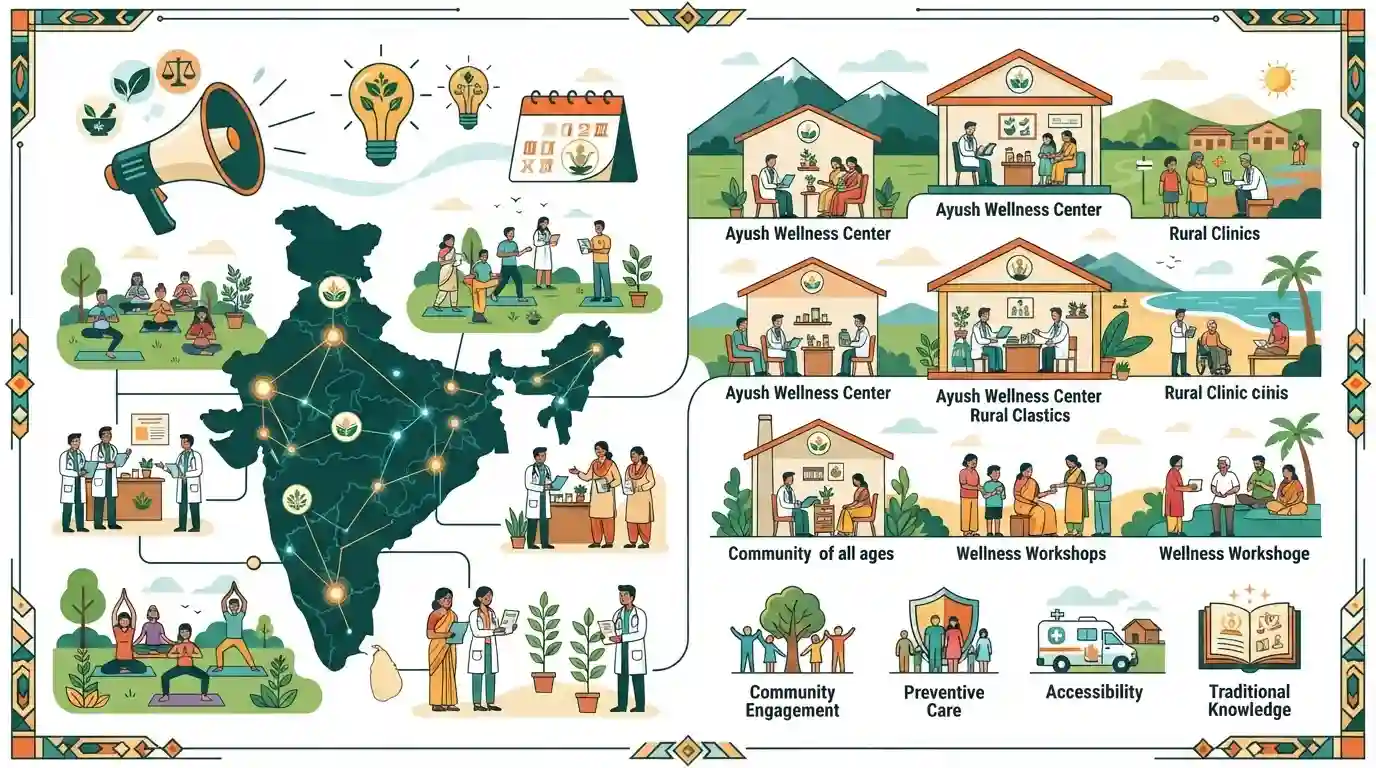
Ayush institutions undertake nationwide outreach for Ayurveda Day 2026
Source:PIB ↗
Why It Matters
This initiative highlights the institutional efforts to mainstream traditional Indian systems of medicine like Ayurveda into public healthcare and preventive wellness, aligning with broader goals of inclusive and accessible grassroots healthcare.
Summary
Ayush institutions across India are undertaking extensive nationwide awareness, wellness, and community outreach activities in the lead-up to the 11th Ayurveda Day 2026, aiming to popularize traditional systems of medicine and enhance preventive healthcare at the grassroots level.
Key Points
- The Ministry of Ayush and its institutions are organizing nationwide awareness, wellness, and community outreach activities leading up to the 11th Ayurveda Day 2026.
- The initiatives focus on promoting public health, preventive healthcare, and community wellness through traditional Ayurvedic practices.
- Outreach programs emphasize integrating traditional medicine into daily life and grassroots healthcare delivery systems.
Important Terms
Ayurveda Day

An annual global observance dedicated to popularizing Ayurveda, raising public awareness of its holistic benefits, and promoting preventive healthcare based on traditional Indian medicine.
UPSC context
UPSC Prelims/Mains (GS Paper II - Health & Social Justice): Tests awareness of traditional medicine promotional initiatives and national health observances.
Ministry of Ayush
A dedicated Indian government ministry established in 2014 to oversee education, research, policy formulation, and propagation of traditional systems of medicine including Ayurveda, Yoga, Unani, Siddha, and Homeopathy.
UPSC context
UPSC Prelims/Mains (GS Paper II - Governance/Health): Evaluates institutional frameworks governing traditional healthcare delivery and public health schemes.
Ayush Institutions
Academic, research, and clinical institutions operating under or supported by the Ayush sector to train practitioners, conduct scientific validation, and deliver traditional healthcare at the grassroots level.
UPSC context
UPSC Prelims/Mains (GS Paper II - Health & Human Resources): Tests understanding of public healthcare infrastructure and institutional capacity in traditional medicine.
Static Concepts Connected
What are the key institutional bodies and global milestones associated with the Ministry of Ayush in India?
- Ministry Origins: Established in November 2014, the Ministry of Ayush was carved out of the Ministry of Health and Family Welfare to focus on traditional medicine systems (Ayurveda, Yoga & Naturopathy, Unani, Siddha, and Homoeopathy).
- WHO GCTM Jamnagar: The WHO Global Centre for Traditional Medicine (GCTM) was established in Jamnagar, Gujarat, as the first and only global outposts center for traditional medicine across the globe.
- ICD-11 Integration: Ayurveda morbidity codes have been successfully integrated into the WHO International Classification of Diseases (ICD-11) traditional medicine module, enabling global standardization.
Cross-Topic Patterns
Ayush Integration with Ayushman Bharat Mission
The operationalization of Ayush facilities within Ayushman Arogya Mandirs connects traditional wellness directly to the Ayushman Bharat digital health mission architecture.
Traditional Medicine and Global Health Diplomacy
WHO Global Centre for Traditional Medicine in Jamnagar highlights India's soft power diplomacy and global health governance strategy.

Expect statement-based questions on WHO ICD-11 inclusion of Ayurveda terms, IRDAI insurance mandates, and Ayush integration in PHCs.
Linked PYQs · 2
Linked PYQs · 2
- 2024MainsGS2
In a crucial domain like the public healthcare system the Indian State should play a vital role to contain the adverse impact of marketisation of the system. Suggest some measures through which the State can enhance the reach of public healthcare at the grassroots level.
- 2021PrelimsGS1
Consider the following statements : 1. Moringa (drumstick tree) is a leguminous evergreen tree. 2. Tamarind tree is endemic to South Asia. 3. In India, most of the tamarind is collected as minor forest produce. 4. India exports tamarind and seeds of moringa. 5. Seeds of moringa and tamarind can be used in the production of biofuels. Which of the statements given above are correct?
