India expands global economic integration through value chain linkages
Source:PIB ↗
આ શા માટે મહત્વનું છે
It provides critical insights into India's evolving trade strategy, export promotion, and manufacturing policies (such as semiconductors and Make in India) vital for economic development and employment generation.
સારાંશ
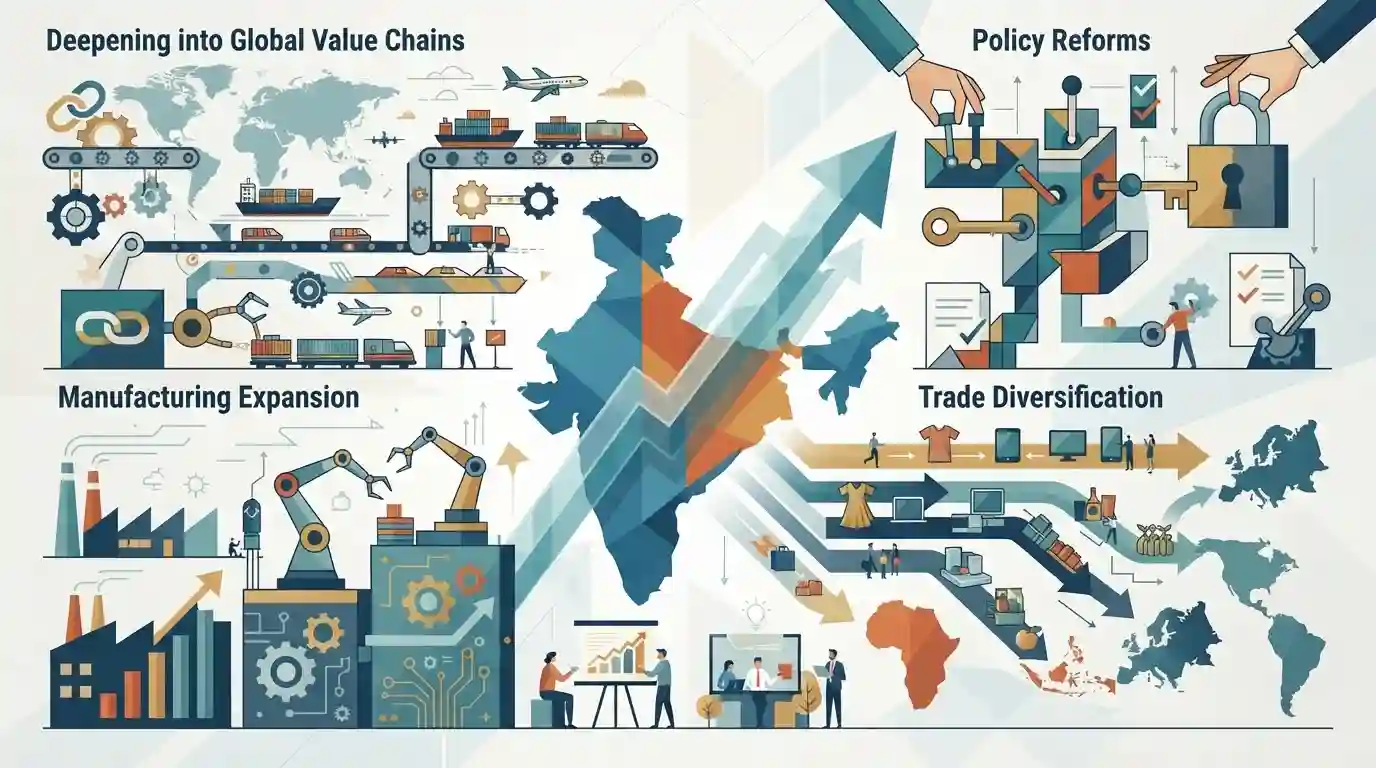
Union Minister of Commerce and Industry Shri Piyush Goyal detailed India's robust economic trajectory, focusing on deeper integration into Global Value Chains (GVCs), manufacturing expansion, policy reforms, and trade diversification to position India as a key pillar of global economic growth.
મુખ્ય મુદ્દા
- Union Minister Shri Piyush Goyal highlighted India's expanding global economic integration and increasing footprint in Global Value Chains (GVCs).
- Emphasized the focus on boosting manufacturing, expanding exports through Free Trade Agreements (FTAs), and fostering an innovation-driven startup ecosystem.
- Stressed the importance of strategic economic partnerships, self-reliance (Atmanirbhar Bharat), and technology-led growth to achieve the vision of Viksit Bharat by 2047.
મહત્વપૂર્ણ શબ્દો
Ministry of Commerce and Industry

A central government ministry responsible for formulating and implementing foreign trade policies, promoting exports, and regulating industrial development and internal trade via its departments like DPIIT.
UPSC context
GS Paper III (Indian Economy - Industrial Policy, Foreign Trade & Investment). Essential for understanding trade promotion and industrial growth strategies.
Global Value Chains (GVCs)
International production networks where manufacturing and assembly of goods are fragmented across different countries, allowing countries to specialize in specific stages of production.
UPSC context
GS Paper III (Economy - Growth, Development and Employment). Important for studying India's export competitiveness, manufacturing integration, and globalization impacts.
Trade Diversification
A strategic economic policy aimed at expanding trade by exploring new international export destinations and broadening the basket of exported goods and services to mitigate global shocks.
UPSC context
GS Paper III (Indian Economy - External Sector and Trade). Crucial for questions on export-led growth, balance of payments, and resilience against external economic shocks.
પ્રિલિમ્સ ટ્રેપ
India's integration into Global Value Chains (GVCs) is mutually exclusive with self-reliance (Atmanirbhar Bharat) policies.
Aspirants often assume integration into Global Value Chains (GVCs) requires abandoning domestic protectionism or self-reliance, whereas India pursues 'Atmanirbhar Bharat' alongside outward-looking export strategies.
સંલગ્ન સ્થિર ખ્યાલો
What are Global Value Chains (GVCs) and what drives developing country participation in them?
- Definition: International fragmentation of production where different stages of manufacturing are distributed across multiple countries.
- Drivers: Low-cost labor, trade facilitation, reducing tariff barriers, and logistics infrastructure development.
- Upgrading: Moving from assembly-only tasks upstream into R&D and design or downstream into branding and marketing.
આંતર-વિષય પેટર્ન
GVC Integration vs WTO Trade Norms
Global Value Chain participation requires balancing domestic manufacturing support via PLI schemes with WTO export subsidy rules and tariff bindings.
Trade Diplomacy & Critical Tech Security
India's push for high-value manufacturing and technology-led growth links trade policy directly to national security and semiconductor supply chain resilience.

GVC integration + PLI schemes + FTA strategy will be tested as a multi-statement match regarding India's export diversification.
સંલગ્ન PYQ · 2
સંલગ્ન PYQ · 2
- 2025MainsGS3
India aims to become a semiconductor manufacturing hub. What are the challenges faced by the semiconductor industry in India? Mention the salient features of the India Semiconductor Mission.
- 2023MainsGS3
Faster economic growth requires increased share of the manufacturing sector in GDP, particularly of MSMEs. Comment on the present policies of the Government in this regard.
