India National Security Framework and Defence Preparedness
Source:PIB ↗
આ શા માટે મહત્વનું છે
This article provides critical conceptual perspectives and policy arguments on India's evolving national security architecture, moving from traditional territorial defense to a comprehensive, technology-driven, and self-reliant security ecosystem, making it highly relevant for UPSC GS Paper 3.
સારાંશ
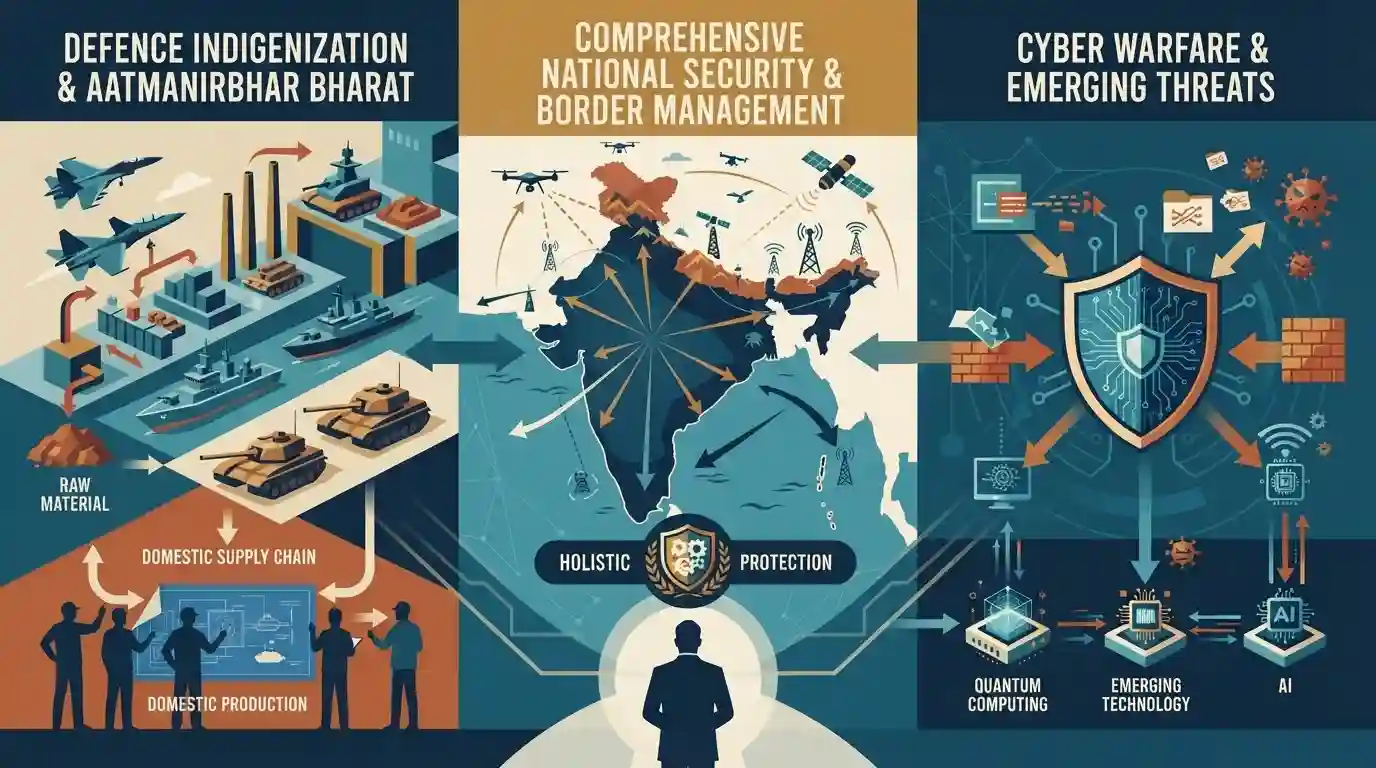
Defence Minister Rajnath Singh emphasized that India's national security framework has evolved beyond traditional border protection to a holistic approach addressing modern multi-domain threats, technological advancements, and self-reliance in defence manufacturing.
મુખ્ય મુદ્દા
- National security is no longer restricted to safeguarding physical borders; it requires a holistic approach covering economic, technological, and strategic dimensions.
- India has shifted from being a major defence importer to a developing defence exporter through indigenous manufacturing and 'Aatmanirbhar Bharat'.
- Emerging security challenges like cyber warfare, asymmetric threats, and fluid geopolitical dynamics necessitate a transformed and tech-enabled military apparatus.
મહત્વપૂર્ણ શબ્દો
Aatmanirbhar Bharat

India's strategic policy initiative aimed at achieving self-reliance across critical sectors, notably defense manufacturing, through domestic procurement lists, indigenization policies, and reduced import dependence.
UPSC context
UPSC GS Paper III (Economy & Security): Tests understanding of economic indigenization, defence manufacturing self-sufficiency, and strategic autonomy.
Ministry of Defence
The central government department charged with coordinating and executing policy regarding the Indian Armed Forces and national defense matters.
UPSC context
UPSC GS Paper II/III (Polity & Security): Relevant for governance structures, administrative control of forces, and defense procurement management.
પ્રિલિમ્સ ટ્રેપ
India has completely ceased defence imports and achieved total self-reliance across all advanced military hardware.
Aspirants often assume India has completely eliminated defence imports; the reality is a transition from being a major importer to a developing exporter, with import dependence still persisting in niche critical components.
સંલગ્ન સ્થિર ખ્યાલો
What are the key institutional mechanisms for integrated multi-domain defence management in India?
- Department of Military Affairs: Created to bring jointness in logistics, training, and procurement among the three services, headed by the Chief of Defence Staff.
- Cyber and Space Agencies: Specialized tri-service bodies established to handle warfare and power projections in non-traditional operational domains.
- Positive Indigenization Lists: Instruments like the positive indigenization lists legally restrict import of specified military items to promote domestic manufacturing.
આંતર-વિષય પેટર્ન
Defence Indigenization & Macroeconomic Import Substitution
Defence indigenization targets under Aatmanirbhar Bharat directly overlap with manufacturing metrics, import substitution policies, and foreign direct investment (FDI) caps in sensitive sectors.
Multi-Domain Warfare & Critical Infrastructure Resilience
The shift toward cyber, space, and asymmetric warfare requires institutional reforms, linking military modernization directly with civilian critical infrastructure protection and inter-ministerial crisis management.

Expect a multi-statement prelims question on the structural shift from traditional border defense to comprehensive multi-domain security frameworks.
સંલગ્ન PYQ · 3
સંલગ્ન PYQ · 3
- 2021MainsGS3
Keeping in view India's internal security, analyse the impact of cross-border cyber attacks. Also discuss defensive measures against these sophisticated attacks.
- 2020MainsGS3
Discuss different types of cyber crimes and measures required to be taken to fight the menace.
- 2017MainsGS3
Discuss the potential threats of Cyber attack and the security framework to prevent it.
