ASEAN India Economic Ministers Meeting and AITIGA Review
Source:PIB ↗
Why It Matters
This article highlights India's strategic economic engagement with ASEAN and East Asia, specifically focusing on the review of the AITIGA and regional trade integration, which are vital for India's Act East Policy and export-led growth.
Summary
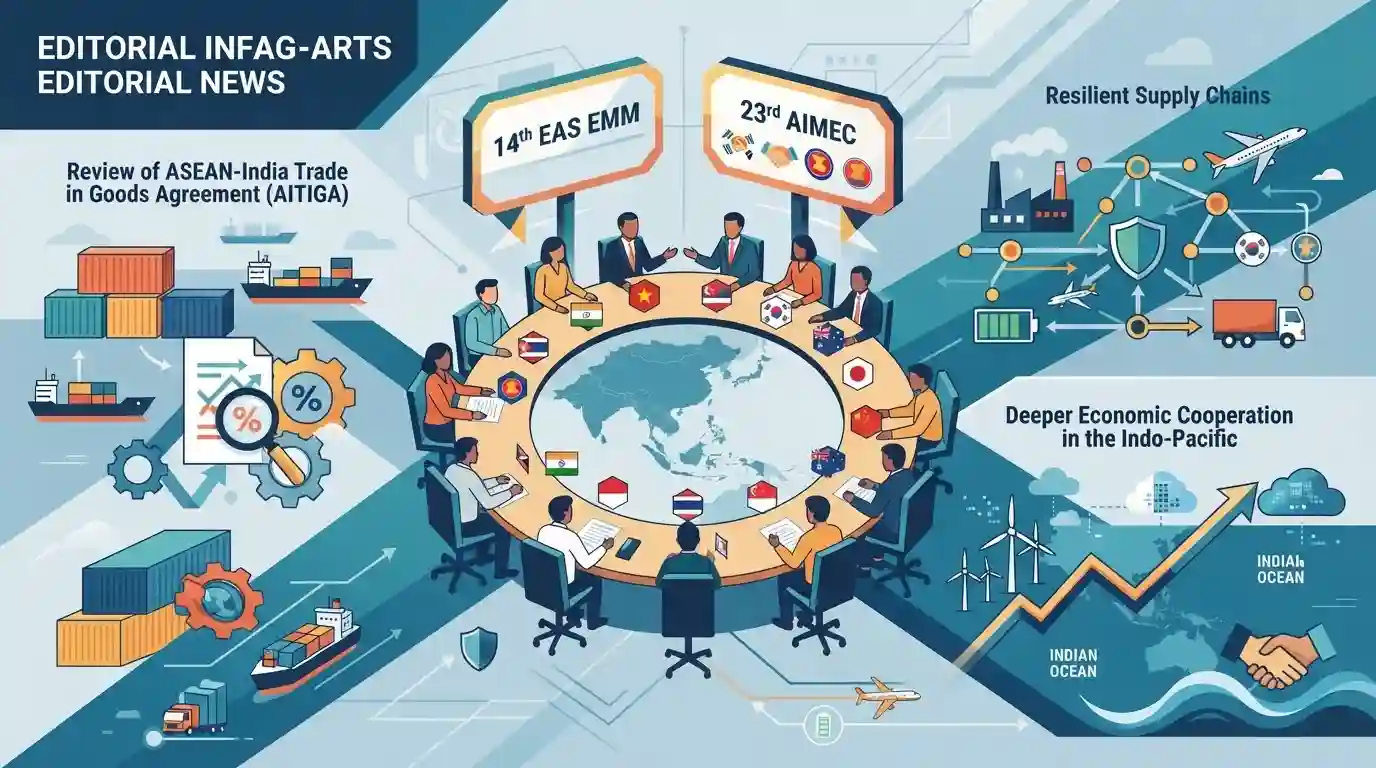
India participated in the 14th East Asia Summit Economic Ministers' Meeting and the 23rd ASEAN-India Economic Ministers Consultation, emphasizing the review of the ASEAN-India Trade in Goods Agreement (AITIGA), resilient supply chains, and deeper economic cooperation in the Indo-Pacific.
Key Points
- India participated in the 14th East Asia Summit Economic Ministers' Meeting and the 23rd ASEAN-India Economic Ministers Consultation.
- Discussions focused on the review of the ASEAN-India Trade in Goods Agreement (AITIGA) to make it more modern, user-friendly, and trade-facilitative.
- Emphasis was placed on strengthening supply chain resilience, enhancing multilateral trade systems, and addressing emerging economic challenges.
- The meetings highlighted the strategic significance of the Indo-Pacific region and deepening economic integration between India and ASEAN member states.
Important Terms
ASEAN-India Trade in Goods Agreement (AITIGA)

A free trade agreement signed in 2009 between India and the ten ASEAN member states to reduce import duties and boost bilateral trade, currently undergoing a formal review to address trade asymmetries.
UPSC context
UPSC Prelims & Mains (GS Paper II / III) – International Trade, Free Trade Agreements, and India-ASEAN Economic Relations.
East Asia Summit
A premier leaders-led regional forum established in 2005 comprising 18 countries (ASEAN plus 8 dialogue partners including India), focusing on strategic, political, and economic cooperation in the Indo-Pacific.
UPSC context
UPSC Prelims & Mains (GS Paper II) – Important International Institutions, Groupings, and India's Foreign Policy in the Indo-Pacific.
Association of Southeast Asian Nations (ASEAN)
A political and economic union of ten Southeast Asian nations established in 1967, serving as a central pillar of India's Act East Policy and regional security architecture.
UPSC context
UPSC Prelims & Mains (GS Paper II) – Regional Groupings, Bilateral Relations, and Strategic Significance of Southeast Asia to India.
Static Concepts Connected
What are the member composition and foundational principles of the East Asia Summit (EAS)?
- Composition: ASEAN plus ten includes the ten ASEAN member states plus India, China, Japan, South Korea, Australia, New Zealand, Russia, and the United States.
- Centrality: ASEAN Centrality is the core foundational principle, ensuring that ASEAN drives the agenda and pacing of integration.
- Nature: It functions as a leader-led forum for strategic dialogue and cooperation on political, security, and economic challenges.
Cross-Topic Patterns
ASEAN Trade + Indo-Pacific Supply Chains
AITIGA review directly links bilateral trade agreements with WTO plurilateral rules of origin and supply chain diversification away from China in the Indo-Pacific.

Expect statement-based questions on AITIGA review mandates, EAS membership criteria, and ASEAN centrality in Indo-Pacific architecture.
Linked PYQs · 1
Linked PYQs · 1
- 2025MainsGS3
What are the challenges before the Indian economy when the world is moving away from free trade and multilateralism to protectionism and bilateralism? How can these challenges be met?
