India International Water Week addresses water security
Source:PIB ↗
ఇది ఎందుకు ముఖ్యం
Water security is a critical component of India's sustainable development, economic growth, and public health. Discussions at IIWW 2026 provide crucial policy insights into managing water stress, climate resilience, and efficient WASH service delivery, aligning with India's domestic programs and global commitments.
సారాంశం
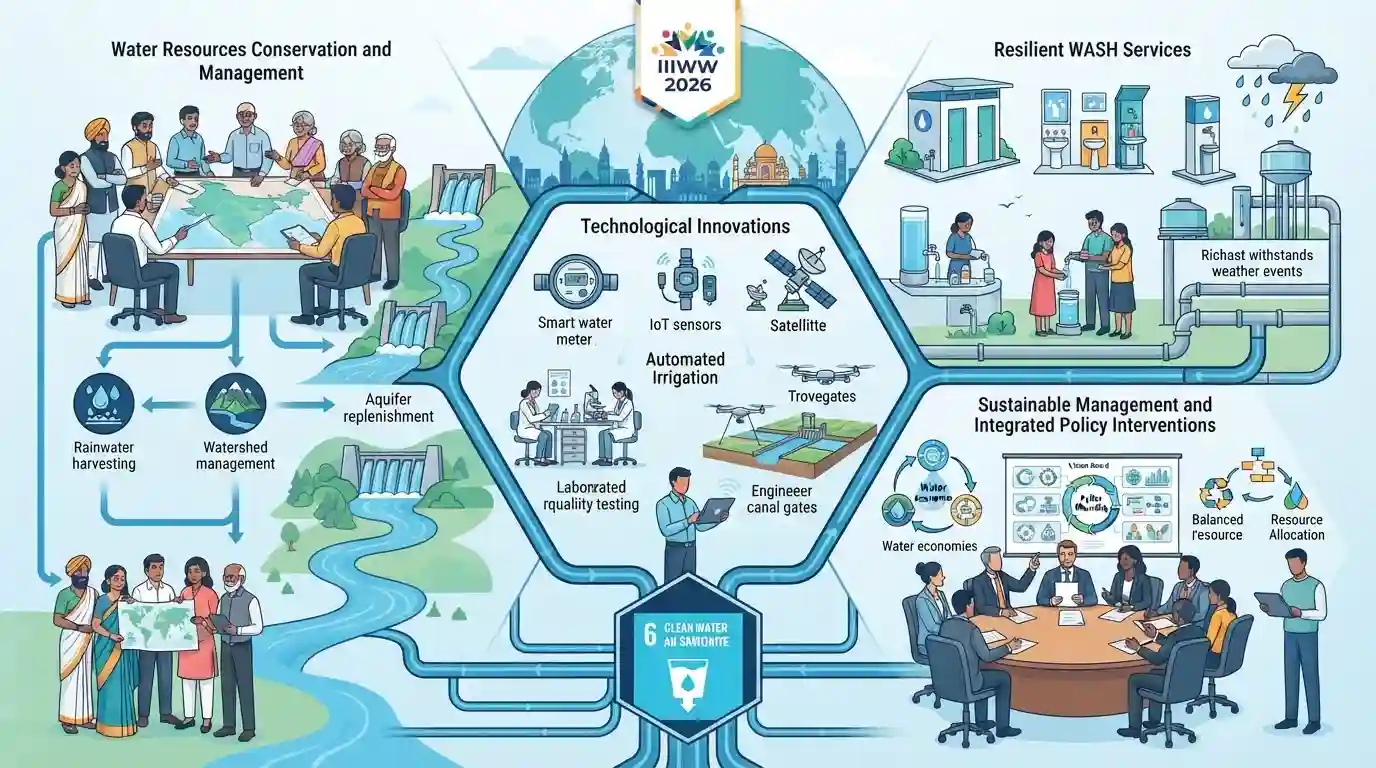
Day 2 of the India International Water Week (IIWW) 2026 convened global and domestic stakeholders to deliberate on water security, technological innovations, and resilient WASH services, emphasizing sustainable management and integrated policy interventions.
ముఖ్య అంశాలు
- Day 2 of the India International Water Week (IIWW) 2026 focused on diverse perspectives surrounding water security, technological innovation, and resilient WASH (Water, Sanitation, and Hygiene) services.
- Discussions highlighted the need for integrated water resource management, community participation, and efficient technologies to combat depleting water resources and climate vulnerabilities.
- Emphasis was laid on leveraging global best practices, digital innovations, and sustainable models for equitable water access and sanitation.
ముఖ్యమైన పదాలు
IIWW 2026

An international platform organized by the Ministry of Jal Shakti to foster global dialogue, technological cooperation, and policy interventions around climate-resilient water management and sustainable water security.
UPSC context
UPSC GS Paper 3 (Water Resources Conservation and Management); tests knowledge of global/national policy forums addressing water scarcity.
WASH
An acronym for Water, Sanitation, and Hygiene, representing the core public health pillars required to ensure safe drinking water supply, proper sanitation facilities, and hygiene practices globally.
UPSC context
UPSC GS Paper 2 & 3 (Social Infrastructure, Health, and Sanitation); tests policies and targets under SDG 6.
Jal Jeevan Mission
A flagship initiative of the Ministry of Jal Shakti aimed at providing safe and adequate drinking water through individual household tap connections to all rural households in India.
UPSC context
UPSC GS Paper 2 & 3 (Government Schemes and Public Infrastructure); tests rural development and drinking water security measures.
అనుసంధానమైన స్థిర భావనలు
What are the core institutional and constitutional frameworks governing water in India?
- Constitutional Status: Water is a State subject under Entry 18 of the State List, except for regulation and development of inter-State rivers under Union List Entry 56.
- Nodal Ministry: The Ministry of Jal Shakti was created in 2019 by merging the Ministry of Water Resources, River Development & Ganga Rejuvenation and the Ministry of Drinking Water and Sanitation.
- Inter-state Disputes: Article 262 empowers Parliament to provide for the adjudication of disputes relating to waters of inter-State rivers or river valleys.
అంతర-అంశ నమూనాలు
Digital Governance + Water Infrastructure
Integrating AI/ML sensors into river rejuvenation (Namami Gange) illustrates the convergence of Digital India governance with environmental conservation.

Water security frameworks (Jal Jeevan Mission, SDG 6) + climate resilience tech likely to appear in Mains GS-3 or Prelims match-ups.
అనుసంధాన PYQలు · 4
అనుసంధాన PYQలు · 4
- 2024MainsGS3
What are the major challenges faced by Indian irrigation system in recent times? State the measures taken by the government for efficient irrigation management.
- 2020MainsGS3
What are the salient features of the Jal Shakti Abhiyan launched by the Government of India for water conservation and water security?
- 2025MainsGS3
Examine the factors responsible for depleting groundwater in India. What are the steps taken by the government to mitigate such depletion of groundwater?
- 2017MainsGS2
To ensure effective implementation of policies addressing water, sanitation and hygiene needs the identification of the beneficiary segments is to be synchronized with the anticipated outcomes." Examine the statement in the context of the WASH scheme.
