Directorate of Revenue Intelligence seizes geckos in Assam
Source:PIB ↗
हे का महत्त्वाचे आहे
This case highlights the active role of enforcement agencies like the DRI in curbing illegal wildlife smuggling networks in biodiversity-rich regions like Northeast India.
सारांश
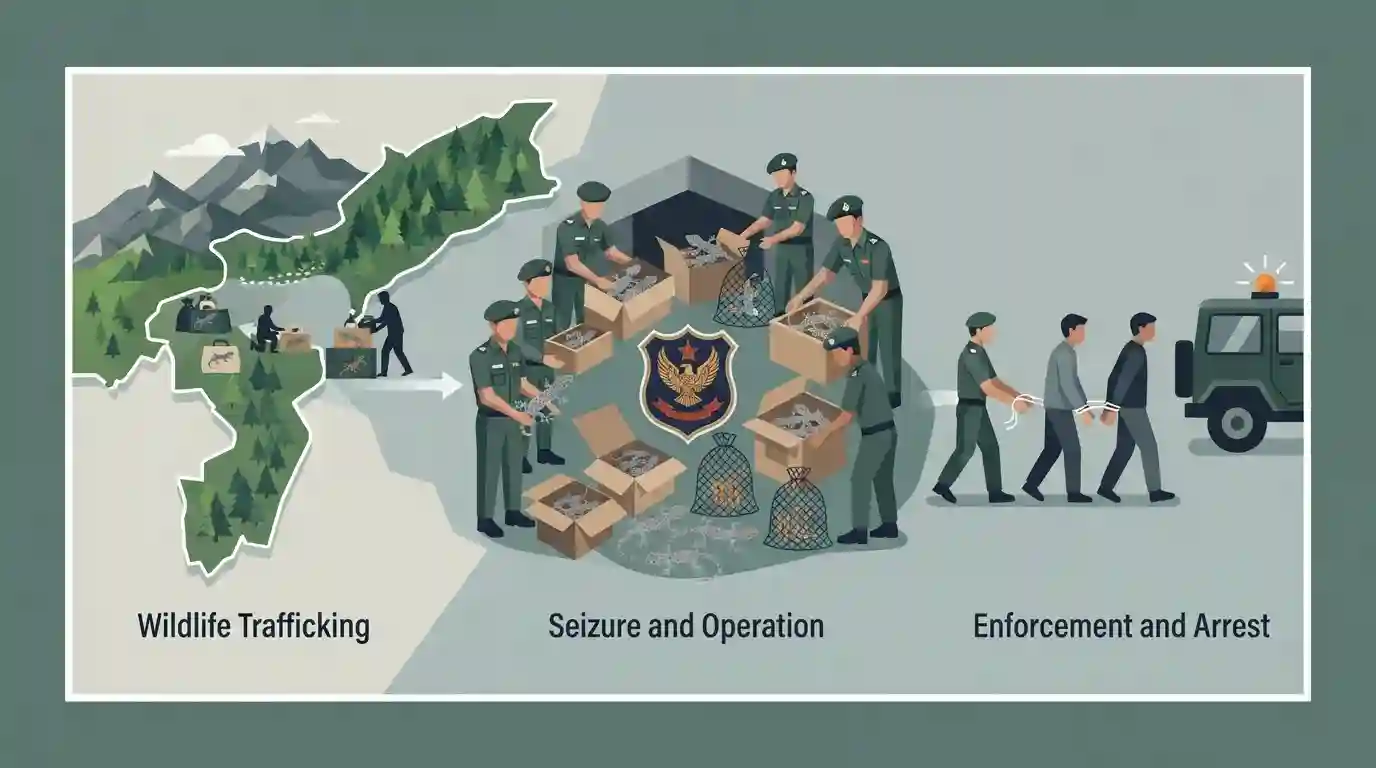
The Directorate of Revenue Intelligence (DRI) conducted a successful operation in Assam, seizing 86 live Tokay Geckos and arresting two persons involved in cross-border wildlife trafficking.
मुख्य मुद्दे
- The Directorate of Revenue Intelligence (DRI) seized 86 live Tokay Geckos in Assam in a crackdown on illegal wildlife trafficking.
- Two individuals were arrested in connection with the smuggling operation.
- Tokay Geckos are heavily targeted in illegal wildlife trade due to unverified traditional medicine beliefs.
महत्त्वाच्या संज्ञा
Directorate of Revenue Intelligence (DRI)

India's apex anti-smuggling intelligence agency under the Central Board of Indirect Taxes and Customs (CBIC), responsible for combating cross-border trade crimes, including illegal wildlife trafficking.
UPSC context
UPSC Prelims/Mains (GS III): Important statutory bodies, security agencies, and mechanisms to check transnational organized crime and wildlife smuggling.
Wildlife (Protection) Act
Comprehensive legislation enacted in 1972 to protect wild animals, birds, and plants, providing legal frameworks, penalties, and schedules regulating hunting, trade, and conservation.
UPSC context
UPSC Prelims/Mains (GS III): Environment and biodiversity conservation, legal safeguards, and wildlife protection governance in India.
Tokay Gecko
A large arboreal gecko species native to Asia, heavily targeted for illegal international wildlife trade due to unverified traditional medicine claims and protected under Indian wildlife laws.
UPSC context
UPSC Prelims: Biodiversity, endangered/trafficked species, and species-specific legal status under Indian schedules and CITES appendices.
पूर्वपरीक्षा सापळा
All CITES Appendix II species are strictly protected under Schedule I of the Wildlife (Protection) Act, 1972.
Aspirants often assume species listed under CITES Appendix II automatically enjoy the highest protection status (Schedule I) under India's Wildlife Protection Act, which is not always the case.
संबंधित स्थिर संकल्पना
What are the key mandates and powers of the Directorate of Revenue Intelligence (DRI) in India?
- Apex Agency: Apex Intelligence Agency: Functions as the premier intelligence agency of India for investigating cross-border smuggling of contraband, narcotics, and wildlife.
- Parent Body: Statutory Origin: Operates under the Central Board of Indirect Taxes and Customs (CBIC), Ministry of Finance.
- Statutory Powers: Legal Empowerment: Authorized to intercept smuggling, seize goods, and make arrests under the Customs Act, 1962, often acting in coordination with environmental acts.
What are the core provisions and Appendix classifications under CITES?
- Appendix I: Appendix I: Includes species threatened with extinction; international trade is permitted only in exceptional circumstances.
- Appendix II: Appendix II: Includes species not necessarily threatened with extinction, but trade must be controlled to avoid utilization incompatible with their survival.
- Appendix III: Appendix III: Species protected in at least one country, which has asked other CITES parties for assistance in control.
आंतर-विषय नमुने
Wildlife Trafficking & Border Security Linkages
Smuggling networks trafficking exotic wildlife like Tokay Geckos often overlap with narcotics and arms routes across porous northeastern borders.
Economic Offences vs Environmental Crimes
The DRI operates under the Customs Act alongside the Wildlife Protection Act, illustrating convergence between economic enforcement and biodiversity conservation.

CITES Appendix listings combined with domestic WPA schedules make high-demand reptiles a recurring match-the-column trap in Prelims.
संबंधित PYQ · 2
संबंधित PYQ · 2
- 2022PrelimsGS1
With reference to Indian laws about wildlife protection, consider the following statements : 1. Wild animals are the sole property of the government. 2. When a wild animal is declared protected, such animal is entitled for equal protection whether it is found in protected areas or outside. 3. Apprehension of a protected wild animal becoming a danger to human life is sufficient ground for its capture or killing. Which of the statements given above is/are correct?
- 2025PrelimsGS1
Regarding Peacock tarantula (Gooty tarantula), consider the following statements : I. It is an omnivorous crustacean. II. Its natural habitat in India is only limited to some forest areas. III. In its natural habitat, it is an arboreal species. Which of the statements given above is/are correct?
