Telecom Manufacturing Zone and Domestic Electronics Production
Source:PIB ↗
Why It Matters
This initiative reflects India's strategic push toward building self-reliance (Atmanirbhar Bharat) in high-tech manufacturing, attracting FDI, and positioning the country as a major global hub for telecom equipment and infrastructure development.
Summary
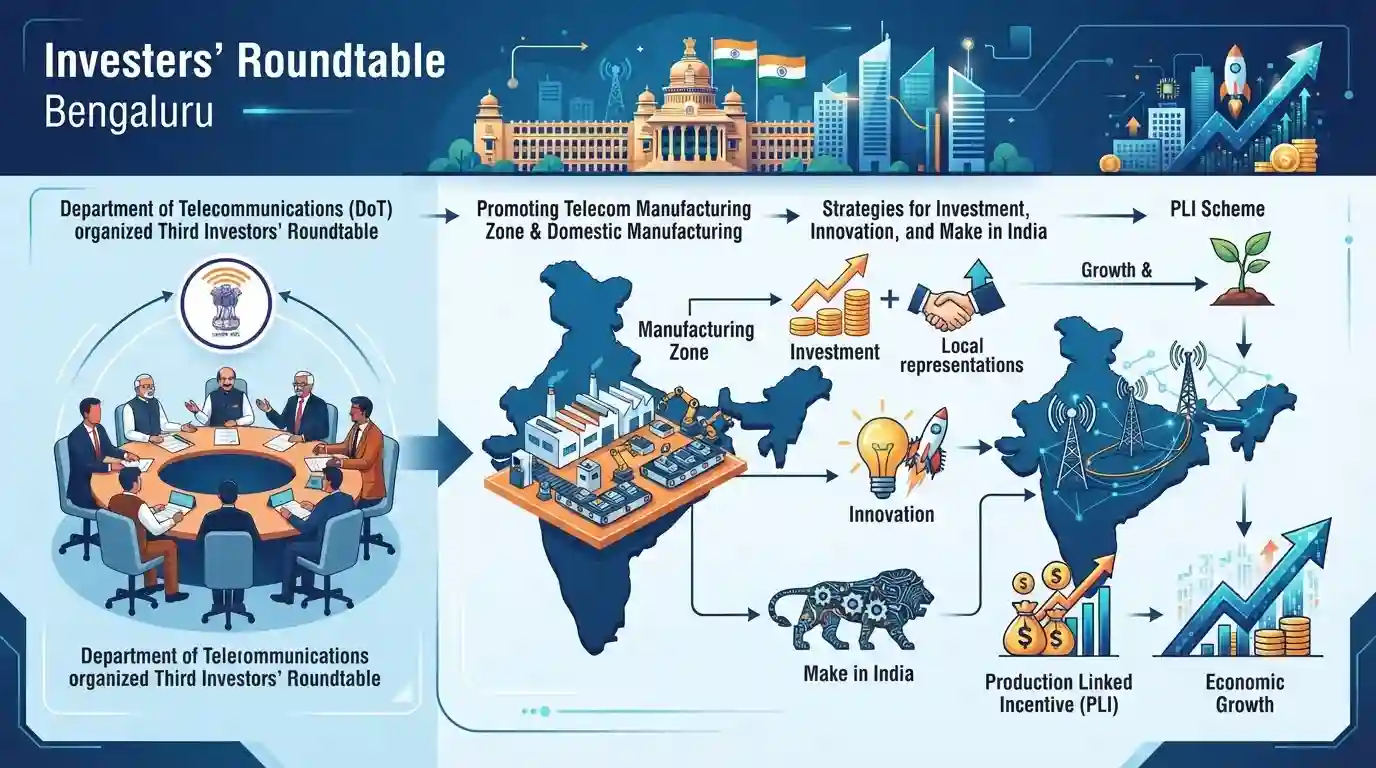
The Department of Telecommunications (DoT) organized the Third Investors' Roundtable in Bengaluru to promote the Telecom Manufacturing Zone, discussing strategies for investment, innovation, and domestic manufacturing under initiatives like Make in India and the PLI scheme.
Key Points
- The Department of Telecommunications (DoT) hosted its Third Investors’ Roundtable in Bengaluru focusing on the Telecom Manufacturing Zone.
- The event emphasized boosting domestic telecom manufacturing, promoting indigenous innovation, and attracting investments.
- Discussions centered on leveraging policy frameworks like the Production Linked Incentive (PLI) scheme and easing regulatory hurdles to establish dedicated telecom manufacturing hubs.
- Collaboration between government stakeholders, industry leaders, and global investors was highlighted to position India as a global manufacturing and export hub for advanced telecom equipment.
Important Terms
Make in India

A flagship national program launched by the Government of India in 2014 to transform the country into a global manufacturing hub by encouraging both multinational and domestic companies to manufacture within India.
UPSC context
UPSC GS Paper III (Indian Economy - Growth & Development, Manufacturing Sector). Evaluates industrial policy, ease of doing business, and import substitution strategies.
Production Linked Incentive (PLI) Scheme
A flagship government financial incentive scheme launched to boost domestic manufacturing, attract foreign investments, and reduce import dependency by offering financial rewards based on incremental sales of manufactured goods.
UPSC context
UPSC GS Paper III (Indian Economy - Government Budgeting & Industrial Policy). Tests the effectiveness of supply-side interventions and export-led growth models.
Department of Telecommunications (DoT)
The central government department under the Ministry of Communications responsible for formulating telecom policies, granting licenses, and managing spectrum and domestic digital infrastructure in India.
UPSC context
UPSC GS Paper II/III (Governance & Technology). Important for understanding telecom governance, digital infrastructure regulation, and domestic manufacturing initiatives.
Static Concepts Connected
What are the key operational features and objectives of the Production Linked Incentive (PLI) Scheme in India?
- Incremental Incentives: Provides financial incentives (4% to 6%) on incremental sales over base year to boost domestic manufacturing and reduce import dependence.
- Targeted Sectors: Focuses on target sectors (e.g., telecom, electronics, pharma) with high employment potential and deep value-addition requirements.
- Design-Led Focus: Includes design-led manufacturing incentives to encourage domestic R&D and intellectual property creation.
Cross-Topic Patterns
Telecom Manufacturing & State-Level Industrial Clusters
India's push to position Bengaluru as a telecom manufacturing and R&D hub intersects directly with urban economic clusters and state-level industrial policy competition under cooperative federalism.

Telecom PLI design-led manufacturing incentives and dedicated TMZs are prime candidates for Mains GS-3 or Prelims match-the-scheme questions.
Linked PYQs · 2
Linked PYQs · 2
- 2025MainsGS3
India aims to become a semiconductor manufacturing hub. What are the challenges faced by the semiconductor industry in India? Mention the salient features of the India Semiconductor Mission.
- 2023MainsGS3
Faster economic growth requires increased share of the manufacturing sector in GDP, particularly of MSMEs. Comment on the present policies of the Government in this regard.
