Ayurveda Day Observance and Traditional Medicine Integration
Source:PIB ↗
Why It Matters
Ayurveda Day highlights India's soft power, traditional knowledge preservation, and its integration into modern public health frameworks, which is vital for GS2 (Health/Governance) and GS3 (Traditional Knowledge/Economy).
Summary
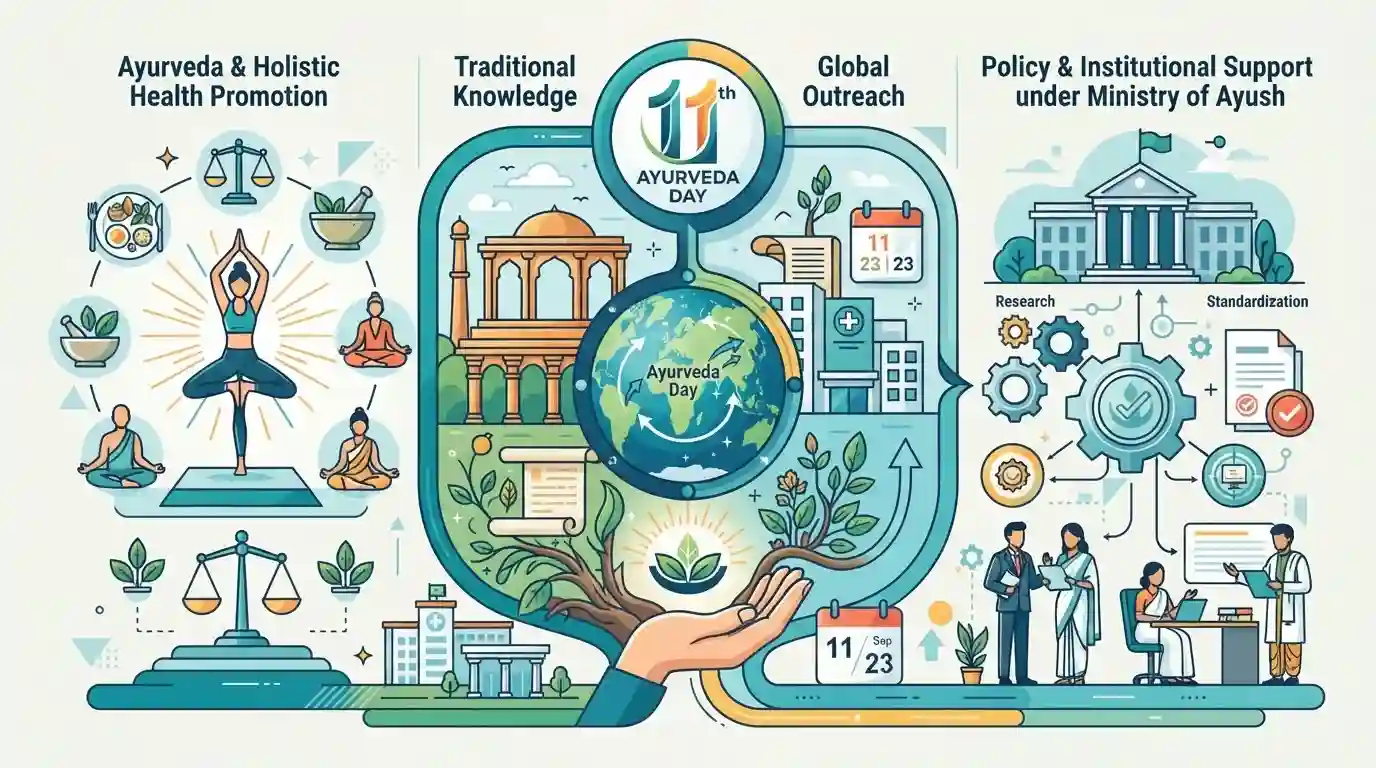
The article discusses the observance of the 11th Ayurveda Day on September 23, highlighting its significance in spreading awareness about traditional Indian medicine systems, promoting holistic health, and boosting global outreach of Ayurveda under the Ministry of Ayush.
Key Points
- The 11th Ayurveda Day is celebrated on 23 September across India and worldwide.
- Focuses on promoting traditional medicine, global health integration, and preventive healthcare.
- Highlights the government's efforts to institutionalize and mainstream AYUSH systems in public health.
Important Terms
Ayurveda Day

An annual observance dedicated to promoting Ayurveda as a holistic medical system and spreading global awareness of traditional Indian medicine, now fixed on September 23 annually.
UPSC context
UPSC Prelims/Mains (GS Paper II - Health, Traditional Knowledge). Tests knowledge of national health campaigns and Ayush sector initiatives.
Ministry of Ayush
A ministry of the Government of India responsible for developing, promoting, and propagating traditional systems of healthcare in India, including Ayurveda, Yoga, Unani, Siddha, and Homoeopathy.
UPSC context
UPSC Prelims/Mains (GS Paper II - Governance and Social Sector). Tests awareness of institutional frameworks governing indigenous medicine.
Prelims Trap
Ayurveda Day is a statutory international holiday established by a parliamentary act.
Aspirants often confuse Ayurveda Day's inception or assume it is a statutory celebration, when it is actually observed annually under the Ministry of Ayush (often coinciding with Dhanwantari Jayanti/Dhanteras).
Static Concepts Connected
What are the key institutional mechanisms and defensive strategies for protecting traditional knowledge in India?
- TKDL Database: Maintains digital databases of traditional formulations in international patent languages to prevent bio-piracy and wrongful patents.
- National Ayush Mission: Centrally sponsored scheme launched in 2014 to upgrade educational institutions, support infrastructure, and ensure quality control of drugs.
- NHP 2017 Goals: Advocates service co-location across public health infrastructure like PHCs, CHCs, and District Hospitals for universal access.
Cross-Topic Patterns
Ayurveda + WTO TRIPS Agreement
India's push for traditional medicine intersects with the TRIPS agreement, utilizing defensive databases like the TKDL to prevent biopiracy of ancient formulations.
Mainstreaming AYUSH + Public Health Infrastructure
Integration of AYUSH services within primary health centers implements the National Health Policy 2017's universal health coverage goals.

Expect a statement-based question linking AYUSH mainstreaming (NHP 2017) with defensive protections like the TKDL under TRIPS.
Linked PYQs · 2
Linked PYQs · 2
- 2024MainsGS2
In a crucial domain like the public healthcare system the Indian State should play a vital role to contain the adverse impact of marketisation of the system. Suggest some measures through which the State can enhance the reach of public healthcare at the grassroots level.
- 2015MainsGS3
India's Traditional Knowledge Digital Library (TKDL), which has a database containing formatted information on more than 2 million medicinal formulations is proving a powerful weapon in the country's fight against erroneous patents. Discuss the pros and cons of making this database publicly available under open-source licensing.
