Anti Narcotics Task Force Conference and Narco Terrorism Strategy
Source:PIB ↗
Why It Matters
The conference highlights India's institutional framework and multi-agency strategy to combat drug trafficking and narco-terrorism, which is directly relevant to internal security syllabi.
Summary
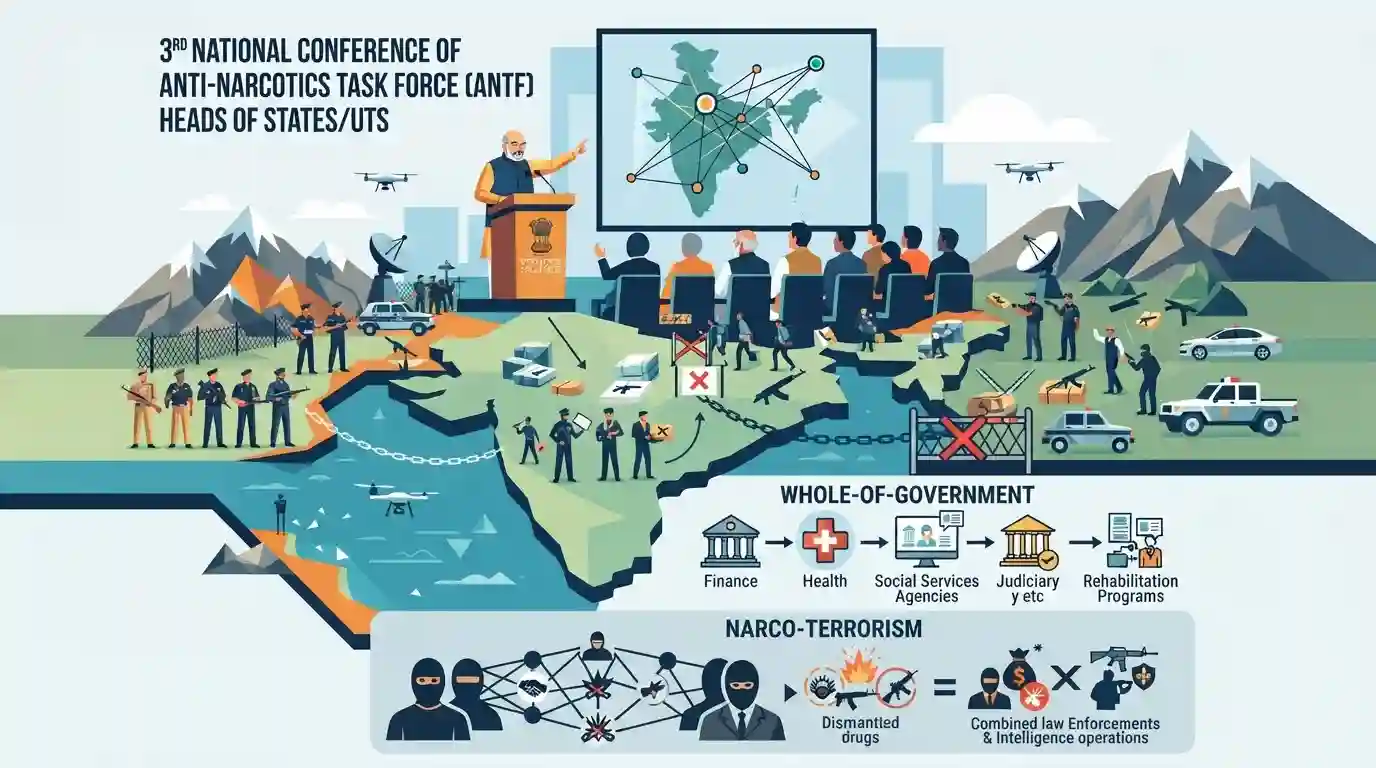
Union Home Minister Shri Amit Shah inaugurated the 3rd National Conference of Anti-Narcotics Task Force (ANTF) Heads of States/UTs in New Delhi, emphasizing a whole-of-government and zero-tolerance approach to tackle drug trafficking and narco-terrorism in India.
Key Points
- Union Home Minister inaugurated the 3rd National Conference of Anti-Narcotics Task Force (ANTF) Heads of States/UTs in New Delhi.
- Focused on strengthening inter-agency coordination, intelligence sharing, and cracking down on drug trafficking networks across states and union territories.
- Highlighted the zero-tolerance policy of the government against drug abuse and narco-terrorism.
Important Terms
Anti-Narcotics Task Force (ANTF)

A specialized state-level task force established across states and Union Territories in India to combat drug trafficking, dismantle drug cartels, and enforce the NDPS Act.
UPSC context
UPSC Paper III: Internal Security - Linkages between organized crime and terrorism, security challenges, and narco-terrorism in border areas.
Ministry of Home Affairs
The central government ministry responsible for internal security, domestic policy, law and order, and coordination of border guarding and anti-narcotics enforcement agencies in India.
UPSC context
UPSC Paper III: Internal Security - Role of central security agencies and overall administrative framework for managing internal security threats.
Prelims Trap
Anti-Narcotics Task Force (ANTF) is an apex central agency established directly under the Ministry of Home Affairs without state-level units.
Aspirants often confuse ANTF with the Narcotics Control Bureau (NCB); ANTF operates at the State/UT level while NCB is the apex central law enforcement and intelligence agency.
Static Concepts Connected
What are the key provisions and institutional mechanisms under India's anti-narcotics framework?
- NDPS Act: Enacted in 1985, it prohibits the cultivation, production, manufacture, possession, sale, purchase, and transport of narcotic drugs and psychotropic substances with stringent penal provisions.
- NCB Role: Functioning under the MHA, it is the apex nodal agency for drug law enforcement, intelligence sharing, and coordinating actions of various central and state agencies.
- Global Treaties: India is signatory to the 1961 Single Convention on Narcotic Drugs, 1971 Convention on Psychotropic Substances, and 1988 UN Convention against Illicit Traffic.
Cross-Topic Patterns
Narco-terrorism and Terror Financing Linkages
Narco-terrorism directly funds insurgencies and proxy wars, linking border management, money laundering under PMLA, and internal security challenges in the Northeast and J&K.
Border Vulnerability and Regional Geopolitics
Geographical vulnerability to the Golden Crescent and Golden Triangle connects India's internal security with regional diplomacy and maritime surveillance in the Indo-Pacific.

Expect a statement-based question pairing NDPS Act penal provisions with institutional roles of ANTF and NCB in tackling narco-terrorism.
Linked PYQs · 3
Linked PYQs · 3
- 2024MainsGS3
Explain how narco-terrorism has emerged as a serious threat across the country. Suggest suitable measures to counter narco-terrorism.
- 2023MainsGS3
What are the internal security challenges being faced by India? Give out the role of Central Intelligence and Investigative Agencies tasked to counter such threats.
- 2018MainsGS3
India's proximity to two of the world's biggest illicit opium-growing states has enhanced her internal security concerns. Explain the linkages between drug trafficking and other illicit activities such as gunrunning, money laundering and human trafficking. What counter-measures should be taken to prevent the same?
