Project Rhino Conservation Status and Habitat Management
Source:PIB ↗
हे का महत्त्वाचे आहे
The launch of Project Rhino and the positive status of the greater one-horned rhinoceros in India are vital for Prelims (species distribution, conservation status) and Mains (wildlife management, habitat restoration initiatives).
सारांश
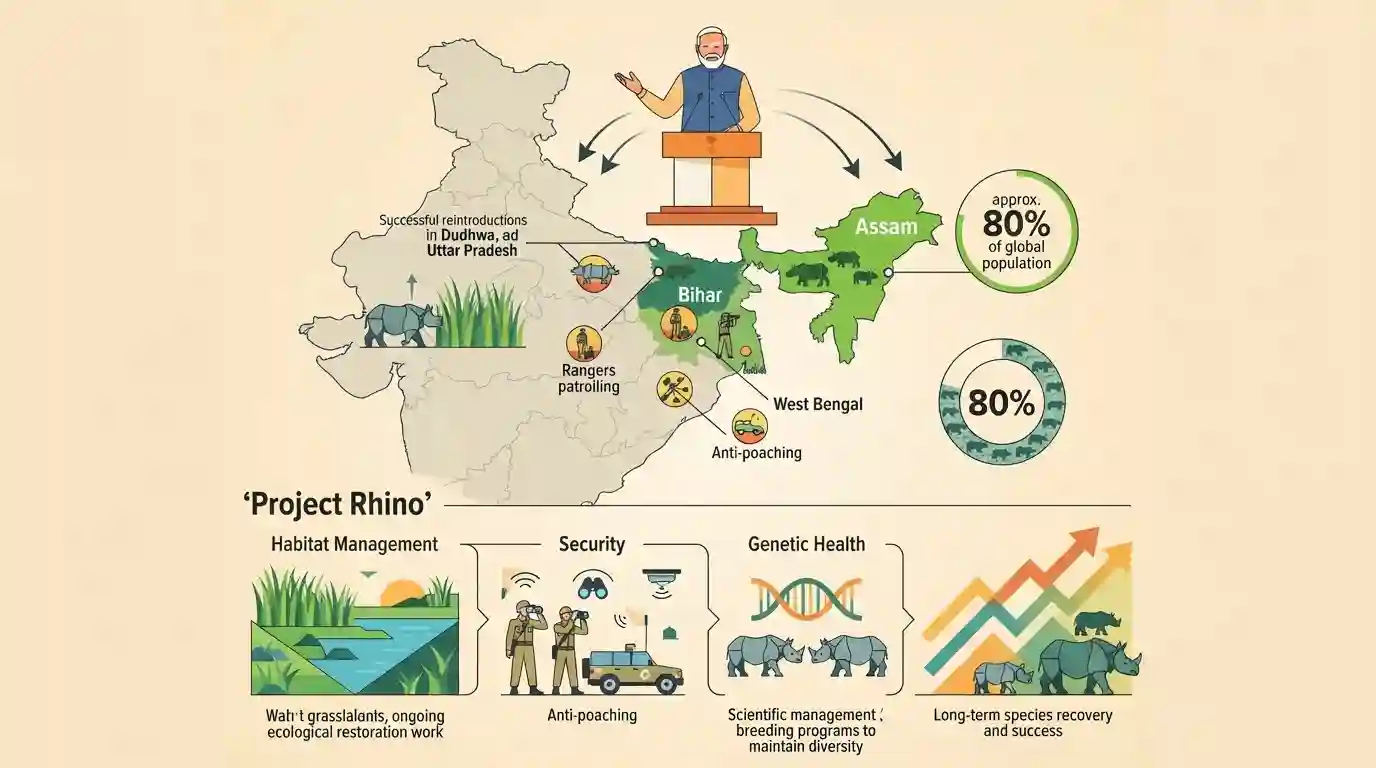
On World Rhino Day, Prime Minister Narendra Modi lauded conservation efforts for the greater one-horned rhinoceros, noting that Assam hosts roughly 80% of the global population. Highlighting successful reintroductions in Dudhwa (Uttar Pradesh) and protective measures in Bihar and West Bengal, the PM announced the launch of 'Project Rhino' to provide technical and financial assistance for range states to enhance habitat management, security, and genetic health.
मुख्य मुद्दे
- Prime Minister Narendra Modi celebrated World Rhino Day, highlighting the conservation success of the greater one-horned rhinoceros.
- Assam holds nearly 80 percent of the world's rhino population, with significant anti-poaching success in Kaziranga.
- Rhino populations have expanded or been protected in Bihar, West Bengal, and successfully reintroduced in Dudhwa, Uttar Pradesh.
- Project Rhino has been initiated to offer financial and technical support to range states focusing on habitat management, protection, genetic improvement, and population dynamics.
महत्त्वाच्या संज्ञा
Project Rhino

A conservation initiative launched to provide technical and financial assistance to range states for habitat management, anti-poaching security, and genetic health enhancement of the greater one-horned rhinoceros.
UPSC context
Important for GS Paper III (Environment and Biodiversity conservation, species recovery programs, and wildlife protection policies).
Kaziranga National Park
A premier UNESCO World Heritage Site in Assam that hosts a major share of the global greater one-horned rhinoceros population.
UPSC context
Important for GS Paper III (Protected Area Network, biodiversity hotspots, and wildlife conservation in India).
पूर्वपरीक्षा सापळा
The greater one-horned rhinoceros is exclusively found and protected within the state of Assam.
Assam holds ~80% of the global population, but rhinos are native to and managed in other states like Uttar Pradesh (Dudhwa), West Bengal, and Bihar as well.
संबंधित स्थिर संकल्पना
What is the conservation status and distribution of the Greater One-Horned Rhinoceros under Indian and international laws?
- IUCN Status: IUCN Status is Vulnerable, having recovered from near extinction due to rigorous protection measures.
- WPA Schedule: Schedule I of the Wildlife Protection Act, 1972, providing the highest level of legal protection in India.
- CITES Appendix: Listed in Appendix I of CITES, strictly prohibiting international commercial trade in specimens.
- Recovery Plan: Indian Rhino Vision 2020 (IRV2020) aimed to wild a population of 3,000 rhinos across seven protected areas in Assam.
आंतर-विषय नमुने
Wildlife Protection Act & Federal Conservation Schemes
Rhino conservation relies on stringent anti-poaching laws (Wildlife Protection Act, 1972) combined with targeted species recovery programs across multiple states, linking environmental law with federal financial mechanisms.

Expect matching-style prelims questions on rhino range states, IUCN status, and specific reintroduction sites like Dudhwa.
संबंधित PYQ · 3
संबंधित PYQ · 3
- 2020PrelimsGS1
Which one of the following protected areas is well-known for the conservation of a sub-species of the Indian swamp deer (Barasingha) that thrives well on hard ground and is exclusively graminivorous?
- 2015PrelimsGS1
With reference to 'dugong', a mammal found in India, which of the following statements is/are correct? 1. It is a herbivorous marine animal. 2. It is found along the entire coast of India. 3. It is given legal protection under Schedule I of the Wildlife (Protection) Act, 1972. Select the correct answer using the code given below.
- 2025PrelimsGS1
Regarding Peacock tarantula (Gooty tarantula), consider the following statements : I. It is an omnivorous crustacean. II. Its natural habitat in India is only limited to some forest areas. III. In its natural habitat, it is an arboreal species. Which of the statements given above is/are correct?
