Critical Minerals Recycling Framework for Supply Chain Security
Source:PIB ↗
આ શા માટે મહત્વનું છે
Critical minerals are foundational to India's clean energy transition, electronics, and defense manufacturing. Developing a robust domestic recycling and circular economy framework reduces import dependency, mitigates supply chain vulnerabilities, and addresses e-waste hazards.
સારાંશ
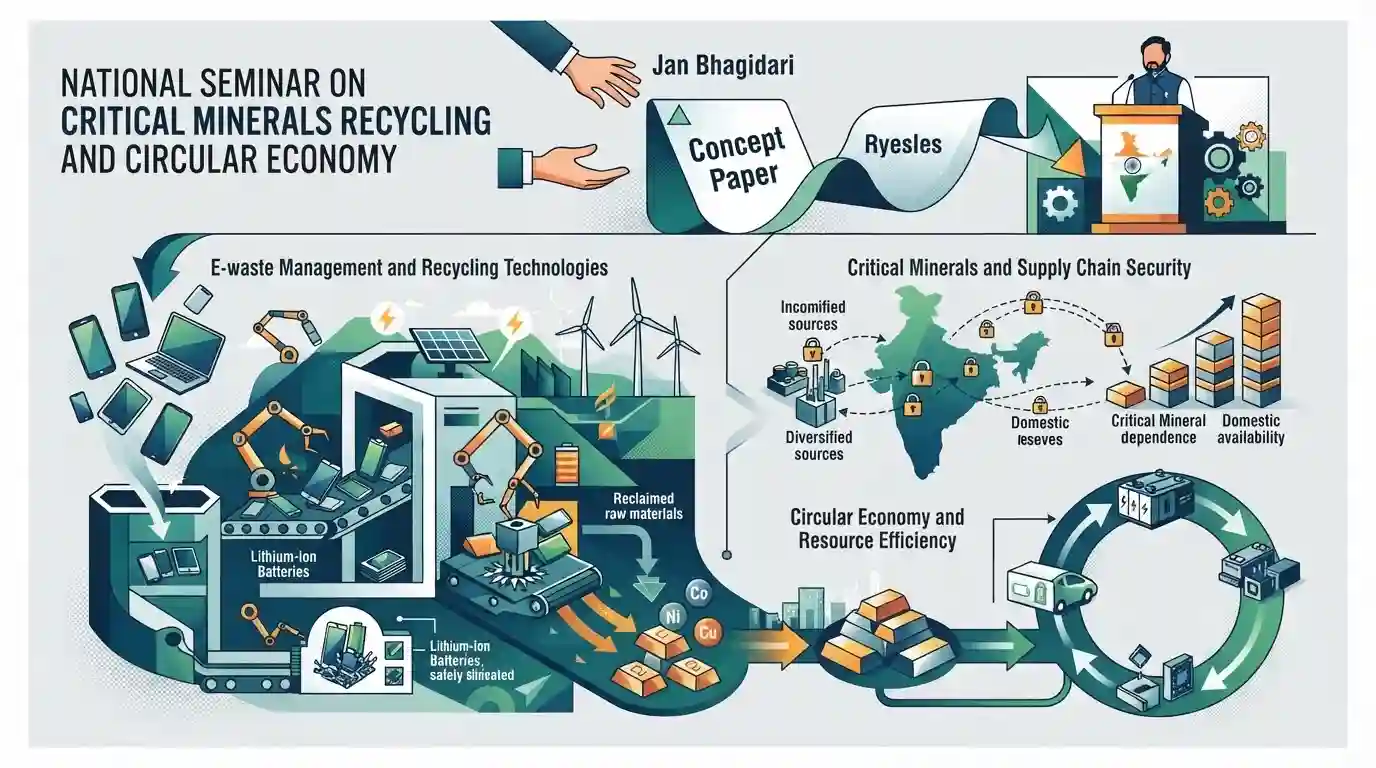
Union Minister for Coal and Mines Shri G. Kishan Reddy inaugurated a national seminar on critical minerals recycling and circular economy, highlighting the strategic necessity of recycling End-of-Life (EOL) products, e-waste, and lithium-ion batteries to ensure critical mineral security for India's clean energy and advanced manufacturing goals. A new concept paper was launched, and emphasis was placed on Jan Bhagidari and formalizing the recycling ecosystem.
મુખ્ય મુદ્દા
- The Ministry of Mines, in collaboration with the Materials Recycling Association of India (MRAI), organized a national seminar on India's Critical Minerals Recycling Ecosystem and Circular Economy in New Delhi.
- Union Minister Shri G. Kishan Reddy emphasized the strategic importance of critical minerals for clean energy transition, defence preparedness, and advanced manufacturing, calling for technology-driven recycling of End-of-Life (EOL) products.
- The Concept Paper on Critical Mineral Recycling Ecosystem was launched to outline a strategic framework focused on resource efficiency and recovery from secondary sources like e-waste and lithium-ion batteries (black mass).
- Stressed the role of Jan Bhagidari (public participation) and grassroots outreach to channel e-waste into the formal recycling ecosystem, aiding India's self-reliance (Atmanirbhar Bharat) and Viksit Bharat vision.
મહત્વપૂર્ણ શબ્દો
Concept Paper on Critical Mineral Recycling Ecosystem

A strategic document launched by the Ministry of Mines and MRAI to establish a framework for recovering critical minerals from End-of-Life products, e-waste, and lithium-ion batteries to ensure supply chain security.
UPSC context
UPSC Prelims/Mains (GS Paper III): Environment and economy, testing policies on circular economy, resource efficiency, and critical mineral supply security.
Materials Recycling Association of India (MRAI)
The apex national association representing India's recycling industry, which collaborates with the government to promote policy reforms, formalize recycling, and reduce import dependencies.
UPSC context
UPSC Prelims: Important industry associations and their role in India's industrial growth, circular economy, and resource recovery frameworks.
Ministry of Mines
The central government ministry responsible for the survey, exploration, and regulation of mines and minerals, including critical minerals essential for clean energy and advanced manufacturing.
UPSC context
UPSC Prelims/Mains (GS Paper II/III): Institutional mechanisms, governance of natural resources, and mineral security policies in India.
સંલગ્ન સ્થિર ખ્યાલો
What are the key pillars of India's strategic framework for critical minerals and circular economy?
- Identified Minerals: Ministry of Mines identified 30 critical minerals essential for economic development, clean energy, and defence preparedness.
- Overseas Acquisition: KABIL (Kavita & Bidesh India Ltd) established to acquire strategic mineral assets overseas like lithium and cobalt.
- Circular Economy: Focus on secondary recovery from e-waste, lithium-ion batteries (black mass), and End-of-Life products to reduce import dependency.
- Formalization: Transitioning informal scrap handling into technology-driven formal recycling ecosystems backed by Extended Producer Responsibility (EPR).
આંતર-વિષય પેટર્ન
Critical Minerals + E-Waste EPR Rules
Critical mineral recovery and battery waste management link industrial manufacturing policies directly to stringent environmental compliance and Extended Producer Responsibility (EPR) frameworks under the CPCB.
KABIL Overseas Assets + Domestic Circular Economy
India's state-backed foreign acquisitions via KABIL for primary extraction parallel domestic secondary recycling incentives, balancing geopolitical supply-chain risks with circular economic resilience.

Expect a matching-list or statement question linking India's 30 identified critical minerals, KABIL's overseas role, and EOL recycling.
સંલગ્ન PYQ · 1
સંલગ્ન PYQ · 1
- 2025MainsGS3
Mineral resources are fundamental to the country's economy and these are exploited by mining. Why is mining considered an environmental hazard? Explain the remedial measures required to reduce the environmental hazard due to mining.
