Investors Meet to Promote Telecom Manufacturing Zone in Gwalior
Source:PIB ↗
Why It Matters
This initiative highlights India's push toward electronics and telecom manufacturing self-reliance under 'Make in India', while also emphasizing decentralized industrial growth by promoting tier-2 cities like Gwalior as manufacturing hubs.
Summary
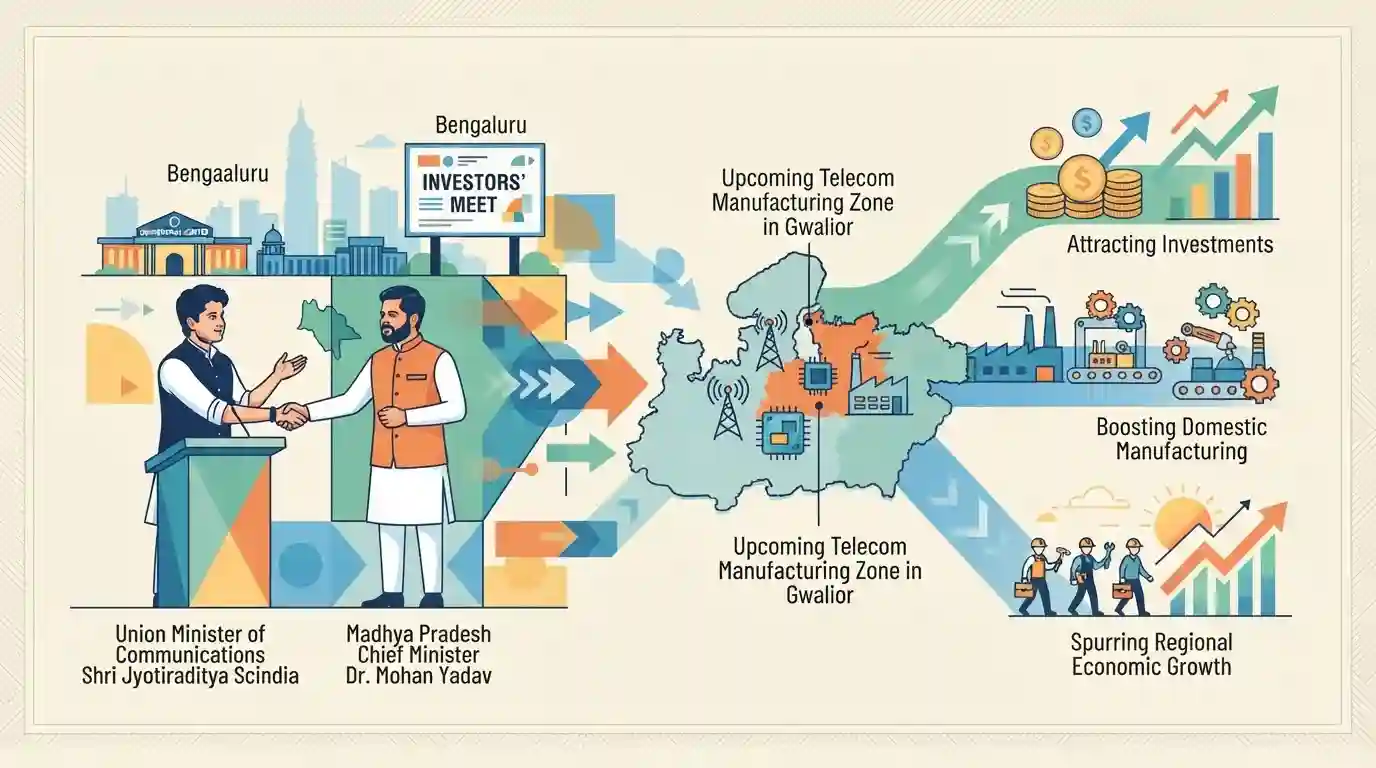
Union Minister of Communications Shri Jyotiraditya Scindia and Madhya Pradesh Chief Minister Dr. Mohan Yadav are hosting an Investors' Meet in Bengaluru to promote the upcoming Telecom Manufacturing Zone in Gwalior, aiming to attract investments, boost domestic manufacturing, and spur regional economic growth.
Key Points
- Union Minister of Communications and the Chief Minister of Madhya Pradesh are convening an Investors' Meet in Bengaluru to attract investments for a Telecom Manufacturing Zone in Gwalior.
- The initiative aims to boost domestic electronics and telecom manufacturing, reduce import dependence, and position India as a global manufacturing hub.
- Fostering industrial growth in tier-2/3 cities like Gwalior helps balance regional economic development and creates localized employment opportunities.
Important Terms
Make in India

A flagship national initiative launched in 2014 to transform India into a global manufacturing, design, and innovation hub by streamlining regulations, developing infrastructure, and opening sectors to foreign capital.
UPSC context
UPSC GS Paper III (Indian Economy): Tests awareness of industrial growth policies, manufacturing sector performance, and employment generation initiatives.
Ministry of Communications
The central government ministry responsible for formulating policies, licensing, and coordinating telecommunication and postal services across India through the Department of Telecommunications and Department of Posts.
UPSC context
UPSC GS Paper II (Governance): Tests knowledge of ministerial responsibilities, telecom infrastructure development, and digital connectivity schemes.
Government of Madhya Pradesh
The sub-national executive body responsible for state governance, economic planning, and industrial promotion policies, including state-level initiatives to attract investments and establish industrial manufacturing zones.
UPSC context
UPSC GS Paper III (Economy & Regional Development): Tests federal fiscal dynamics, state-level industrial policy, and resource mobilization.
Prelims Trap
Telecom Manufacturing Zones are restricted exclusively to tier-1 metropolitan information technology hubs.
Aspirants may assume telecom manufacturing zones are exclusively set up in major tech hubs like Bengaluru or Chennai, overlooking targeted decentralization in tier-2/3 cities like Gwalior.
Static Concepts Connected
What are the key objectives of industrial corridors and dedicated manufacturing zones in India's industrial policy?
- Logistics Efficiency: Infrastructure integration through high-capacity transport networks to reduce logistics costs for manufacturers.
- Regional Balance: Decentralized growth by promoting tier-2 and tier-3 cities as industrial hubs to reduce urban migration pressure.
- Ease of Doing Business: Plug-and-play facilities offering pre-approved clearances to attract foreign and domestic capital quickly.
Cross-Topic Patterns
Telecom Manufacturing + Decentralized Regional Industrialisation
Decentralizing industrial clusters to tier-2/3 cities connects national digital infrastructure goals with balanced regional development and cooperative federalism initiatives.

Industrial policy shift toward tier-2/3 cities for high-tech manufacturing may feature in prelims/mains economic geography questions.
Linked PYQs · 2
Linked PYQs · 2
- 2025MainsGS3
India aims to become a semiconductor manufacturing hub. What are the challenges faced by the semiconductor industry in India? Mention the salient features of the India Semiconductor Mission.
- 2023MainsGS3
Faster economic growth requires increased share of the manufacturing sector in GDP, particularly of MSMEs. Comment on the present policies of the Government in this regard.
