India and New Zealand Free Trade Agreement Implementation
Source:PIB ↗
આ શા માટે મહત્વનું છે
Bilateral FTAs are critical instruments for India's export growth, market diversification, and integration into global value chains, making this agreement important for GS3 (Economy) and GS2 (International Relations).
સારાંશ
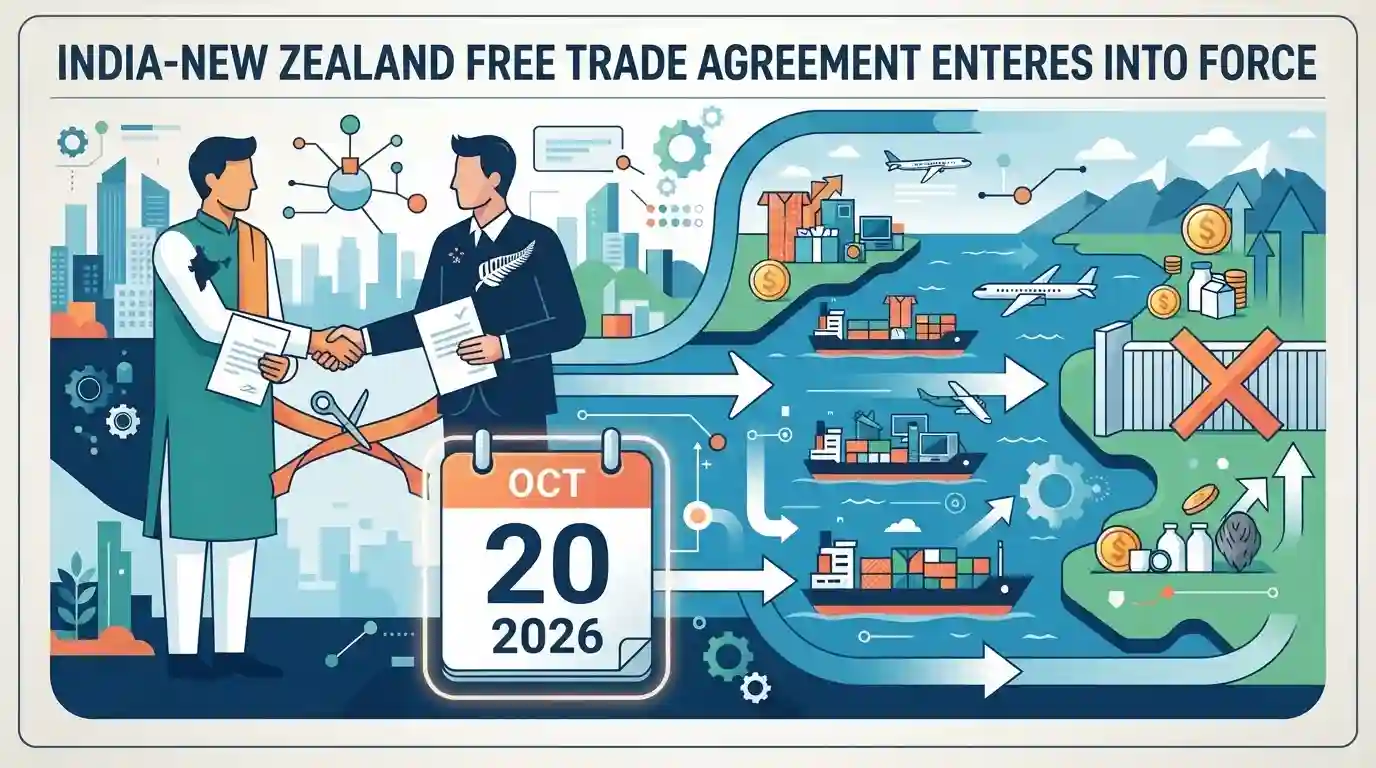
The PIB announcement details that the India-New Zealand Free Trade Agreement (FTA) will officially enter into force starting October 20, 2026, marking a significant milestone in bilateral economic cooperation, trade enhancement, and market access between the two countries.
મુખ્ય મુદ્દા
- The India-New Zealand Free Trade Agreement (FTA) is officially scheduled to enter into force on October 20, 2026.
- The agreement aims to significantly boost bilateral trade, enhance economic integration, and open up new export opportunities for goods and services between India and New Zealand.
- It reflects the growing commitment of both nations towards deepening bilateral economic cooperation and navigating global trade dynamics through strategic partnerships.
મહત્વપૂર્ણ શબ્દો
India-New Zealand Free Trade Agreement

A bilateral economic pact between India and New Zealand slated to enter into force on October 20, 2026, boosting market access, investments, and trade.
UPSC context
Important for GS Paper II (International Relations - Bilateral ties) and GS Paper III (Indian Economy - Trade).
Ministry of Commerce and Industry
The nodal Union ministry in India responsible for formulating and implementing foreign trade policy, commercial relations, and bilateral trade agreements.
UPSC context
Relevant for GS Paper II (Government Policies & Governance) and GS Paper III (Economic Development and Foreign Trade).
New Zealand Government
The executive government of New Zealand, which negotiated, passed implementing legislation, and partnered with India to operationalize the bilateral FTA.
UPSC context
Important for GS Paper II under International Relations, focusing on India's diplomatic and economic outreach in the Indo-Pacific region.
પ્રિલિમ્સ ટ્રેપ
The India-New Zealand FTA provides reciprocal 100% duty-free market access across all agricultural and industrial goods.
Aspirants often assume FTAs provide blanket 100% mutual duty-free access, missing that asymmetric FTAs can grant one-way duty-free access while protecting sensitive domestic sectors like dairy.
સંલગ્ન સ્થિર ખ્યાલો
What is the difference between an FTA, CECA, and CEPA in Indian trade diplomacy?
- Free Trade Agreement: Focuses primarily on the reduction or elimination of tariffs on goods traded between member nations.
- CECA / CEPA: Broader than an FTA; includes free trade in goods, services, and mechanisms for economic cooperation and investment.
- Usage in India: India uses CECA/CEPA terminology for comprehensive agreements that also cover institutional mechanisms and dispute settlement.
આંતર-વિષય પેટર્ન
Agri-Exclusion vs. FDI Pacts in Modern FTAs
FTAs that exclude sensitive agricultural goods while securing FDI commitments mirror India's strategic balancing act seen in agreements like the UAE CEPA and Australia ECTA.
Professional Mobility in Bilateral Trade Pacts
Dedicated visa quotas for skilled workers in FTAs tie trade negotiations directly to domestic service sector exports and diaspora diplomacy.

Expect a statement-based prelims question on FTA duty concessions vs. sensitive domestic exclusions (e.g. dairy/sugar) in recent Indian FTAs.
સંલગ્ન PYQ · 2
સંલગ્ન PYQ · 2
- 2025MainsGS3
What are the challenges before the Indian economy when the world is moving away from free trade and multilateralism to protectionism and bilateralism? How can these challenges be met?
- 2025MainsGS2
India-Africa digital partnership is achieving mutual respect, co-development and long-term institutional partnerships. Elaborate.
