Pharmacopoeia Standards and Working Group for Sowa-Rigpa System
Source:PIB ↗
આ શા માટે મહત્વનું છે
Standardisation and pharmacopoeial regulation of traditional medicine systems like Sowa-Rigpa are vital for ensuring drug quality, patient safety, and promoting alternative therapeutics globally under the public healthcare framework.
સારાંશ
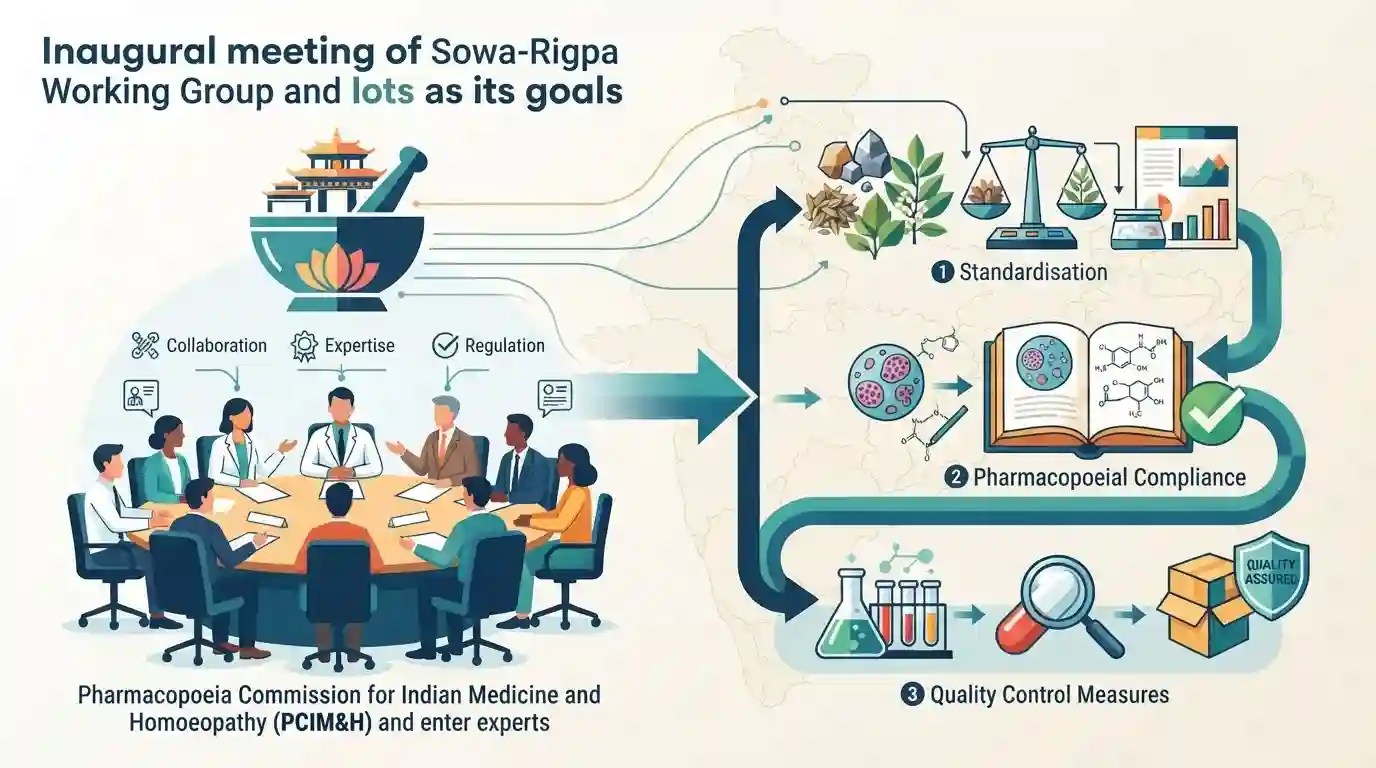
The Pharmacopoeia Commission for Indian Medicine and Homoeopathy (PCIM&H) recently convened the inaugural meeting of the Sowa-Rigpa Working Group. The session aimed to establish standardisation, pharmacopoeial compliance, and quality control measures for Sowa-Rigpa medicines, enhancing regulatory mechanisms for traditional medical systems in India.
મુખ્ય મુદ્દા
- The first meeting of the Sowa-Rigpa Working Group was held under the Pharmacopoeia Commission for Indian Medicine and Homoeopathy (PCIM&H).
- The meeting focused on standardizing pharmacopoeial parameters, quality control, and formulation development for Sowa-Rigpa (the traditional medical system of the Himalayan region).
- Strengthening regulatory frameworks and standardization for Indian systems of medicine aids safety, efficacy, and global acceptance.
મહત્વપૂર્ણ શબ્દો
Sowa-Rigpa

An ancient Himalayan medical tradition, meaning 'Knowledge of Healing' in Bhoti, officially recognized in India under the Ministry of AYUSH as a traditional system of medicine.
UPSC context
Important for UPSC CSE Prelims/Mains (GS Paper II: Health Policy and Governance, Traditional Systems of Medicine). Tests awareness of India's recognized indigenous medical systems.
PCIM&H (Pharmacopoeia Commission for Indian Medicine and Homoeopathy)
A subordinate office under the Ministry of AYUSH tasked with developing pharmacopoeial standards, quality control parameters, and testing compliance for Indian systems of medicine and homeopathy.
UPSC context
Crucial for UPSC Prelims/Mains (GS Paper II: Governance and Health Institutions). Tests knowledge of regulatory bodies governing AYUSH drug standards.
Ministry of Ayush
The nodal government ministry in India responsible for developing, promoting, and regulating education, research, and standardization in traditional and indigenous healthcare systems under AYUSH.
UPSC context
Frequently tested in UPSC Prelims and Mains (GS Paper II: Government Schemes and Social Sector Policies relating to Health).
Sowa-Rigpa Working Group
A newly established working group under the PCIM&H specifically mandated to formulate standardisation, pharmacopoeial compliance, and quality control frameworks for Sowa-Rigpa medicines.
UPSC context
Relevant for UPSC Prelims/Mains current affairs (Health Governance and Standardisation). Tests updates on institutional mechanisms for traditional medicine.
પ્રિલિમ્સ ટ્રેપ
Sowa-Rigpa is an exclusive foreign traditional system of medicine outside the statutory framework of Indian systems of medicine.
Sowa-Rigpa is often assumed to be purely a regional Tibetan practice, but it is officially recognized as one of the formal Indian systems of medicine under AYUSH.
સંલગ્ન સ્થિર ખ્યાલો
What are the key institutional mechanisms and statutory frameworks governing traditional medicine standardisation in India?
- PCIM&H Role:: Apex standardisation body functioning as a subordinate office under the Ministry of AYUSH, setting pharmacopoeial standards.
- Drugs Act 1940:: Statutory legislation empowering authorities to regulate the manufacture, sale, and distribution of Ayurvedic, Siddha, Unani, and Sowa-Rigpa drugs.
- NISR Leh:: Autonomous national institute located in Leh, Ladakh, dedicated to research and education in the Sowa-Rigpa system.
આંતર-વિષય પેટર્ન
Traditional Medicine Regulation & Public Health
Integration of traditional Himalayan medicine with modern regulatory frameworks under the Drugs and Cosmetics Act bridges federal public health mandates with indigenous knowledge preservation.

Sowa-Rigpa's statutory integration under the Drugs and Cosmetics Act makes it a prime candidate for a matching or assertion-reason prelims question.
સંલગ્ન PYQ · 2
સંલગ્ન PYQ · 2
- 2024MainsGS2
In a crucial domain like the public healthcare system the Indian State should play a vital role to contain the adverse impact of marketisation of the system. Suggest some measures through which the State can enhance the reach of public healthcare at the grassroots level.
- 2021MainsGS2
“Besides being a moral imperative of a Welfare State, primary health structure is a necessary precondition for sustainable development.” Analyze.
