NGT International Conference on Environment and Climate Dynamics
Source:PIB ↗
આ શા માટે મહત્વનું છે
The article touches upon the core components of India's environmental jurisprudence (NGT) and international climate commitments, making it directly relevant to GS Paper 3 (Conservation and Environmental Governance) and GS Paper 2 (Statutory Bodies).
સારાંશ
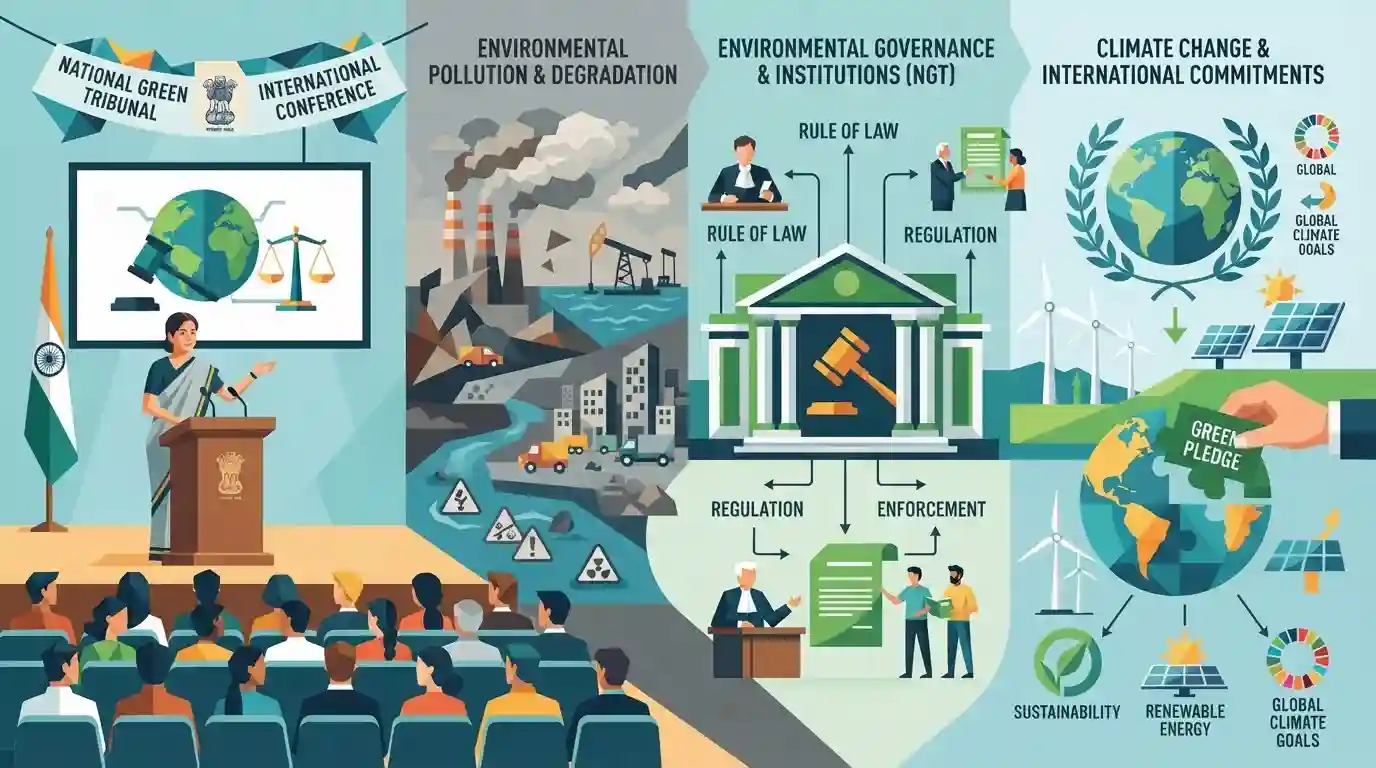
The President of India addressed the valedictory session of the National Green Tribunal's International Conference on 'The Future of Environment and Climate Dynamics' in New Delhi, underscoring the significance of robust environmental governance, judicial mechanisms like the NGT, and India's steadfast commitment to global climate goals and sustainable practices.
મુખ્ય મુદ્દા
- The President of India addressed the valedictory session of the NGT’s International Conference on 'The Future of Environment and Climate Dynamics' in New Delhi.
- Highlighted the critical role of institutions like the NGT in balancing developmental imperatives with ecological conservation and environmental justice.
- Emphasized India's commitment to climate action, sustainable development, and global leadership in renewable energy transitions.
- Stressed the importance of judicial activism, public participation, and science-backed policymaking to address contemporary climate challenges.
મહત્વપૂર્ણ શબ્દો
National Green Tribunal (NGT)

A specialized judicial body established under the National Green Tribunal Act, 2010, for effective and expeditious disposal of cases relating to environmental protection and conservation of forests and natural resources.
UPSC context
UPSC GS Paper III (Environment & Ecology, Conservation) and GS Paper II (Statutory Bodies & Governance). Tests understanding of environmental institutions and justice.
National Green Tribunal Act, 2010
An Act of Parliament enacted in 2010 to establish a specialized environmental tribunal for handling civil cases relating to environmental laws, making India the third country globally to set up such a body.
UPSC context
UPSC GS Paper III (Environment & Ecology) and GS Paper II (Polity & Governance). Tests knowledge of statutory environmental legislation and judicial mechanisms.
સંલગ્ન સ્થિર ખ્યાલો
What are the key statutory features, jurisdiction, and guiding principles of the National Green Tribunal (NGT)?
- Statutory Origin: Established under the National Green Tribunal Act, 2010, as a specialized body for effective and expeditious disposal of environmental cases.
- Guiding Principles: Guided by principles of natural justice, the 'polluter pays' principle, and the precautionary principle; not bound by the Civil Procedure Code, 1908.
- Jurisdiction Scope: Covers civil cases under seven specific environmental laws including the Water Act, Air Act, and Environment (Protection) Act, but notably excludes the Wildlife (Protection) Act, 1972.
- Timeline & Appeals: Mandated to dispose of applications and appeals within six months of filing, with orders appealable to the Supreme Court within 90 days.
આંતર-વિષય પેટર્ન
NGT Jurisprudence & Article 21 Expansion
The NGT's enforcement of the precautionary principle intersects directly with the Supreme Court's expanding interpretation of Article 21 (Right to a Clean Environment).
Domestic Tribunals & International Climate Commitments
India's domestic environmental tribunal framework supports international treaty obligations under UNFCCC and biodiversity conventions by ensuring domestic judicial accountability.

NGT statutory provisions (exclusion of CPC, 6-month disposal timeline, specific statutes) are prime targets for prelims elimination traps.
સંલગ્ન PYQ · 3
સંલગ્ન PYQ · 3
- 2018PrelimsGS1
How is the National Green Tribunal (NGT) different from the Central Pollution Control Board (CPCB)? 1. The NGT has been established by an Act whereas the CPCB has been created by an executive order of the Government. 2. The NGT provides environmental justice and helps reduce the burden of litigation in the higher courts whereas the CPCB promotes cleanliness of streams and wells, and aims to improve the quality of air in the country. Which of the statements given above is/are correct?
- 2022MainsGS3
Do you think India will meet 50 percent of its energy needs from renewable energy by 2030 ? Justify your answer. How will the shift of subsidies from fossil fuels to renewables help achieve the above objective ? Explain.
- 2025MainsGS3
Write a review on India's climate commitments under the Paris Agreement (2015) and mention how these have been further strengthened in COP26 (2021). In this direction, how has the first Nationally Determined Contribution intended by India been updated in 2022?
