India Silk Production Global Ranking and Sericulture Expansion Policy
Source:PIB ↗
हे का महत्त्वाचे आहे
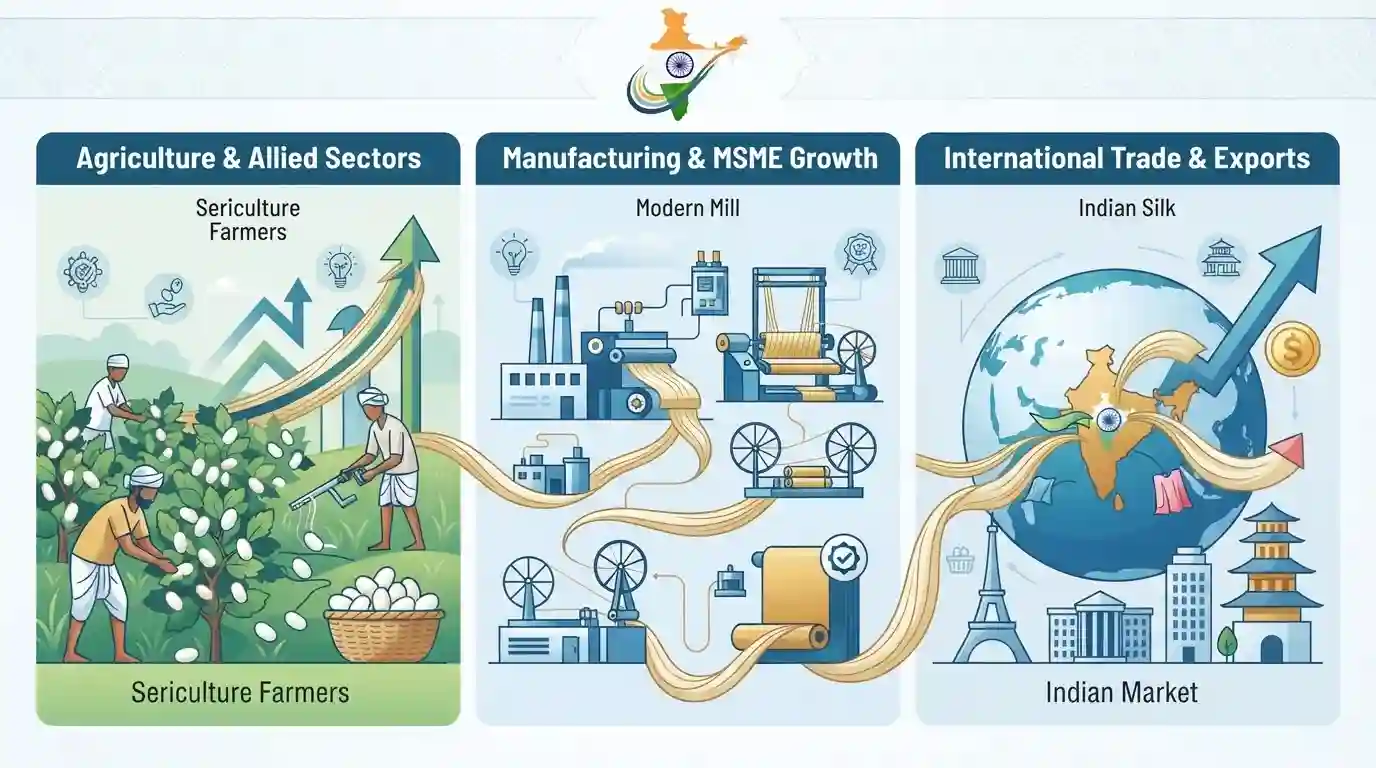
It addresses India's strategic push to expand rural manufacturing, boost high-value agricultural allied sectors like sericulture, and capture global export markets in textiles.
सारांश
Union Minister of Textiles Shri Giriraj Singh announced the government's resolute goal to make India the top global producer of silk, highlighting measures to empower sericulture farmers, modernize production infrastructure, and enhance the international market share of Indian silk.
मुख्य मुद्दे
- Union Minister of Textiles Shri Giriraj Singh resolved to elevate India to the No. 1 position globally in silk production.
- Focuses on enhancing domestic sericulture, expanding employment opportunities, and strengthening rural economies through silk value chains.
- Emphasizes the integration of modern technology, sustainable practices, and quality standards to boost export competitiveness in the global textile market.
महत्त्वाच्या संज्ञा
Sericulture

An agro-based cottage industry involving the cultivation of silkworms for raw silk production. India is uniquely capable of commercially producing all major varieties: Mulberry, Tasar, Eri, and Muga.
UPSC context
Relevant to UPSC GS Paper III (Agriculture & Rural Development); tests knowledge of agro-based allied sectors, livelihoods, and rural employment.
Silk Samagra scheme
A flagship centrally sponsored scheme implemented by the Ministry of Textiles via the Central Silk Board to develop India's silk industry, boost production quality, and support farmers.
UPSC context
Relevant to UPSC GS Paper III (Government Policies & Interventions, Manufacturing & MSME Growth); tests awareness of sector-specific welfare and modernization schemes.
Central Silk Board (CSB)
A statutory body established by an Act of Parliament in 1948 under the Ministry of Textiles to promote and develop India's sericulture and silk industry.
UPSC context
Relevant to UPSC GS Paper II/III (Statutory Bodies, Governance, and Economic Development); tests knowledge of institutional mechanisms governing key agro-industries.
Ministry of Textiles
The nodal Union government department responsible for formulating policies, planning, development, and export promotion of the textile and apparel sector in India.
UPSC context
Relevant to UPSC GS Paper III (Industrial Growth, Manufacturing, and Exports); tests understanding of government ministries driving manufacturing MSMEs and international trade.
संबंधित स्थिर संकल्पना
What are the four principal varieties of natural silk commercially produced in India?
- Mulberry Silk: Mulberry Silk: Accounts for the vast majority of India's commercial silk production, primarily cultivated in southern states like Karnataka, Andhra Pradesh, and Tamil Nadu.
- Tasar Silk: Tasar & Oak Tasar: Wild silk varieties produced by silkworms fed on forest trees like Arjun and Asan, largely driven by tribal communities in central India.
- Eri Silk: Eri Silk: Also known as 'Peace Silk' or 'Ahimsa Silk' because the moth emerges from the cocoon before spinning, primarily produced in Northeast India.
- Muga Silk: Muga Silk: Exclusive to Assam and Northeast India, famous for its glossy golden-yellow sheen and Geographical Indication (GI) status.
आंतर-विषय नमुने
Sericulture + Rural Livelihoods + Act East Policy
Sericulture supports millions of smallholders and rural artisans across Northeast India, directly linking agro-based cottage industries with the Act East Policy and cross-border trade with neighboring Asian economies.

Expect a matching-list prelims question pairing the four commercial silk varieties (Mulberry, Tasar, Eri, Muga) with their unique traits.
संबंधित PYQ · 2
संबंधित PYQ · 2
- 2023MainsGS3
Faster economic growth requires increased share of the manufacturing sector in GDP, particularly of MSMEs. Comment on the present policies of the Government in this regard.
- 2026PrelimsGS1
Which of the following is/are the most significant implication(s) of obtaining Oeko-Tex certification for Eri Silk in the global textile industry ? 1. It allows Indian exporters to compete in high-end markets that prioritise chemical-free products. 2. It confirms that Eri Silk meets international safety, environmental, and quality standards, enabling its entry into premium eco-conscious markets. Select the answer using the code given below :
