Swachh Bharat Mission Evolution into People Sanitation Movement
Source:PIB ↗
ఇది ఎందుకు ముఖ్యం
The Swachh Bharat Mission is a landmark example of large-scale behavioral change and public administration through 'Jan Bhagidari' (public participation), making it highly relevant for questions on governance, public welfare schemes, and social mobilization in GS Paper II.
సారాంశం
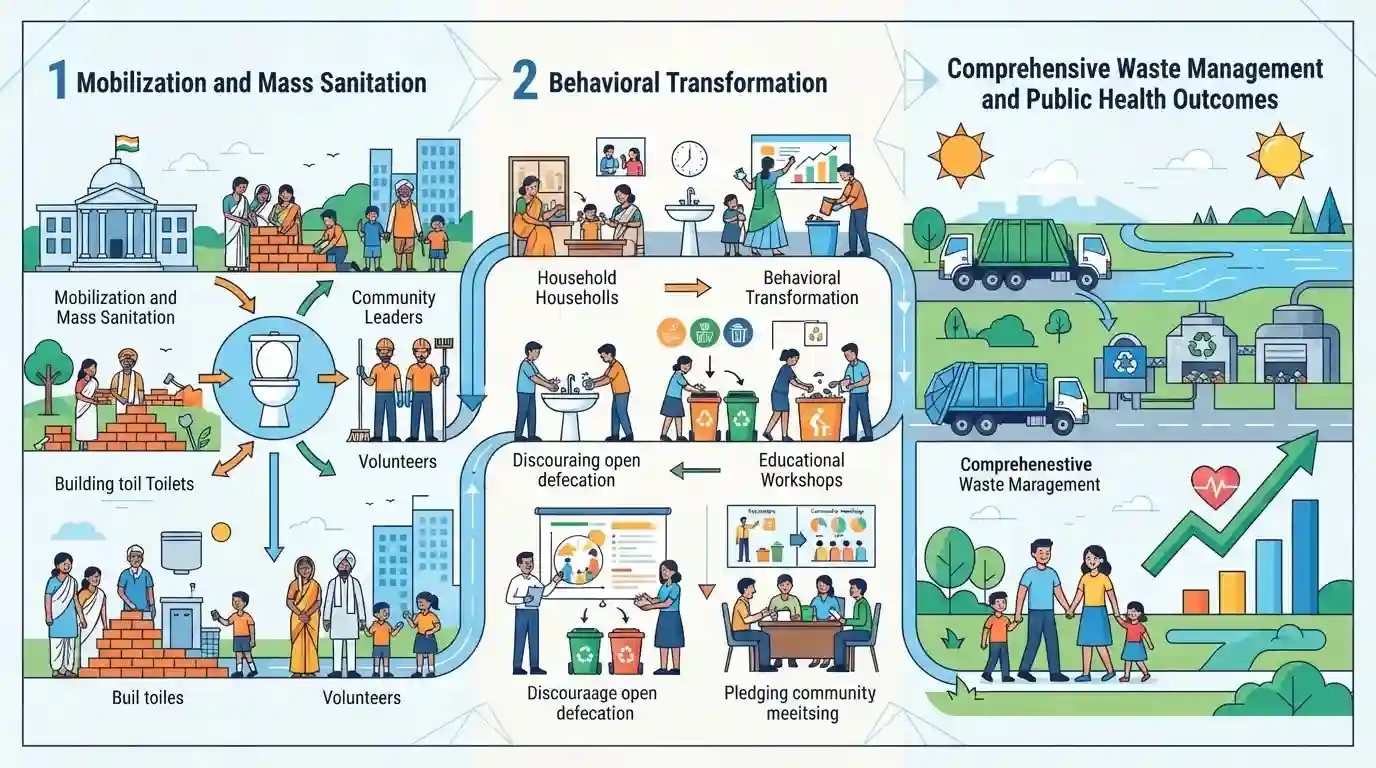
The article highlights the journey of the Swachh Bharat Mission, detailing how it evolved into a comprehensive people's movement (Jan Andolan) focusing on mass sanitation, behavioral transformation, waste management, and public health outcomes across India.
ముఖ్య అంశాలు
- Swachh Bharat Mission transformed from a government scheme into a massive Jan Andolan (people's movement) focused on behavioral change and public health.
- Achieved universal sanitation coverage and progressed towards ODF Plus status, addressing solid and liquid waste management in rural and urban India.
- Emphasized community participation, women empowerment, and mass mobilization across grassroots levels.
ముఖ్యమైన పదాలు
Swachh Bharat Mission (SBM)

A nationwide campaign launched in 2014 to eliminate open defecation and improve solid waste management, transitioning into a comprehensive people's movement (Jan Andolan).
UPSC context
GS Paper II (Government Policies & Interventions) and Social Sector (Health & Sanitation); evaluates welfare schemes and mass mobilization.
Swachh Bharat Mission Grameen
The rural component of the Swachh Bharat Mission focused on achieving Open Defecation Free status and managing solid and liquid waste in rural areas.
UPSC context
GS Paper II/III (Rural Development and Sanitation); tests rural infrastructure, behavioral change, and decentralized waste management.
Ministry of Jal Shakti
The Union ministry in India responsible for policy formulation, planning, funding, and coordination of water resources and sanitation programs, including SBM.
UPSC context
GS Paper II (Structure of Ministries and Departments, Governance); tests administrative frameworks for water and sanitation delivery.
అనుసంధానమైన స్థిర భావనలు
What are the key pillars and funding mechanisms of the Swachh Bharat Mission (Grameen) Phase II?
- Core Focus: Focuses on sustaining ODF status and implementing solid and liquid waste management (SLWM) in all villages.
- Funding Model: Financed through a mix of budgetary allocations from Central and State governments, convergence with MGNREGS, and external funding.
- Execution Mode: Implemented by the Ministry of Jal Shakti with heavy reliance on Gram Panchayats for community-level operations.
అంతర-అంశ నమూనాలు
Behavioral Economics + Nudge Theory in Governance
SBM institutionalized behavioral nudges via the 'ISM' framework, directly feeding into NITI Aayog's emphasis on behavioral economics for public policy delivery.
Sanitation Access + Gender & Education Outcomes
Universal sanitation access directly drives female workforce participation and reduces school dropouts among adolescent girls in rural districts.

SBM-Grameen Phase II targets (ODF Plus) combined with decentralized waste management models will anchor governance/social sector MCQs.
అనుసంధాన PYQలు · 2
అనుసంధాన PYQలు · 2
- 2024MainsGS2
Public charitable trusts have the potential to make India's development more inclusive as they relate to certain vital public issues. Comment.
- 2016PrelimsGS1
'Mission Indradhanush' launched by the Government of India pertains to
