Semiconductor Mission and Indigenous Technology Innovation Focus
Source:PIB ↗
हे का महत्त्वाचे आहे
It highlights India's strategic push towards tech-sovereignty, semiconductor manufacturing, and human resource development, which are core priorities under GS3 Science & Technology.
सारांश
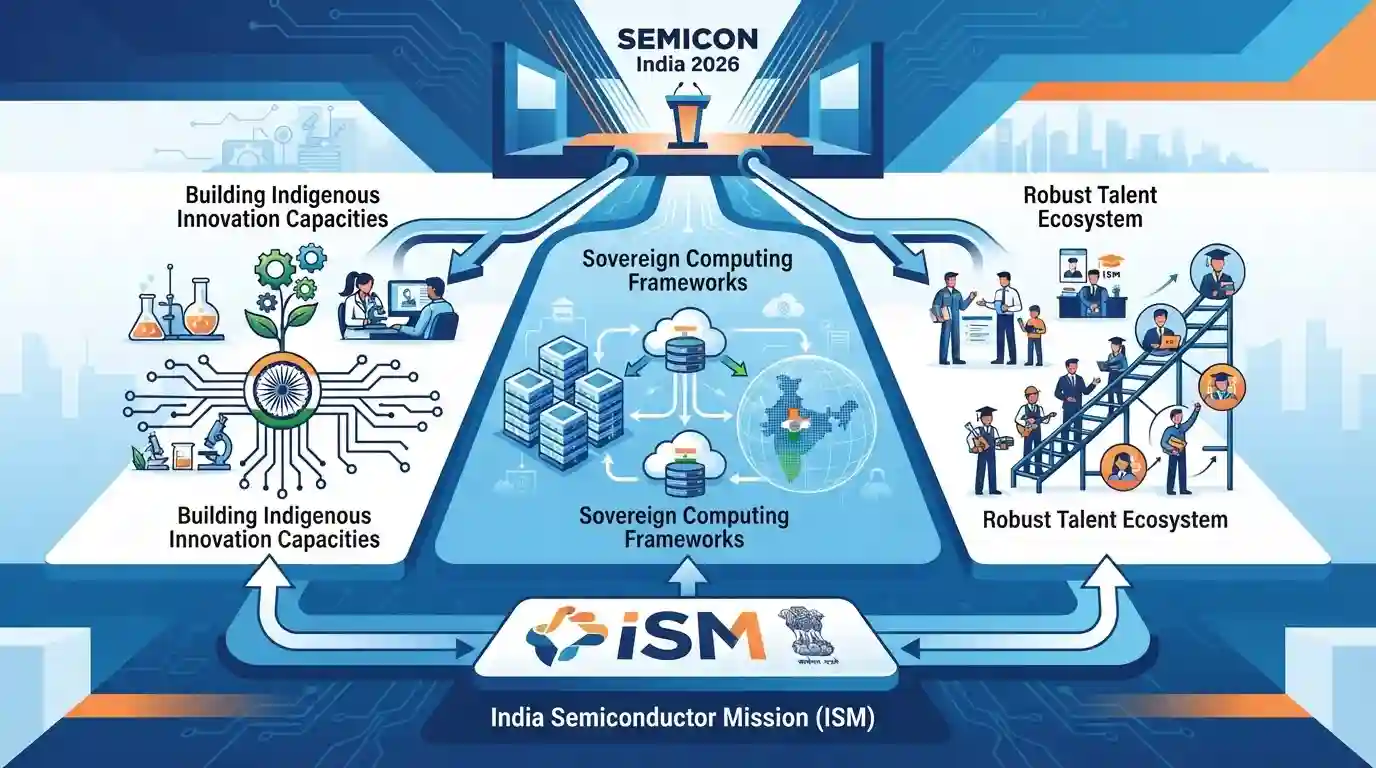
SEMICON India 2026 concluded with a high-level focus on building indigenous innovation capacities, sovereign computing frameworks, and a robust talent ecosystem for the semiconductor industry, aligning closely with the India Semiconductor Mission (ISM).
मुख्य मुद्दे
- SEMICON India 2026 concluded with a core emphasis on achieving self-reliance via indigenous innovation, sovereign computing, and workforce development.
- The event highlighted India's rapid strides in establishing semiconductor manufacturing ecosystems, assembly and testing units (OSAT/ATMP), and design capabilities.
- Strategic integration with sovereign computing and critical mineral supply chains was highlighted as vital to India's technological autonomy and economic growth.
महत्त्वाच्या संज्ञा
India Semiconductor Mission (ISM)

A specialized business division within MeitY aiming to catalyze the semiconductor and display ecosystem in India by providing financial incentives and infrastructure support.
UPSC context
GS Paper III (Technology / Govt Policies): Important for questions on high-tech manufacturing, indigenization, and supply chain resilience.
SEMICON India
A flagship international conference and exhibition platform designed to foster collaboration, investment, and ecosystem development across the semiconductor value chain in India.
UPSC context
GS Paper III (IT & Computers): Tests initiatives promoting domestic semiconductor design, fabrication, and sovereign computing capabilities.
National Critical Mineral Mission
A strategic government initiative launched to ensure a secure, resilient domestic supply of critical minerals across exploration, processing, and recycling to support high-tech manufacturing.
UPSC context
GS Paper III (Economy / Resources): Critical for questions on mineral security, clean energy transition, and hi-tech supply chain dependencies.
पूर्वपरीक्षा सापळा
The India Semiconductor Mission operates as an independent ministry under the Union Cabinet to oversee chip manufacturing.
Aspirants often assume ISM is an independent ministry or a standalone statutory body, whereas it actually operates as a specialized business division under the Digital India Corporation (MeitY).
संबंधित स्थिर संकल्पना
What are the key components of the semiconductor value chain and specialized facilities like OSAT and ATMP?
- Wafer Fabrication: Wafer Fabrication, The capital-intensive foundational stage where intricate microelectronic circuits are etched onto silicon wafers using photolithography.
- OSAT and ATMP: OSAT/ATMP Facilities, Outsourced Semiconductor Assembly and Test (OSAT) or Assembly, Testing, Marking, and Packaging (ATMP) units cut, protect, and test fabricated wafers for deployment.
- Design Phase: Design Ecosystem, The intellectual property (IP) and electronic design automation (EDA) software phase where microchips are architected before physical manufacturing.
आंतर-विषय नमुने
Semiconductors + Critical Minerals Supply Chains
Semiconductor manufacturing requires ultra-pure electronic-grade chemicals, rare gases, and critical minerals, directly linking technology indigenization to secure supply chain diplomacy and plurilateral mineral partnerships like the MSP.
Sovereign Computing + Global Trade Rules
Sovereign computing and data localization frameworks intersect with domestic trade rules and international IP regimes, balancing technological protectionism with global value chain integration.

ISM + OSAT/ATMP ecosystem incentives and sovereign computing goals will likely feature in a multi-statement tech indigenization question.
संबंधित PYQ · 2
संबंधित PYQ · 2
- 2025MainsGS3
India aims to become a semiconductor manufacturing hub. What are the challenges faced by the semiconductor industry in India? Mention the salient features of the India Semiconductor Mission.
- 2026PrelimsGS1
Which one of the following pairs of semiconductor plants in India and their locations is not correctly matched ?
