Financial Strategies and Capital Formation for Viksit Bharat
Source:PIB ↗
Why It Matters
The conference addresses core structural requirements for India's long-term economic growth, particularly resource mobilization, capital formation, and investment strategies crucial for the Viksit Bharat 2047 agenda.
Summary
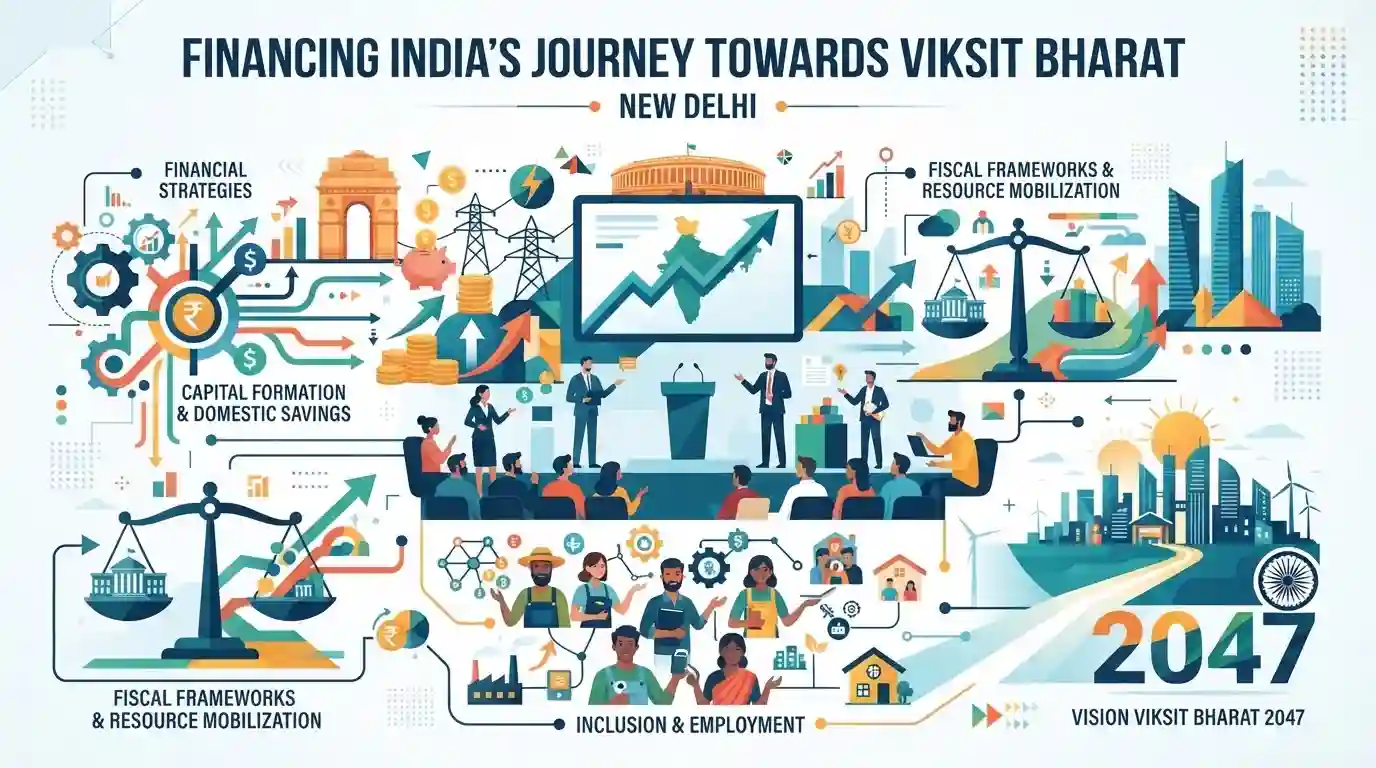
The conference on 'Financing India's Journey towards Viksit Bharat' in New Delhi brought together key stakeholders to discuss financial strategies, capital formation, domestic savings mobilization, and fiscal frameworks necessary to support India's vision of becoming a developed economy by 2047.
Key Points
- A conference on 'Financing India's Journey towards Viksit Bharat' concluded in New Delhi, focusing on strategies to mobilize long-term financing for India's development goals.
- Discussions emphasized the crucial role of domestic savings, capital formation, and financial sector deepening in achieving a developed nation status by 2047.
- Stakeholders from government, financial institutions, and academia deliberated on private investment, fiscal sustainability, and infrastructure financing.
Important Terms
Viksit Bharat

India's national vision plan to transform into a fully developed, high-income nation by the centenary of its independence in 2047, focusing on robust economic growth, structural reforms, and social inclusion.
UPSC context
Crucial for GS Paper III (Indian Economy, Planning, Growth & Development) and essay prompts on long-term national development strategies.
Ministry of Finance
The apex ministry of the Government of India responsible for economic policy, taxation, fiscal management, public expenditure, financial institutions, and preparation of the Union Budget.
UPSC context
Important for GS Paper II (Polity and Governance - executive organs) and GS Paper III (Indian Economy - fiscal policy and resource mobilization).
Static Concepts Connected
What are the key components and determinants of Capital Formation in the Indian Economy?
- GCF Definition: Gross Capital Formation (GCF) includes investments in fixed assets (infrastructure, machinery) and change in inventories, financed primarily through domestic savings and net capital inflows.
- Savings Composition: Household sector is traditionally the largest net saver in India, followed by private corporate and public sectors. Net financial savings of households are critical for financial intermediation.
- ICOR Efficiency: ICOR (Incremental Capital-Output Ratio) measures the additional capital required to produce an additional unit of output; lower ICOR indicates higher capital efficiency.
Cross-Topic Patterns
Viksit Bharat and Fiscal Federalism
Viksit Bharat goals depend heavily on sustainable fiscal consolidation and tax-to-GDP ratio improvements, linking growth strategy directly to Centre-State fiscal federalism and FRBM Act limits.
Long-term Capital Formation and Bond Markets
Scaling infrastructure financing requires deepening corporate bond markets and alternate investment funds, tying growth targets directly to SEBI regulations and monetary policy transmission.

Viksit Bharat 2047 targets + domestic savings trends (household financial savings vs physical assets) is prime Prelims statement material.
Linked PYQs · 3
Linked PYQs · 3
- 2017MainsGS3
Among several factors for India's potential growth, savings rate is the most effective one. Do you agree? What are the other factors available for growth potential?
- 2020MainsGS3
Explain the meaning of investment in an economy in terms of capital formation. Discuss the factors to be considered while designing a concession agreement between a public entity and a private entity.
- 2025MainsGS3
Explain how the Fiscal Health Index (FHI) can be used as a tool for assessing the fiscal performance of states in India. In what way would it encourage the states to adopt prudent and sustainable fiscal policies?
