Biometric Aadhaar Authentication for Subsidized LPG Refills
Source:PIB ↗
हे का महत्त्वाचे आहे
It highlights the evolving use of Digital Public Infrastructure (DPI) and biometric authentication in rationalizing government subsidies, plugging leakages, and ensuring targeted delivery of welfare benefits to vulnerable sections.
सारांश
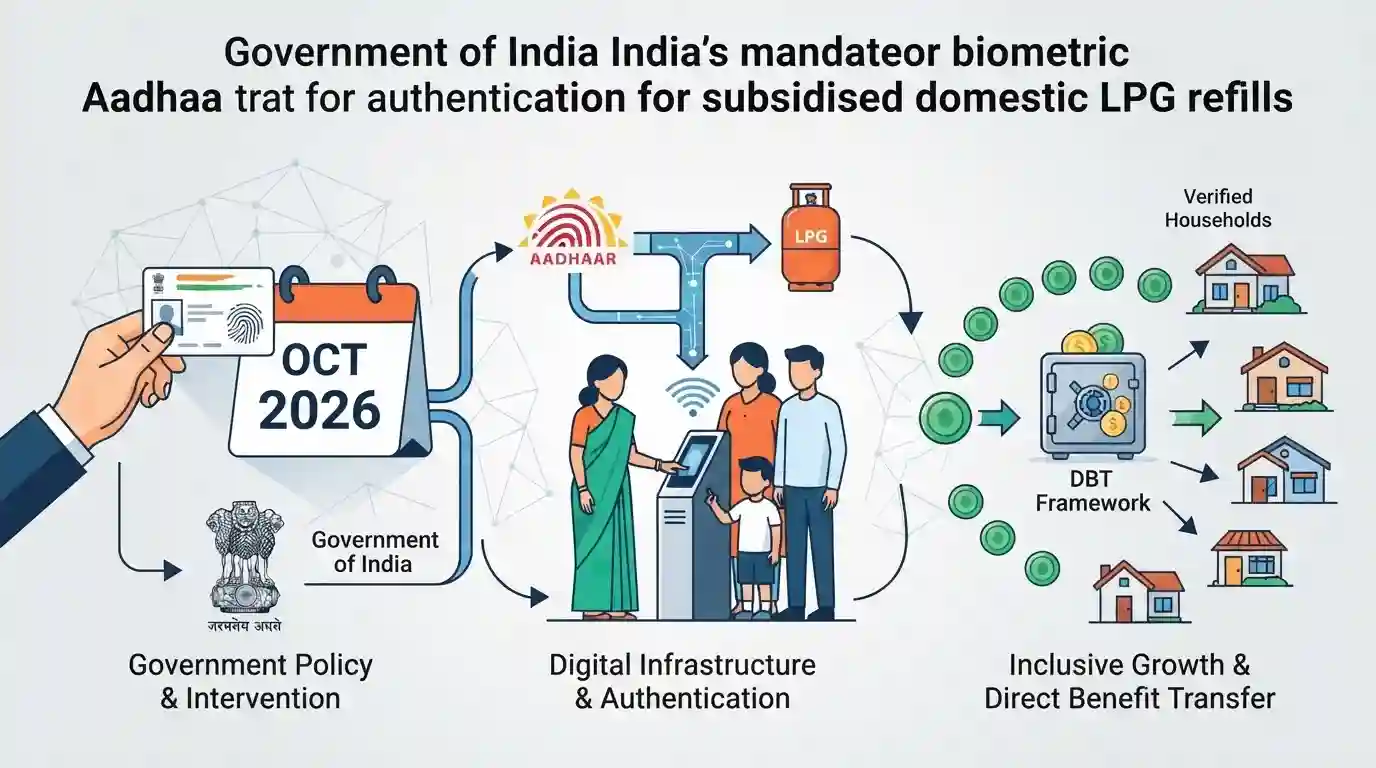
The Government of India has mandated biometric Aadhaar authentication for availing subsidised domestic LPG refills starting 1 October 2026. This policy push seeks to leverage digital identity infrastructure to plug leakage in state subsidies, ensure precise delivery to genuine households, and strengthen governance under the Direct Benefit Transfer (DBT) framework.
मुख्य मुद्दे
- Biometric Aadhaar authentication has been made mandatory for receiving subsidised domestic LPG refills effective from 1 October 2026.
- This measure aims to streamline the delivery mechanism, target genuine beneficiaries, and prevent leakages in the subsidy distribution network.
- It builds upon the Direct Benefit Transfer (DBT) framework for LPG (DBTL/PAHAL) to enhance transparency and accountability using digital public infrastructure.
महत्त्वाच्या संज्ञा
Aadhaar Act

A statutory framework enacted in 2016 that backs the issuance of unique 12-digit biometric identity numbers (Aadhaar) and empowers the government to mandate Aadhaar authentication for availing state-funded subsidies, benefits, and services under Section 7.
UPSC context
GS Paper II (Governance, Polity, Constitution - Statutory Frameworks, Right to Privacy issues). Important for questions on digital identity and welfare targeting.
Direct Benefit Transfer (DBT) scheme
A governance reform mechanism that transfers welfare subsidies and cash benefits directly into the bank accounts of targeted beneficiaries, cutting out intermediaries and plugging leakages.
UPSC context
GS Paper III (Economy - Inclusive Growth, Government Budgeting, and Subsidy Reforms). Tests administrative efficiency and public finance management.
Pradhan Mantri Ujjwala Yojana (PMUY)
A flagship social welfare scheme launched in 2016 by the Ministry of Petroleum and Natural Gas to provide deposit-free LPG connections to women from below-poverty-line households.
UPSC context
GS Paper II / III (Social Justice and Inclusive Growth - Welfare Schemes for Vulnerable Sections, Clean Energy Transition).
Unique Identification Authority of India (UIDAI)
The central statutory authority established under the Aadhaar Act 2016 responsible for issuing Aadhaar numbers, operating the biometric database, and ensuring data security and authentication integrity across India.
UPSC context
GS Paper II (Statutory Bodies, Governance, and Regulatory Institutions). Tests understanding of digital public infrastructure (DPI) architecture.
Ministry of Petroleum and Natural Gas
The nodal central government ministry responsible for the exploration, production, refining, distribution, and pricing of petroleum, natural gas, and petroleum products, including domestic LPG schemes.
UPSC context
GS Paper II (Government Ministries & Institutional Functioning) and GS Paper III (Energy Sector & Subsidy Policies).
पूर्वपरीक्षा सापळा
Mandatory biometric Aadhaar authentication is required to purchase domestic LPG cylinders of any kind from October 2026.
Aadhaar authentication is mandatory only for availing the *subsidy*, not for buying the LPG cylinder itself. Consumers can still buy cylinders at market price without Aadhaar.
संबंधित स्थिर संकल्पना
What are the constitutional and legal parameters governing the mandatory use of Aadhaar for government welfare schemes?
- Puttaswamy Verdict: The Supreme Court in the Puttaswamy judgment upheld Aadhaar's constitutional validity under Article 14, 19, and 21, specifically endorsing Section 7 of the Aadhaar Act for subsidised welfare benefits.
- Section 7 Power: Section 7 of the Aadhaar Act, 2016 empowers the government to mandate Aadhaar for expenditure incurred from the Consolidated Fund of India for subsidies, benefits, and services.
- Alternative ID safeguard: Alternative identification must be provided if Aadhaar authentication fails, ensuring no genuine beneficiary is denied essential subsidies due to technical glitches (as ruled by the Supreme Court).
आंतर-विषय नमुने
DPI Subsidies + Fiscal Consolidation & Green Transition
The intersection of DPI and fiscal prudence allows the state to reallocate billions in saved subsidy leakages directly into green transition funds like PMUY solar or electric cooking initiatives.

Aadhaar-linked DBT mandates will feature in GS-3 as a critical evaluation of DPI balancing financial inclusion with privacy safeguards.
संबंधित PYQ · 2
संबंधित PYQ · 2
- 2015MainsGS3
In what way could replacement of price subsidy with Direct Benefit Transfer (DBT) change the scenario of subsidies in India ? Discuss.
- 2025MainsGS2
e-governance projects have a built-in bias towards technology and back-end integration than user-centric designs. Examine.
