Administrative Reforms and Pendency Reduction in CBIC Campaigns
Source:PIB ↗
কেন এটি গুরুত্বপূর্ণ
The article highlights institutional initiatives for pendency reduction, record management, and cleanliness in government offices, which are core elements of administrative reforms and good governance syllabus under GS Paper II.
সারসংক্ষেপ
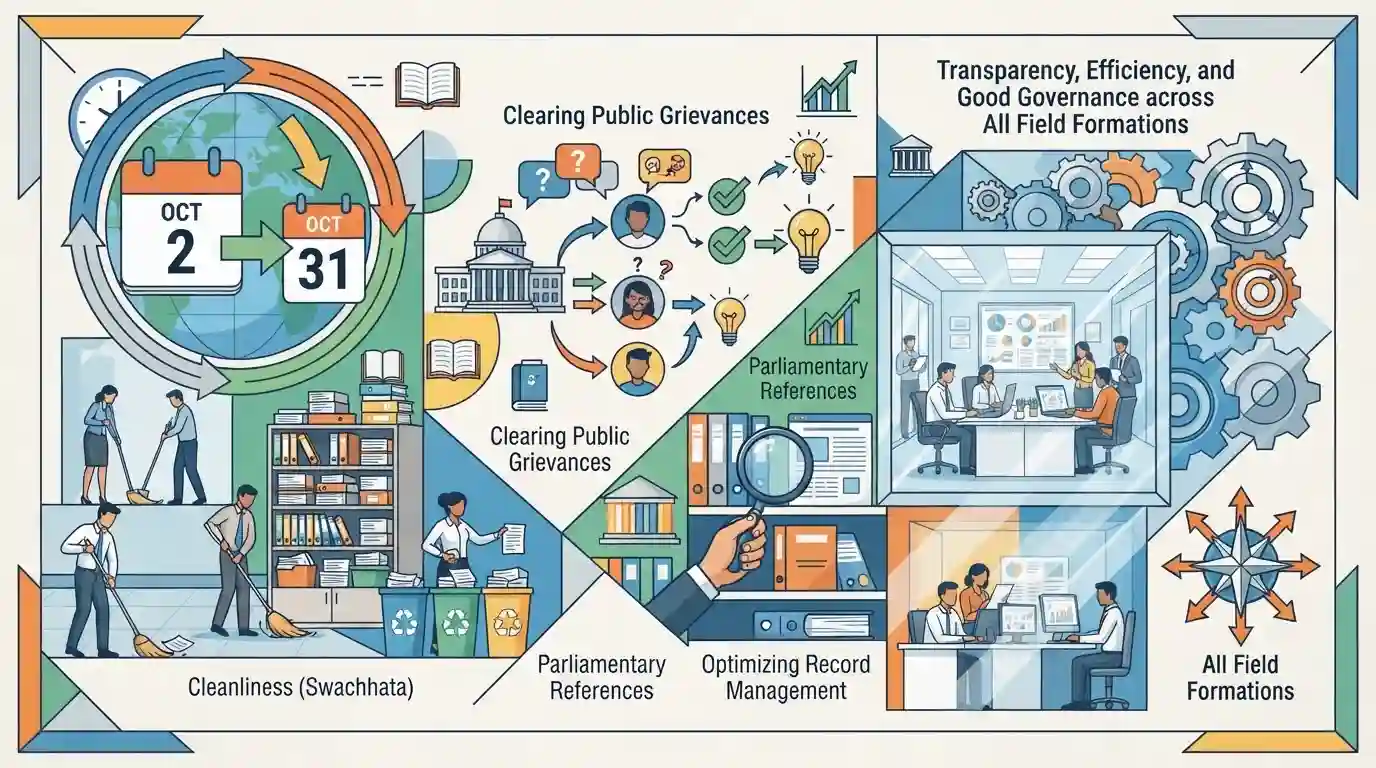
The Central Board of Indirect Taxes and Customs (CBIC) is gearing up for Special Campaign 6, scheduled from October 2 to October 31, 2026. Aimed at institutionalizing cleanliness (Swachhata), clearing public grievances and parliamentary references, and optimizing record management, the campaign underscores the government's ongoing administrative reforms to enhance transparency, efficiency, and good governance across all field formations.
মূল বিষয়
- The Central Board of Indirect Taxes and Customs (CBIC) and its field formations are preparing to launch Special Campaign 6 from October 2nd to October 31st, 2026.
- The nationwide campaign focuses on institutionalizing Swachhata (cleanliness), reducing pendency of public grievances, appeals, and references from Members of Parliament (MPs), and promoting efficient record management.
- It aims to enhance institutional efficiency, clean up office spaces, dispose of scrap, and generate revenue through recycling, aligning with broader good governance and administrative reform objectives.
গুরুত্বপূর্ণ শব্দ
Special Campaign 6

A periodic government-wide initiative focused on institutionalizing cleanliness, reducing pendency of public grievances, optimizing record management, and enhancing administrative efficiency across all ministries and field formations.
UPSC context
UPSC GS Paper II (Governance, Administrative Reforms): Tests initiatives on reducing pendency, promoting transparency, and institutionalizing swachhata in governance.
Central Board of Indirect Taxes and Customs (CBIC)
A premier statutory apex body under the Department of Revenue, Ministry of Finance, responsible for administering indirect taxes including GST, customs, and central excise in India.
UPSC context
UPSC GS Paper II/III (Economy, Taxation, Statutory Bodies): Tests understanding of tax administration and revenue structures in India.
Ministry of Finance
The nodal ministry of the Government of India concerned with the economy, financial administration, public revenue, taxation, and overall macroeconomic management of the country.
UPSC context
UPSC GS Paper III (Indian Economy & Budgeting): Tests the role of central ministries in fiscal policy, revenue mobilization, and administrative governance.
সংযুক্ত স্থির ধারণা
What are the statutory origins and administrative domains of the Central Board of Indirect Taxes and Customs (CBIC)?
- Statutory Origin: Statutory Basis: Constituted under the Central Boards of Revenue Act, 1963, functioning under the Department of Revenue, Ministry of Finance.
- Functional Scope: Core Mandate: Formulates policies and administers laws related to GST, custom duties, central excise, and erstwhile service tax.
- Field Setup: Field Formations: Operates through a nationwide network of custom houses, central GST commissionerates, and centralized processing cells.
আন্তঃবিষয় প্যাটার্ন
Good Governance meets RTI Act Disposals
Administrative cleanliness drives intersect with Right to Information (RTI) disposal targets, testing departmental efficiency and grievance redressal timelines across ministries.
Office Scrap Disposal & Non-Tax Revenue
Revenue generation via scrap disposal feeds into non-tax revenue receipts, linking routine housekeeping drives directly to fiscal management metrics.

Special campaigns for institutionalizing cleanliness and clearing pendency in govt offices are recurring themes in GS Paper II (Governance).
সংযুক্ত PYQ · 1
সংযুক্ত PYQ · 1
- 2023MainsGS2
e-governance, as a critical tool of governance, has ushered in effectiveness, transparency and accountability in governments. What inadequacies hamper the enhancement of these features ?
