ITEC Capacity Building Programs and India Human Rights Diplomacy
Source:PIB ↗
हे का महत्त्वाचे आहे
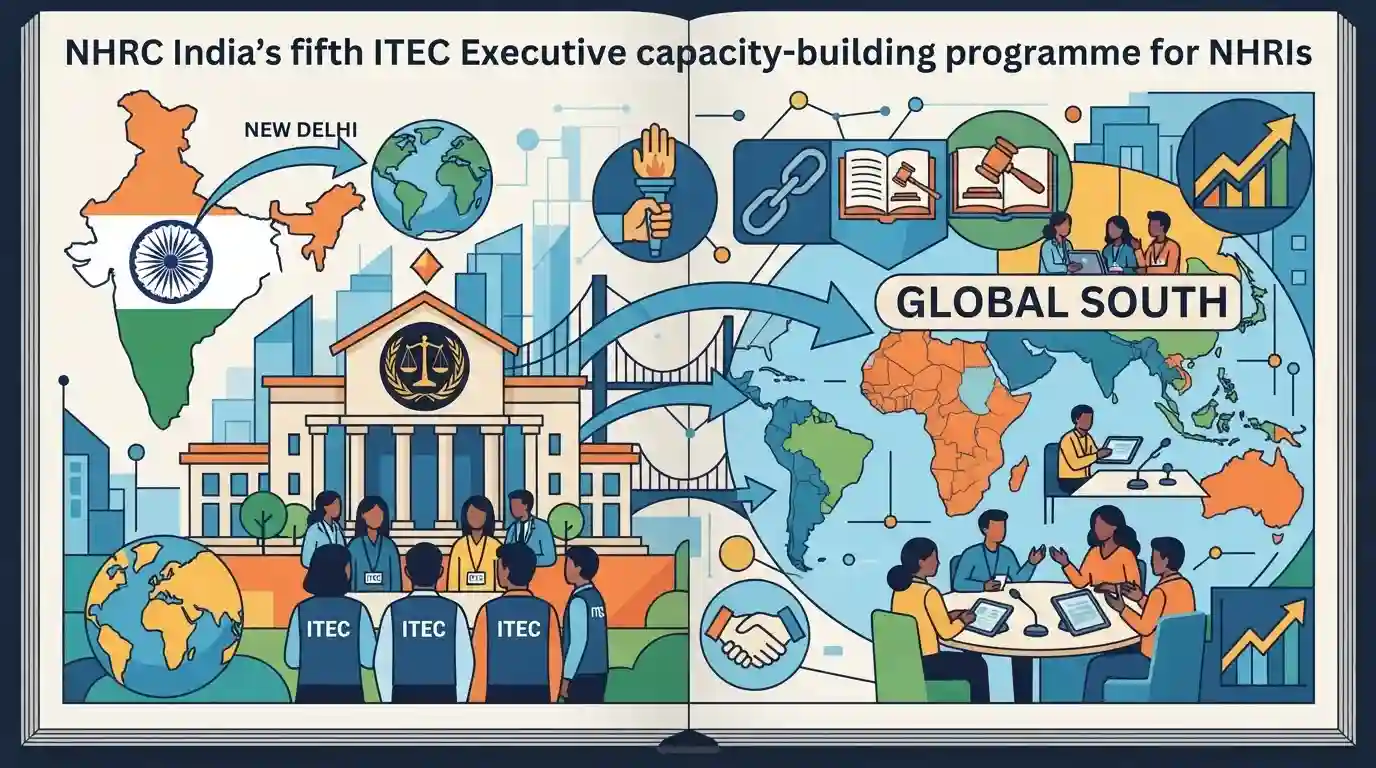
The article illustrates India's diplomatic and institutional outreach via capacity building (ITEC) for global south NHRIs, reinforcing India's soft power and leadership in human rights discourses.
सारांश
The National Human Rights Commission (NHRC) of India successfully concluded its fifth ITEC Executive capacity-building programme focused on human rights for National Human Rights Institutions (NHRIs) of the Global South in New Delhi. The initiative underscores India's active role in South-South cooperation, institutional capacity-building, and international collaboration in upholding human rights standards.
मुख्य मुद्दे
- The National Human Rights Commission (NHRC), India concluded its fifth ITEC Executive capacity-building programme on human rights for NHRIs of the Global South in New Delhi.
- The programme aims to foster international cooperation, share best practices, and strengthen institutional capabilities for human rights protection across developing nations.
- It highlights India's commitment to South-South cooperation and capacity building through the Indian Technical and Economic Cooperation (ITEC) framework.
महत्त्वाच्या संज्ञा
ITEC (Indian Technical and Economic Cooperation)

A flagship bilateral assistance program launched by the Government of India in 1964 to provide technical cooperation and capacity-building training to developing nations, particularly across the Global South.
UPSC context
GS Paper II (International Relations) - Tests India's developmental diplomacy, soft power projection, and cooperation framework with developing nations.
National Human Rights Commission (NHRC) India
A statutory public body established in 1993 under the Protection of Human Rights Act to protect and promote human rights in India, empowered to inquire into human rights violations.
UPSC context
GS Paper II (Polity & Governance) - Important statutory body; tests powers, functions, independence, and constitutional/statutory safeguards of human rights in India.
ITEC Executive capacity-building programme
A specialized collaborative training initiative between NHRC and MEA aimed at strengthening institutional capabilities and sharing best practices among human rights bodies of the Global South.
UPSC context
GS Paper II (International Relations / Governance) - Tests India's institutional outreach, South-South cooperation, and multilateral human rights advocacy.
संबंधित स्थिर संकल्पना
What are the constitutional and statutory provisions governing the National Human Rights Commission (NHRC) in India?
- Statutory Basis: Established on October 12, 1993, under the Protection of Human Rights Act, 1993 (amended in 2019).
- Composition: Chairperson must be a retired Chief Justice of India or a Supreme Court Judge. Term is 3 years or up to 70 years of age.
- Appointment: Appointed by the President on the recommendation of a 6-member committee headed by the Prime Minister.
आंतर-विषय नमुने
ITEC Diplomacy and Global South Leadership
ITEC capacity building programmes reinforce India's soft power and diplomatic outreach in the Global South, bridging foreign policy objectives with institutional export.

NHRC composition criteria + ITEC founding year frequently appear in matching-list prelims questions.
संबंधित PYQ · 1
संबंधित PYQ · 1
- 2014MainsGS2
National Human Rights Commission (NHRC) in India can be most effective when its tasks are adequately supported by other mechanisms that ensure the accountability of a government. In light of the above observation assess the role of NHRC as an effective complement to the judiciary and other institutions in promoting and protecting human rights standards.
