Community Participation and Public Health Goals in Swachhata Campaign
Source:PIB ↗
ఇది ఎందుకు ముఖ్యం
The Swachhata Hi Seva campaign is a cornerstone government intervention highlighting community-led total sanitation, behavioral change (Jan Andolan), and grassroots governance, which directly relates to syllabus areas concerning government policies, welfare schemes, and public health administration.
సారాంశం
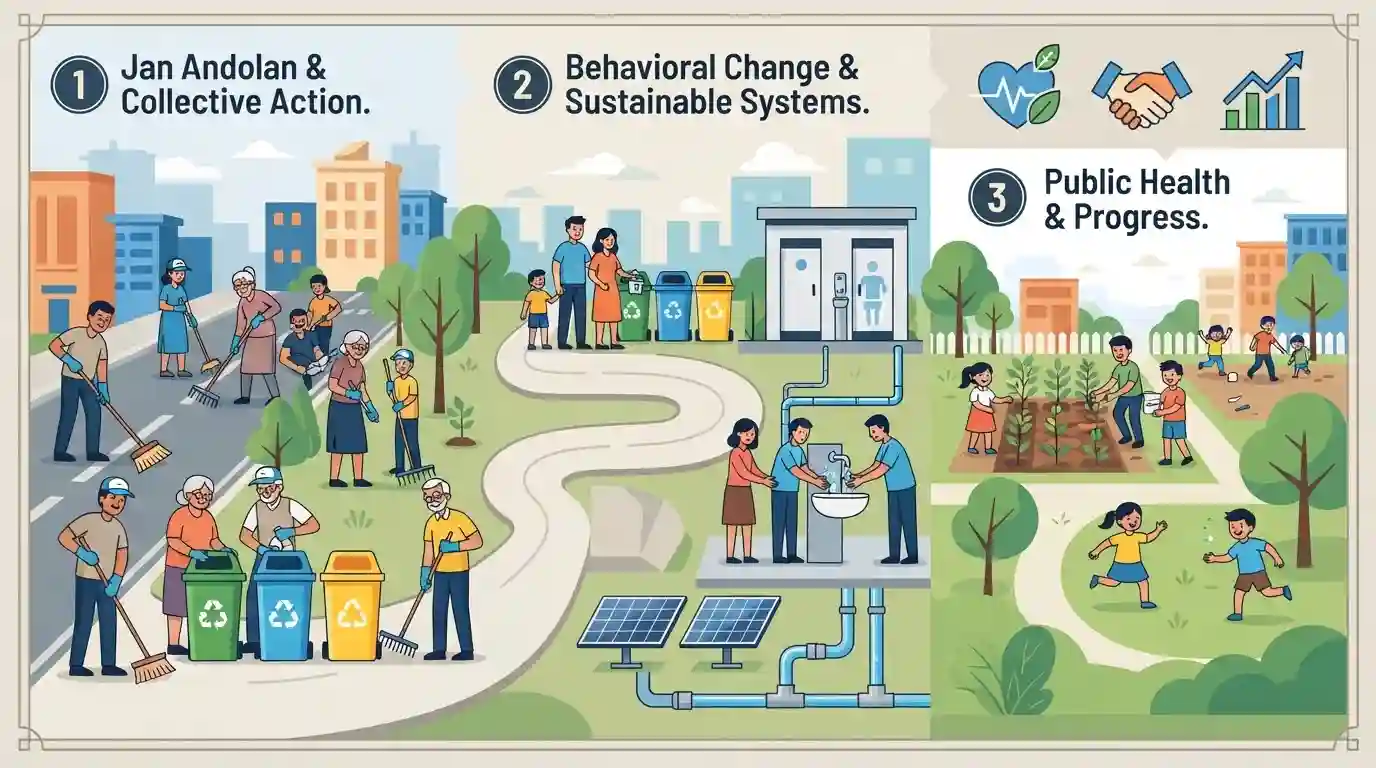
The article outlines the ongoing initiatives and significance of the Swachhata Hi Seva campaign, highlighting its role in promoting nationwide cleanliness, behavioural change, public health, and jan andolan (people's movement) towards sustainable sanitation and waste management under the Swachh Bharat framework.
ముఖ్య అంశాలు
- Swachhata Hi Seva (SHS) campaign focuses on sanitation, cleanliness, and public participation (Jan Andolan).
- Emphasizes community mobilization, swachhata pledge, cleaning of difficult spots (Safai Mitra Suraksha), and waste-to-wealth initiatives.
- Integrates public health outcomes with behavioral change and institutional cleanliness.
- Highlights the role of grassroots governance, citizen engagement, and stakeholder coordination in maintaining cleanliness standards.
ముఖ్యమైన పదాలు
Swachhata Hi Seva

A flagship nationwide campaign launched under the Swachh Bharat Mission to mobilize citizens through voluntary action (Shramdaan) and foster collective responsibility for sanitation and waste management.
UPSC context
Mains GS Paper II (Govt Policies/WASH): Tests understanding of jan andolan, behavioral change, and public welfare schemes in governance.
Swachh Bharat Mission
A nationwide mission launched in 2014 to eliminate open defecation, improve solid waste management, and promote sustainable sanitation and hygiene practices across India.
UPSC context
Mains GS Paper II & III: Tests evaluation of flagship welfare schemes, public health outcomes, and sanitation infrastructure goals.
Ministry of Housing and Urban Affairs
The central ministry responsible for formulating and implementing urban development policies, housing programs, and urban sanitation initiatives like SBM-Urban.
UPSC context
Mains GS Paper II: Tests governance structure, institutional frameworks, and administrative responsibilities for urban governance.
Department of Drinking Water and Sanitation
A department under the Ministry of Jal Shakti responsible for accelerating rural sanitation coverage, safe drinking water, and implementing SBM-Gramin.
UPSC context
Mains GS Paper II & III: Tests rural development, water security policies, and sanitation interventions at the grassroots.
Ministry of Jal Shakti
The nodal Union ministry created in 2019 to consolidate water management, drinking water supply, and sanitation responsibilities under a single umbrella.
UPSC context
Mains GS Paper II & III: Tests administrative reforms and policies related to water resource management and public health.
అనుసంధానమైన స్థిర భావనలు
What are the core pillars and ministries implementing the Swachh Bharat Mission (SBM)?
- Nodal Ministries: Dual Ministries: Implemented jointly by the Ministry of Housing and Urban Affairs (urban) and Department of Drinking Water and Sanitation, Ministry of Jal Shakti (rural).
- Key Focus: Core Objectives: Universal sanitation coverage, elimination of open defecation, scientific solid waste management, and behavioral change through Jan Andolan.
- SBM Phase II: SBM 2.0 Phase: Focuses on sustained ODF status (ODF+ and ODF++) alongside greywater management and plastic waste mitigation.
అంతర-అంశ నమూనాలు
Sanitation Campaigns + Constitutional Labor Rights
The institutional focus on SafaiMitra occupational welfare connects public health schemes directly with Constitutional protections against hazardous labor under Article 23 and labor welfare jurisprudence.
Swachh Bharat + Circular Economy (SDG 12)
SBM's evolution towards waste-to-wealth and circular economy ties grassroots behavioral change directly to SDG 12 (Responsible Consumption and Production) and urban climate resilience.

SHS + SBM 2.0 welfare linkages (SafaiMitra Suraksha) likely to feature in a matching or multi-statement prelims question.
అనుసంధాన PYQలు · 1
అనుసంధాన PYQలు · 1
- 2017MainsGS2
To ensure effective implementation of policies addressing water, sanitation and hygiene needs the identification of the beneficiary segments is to be synchronized with the anticipated outcomes." Examine the statement in the context of the WASH scheme.
