EV Sector Growth and Policy Frameworks for Sustainable Transport
Source:PIB ↗
Why It Matters
Electric mobility is central to India's climate commitments (net-zero goals) and reducing fossil fuel dependency, making government initiatives, manufacturing policies, and consumer adoption patterns vital for GS3 syllabus coverage.
Summary
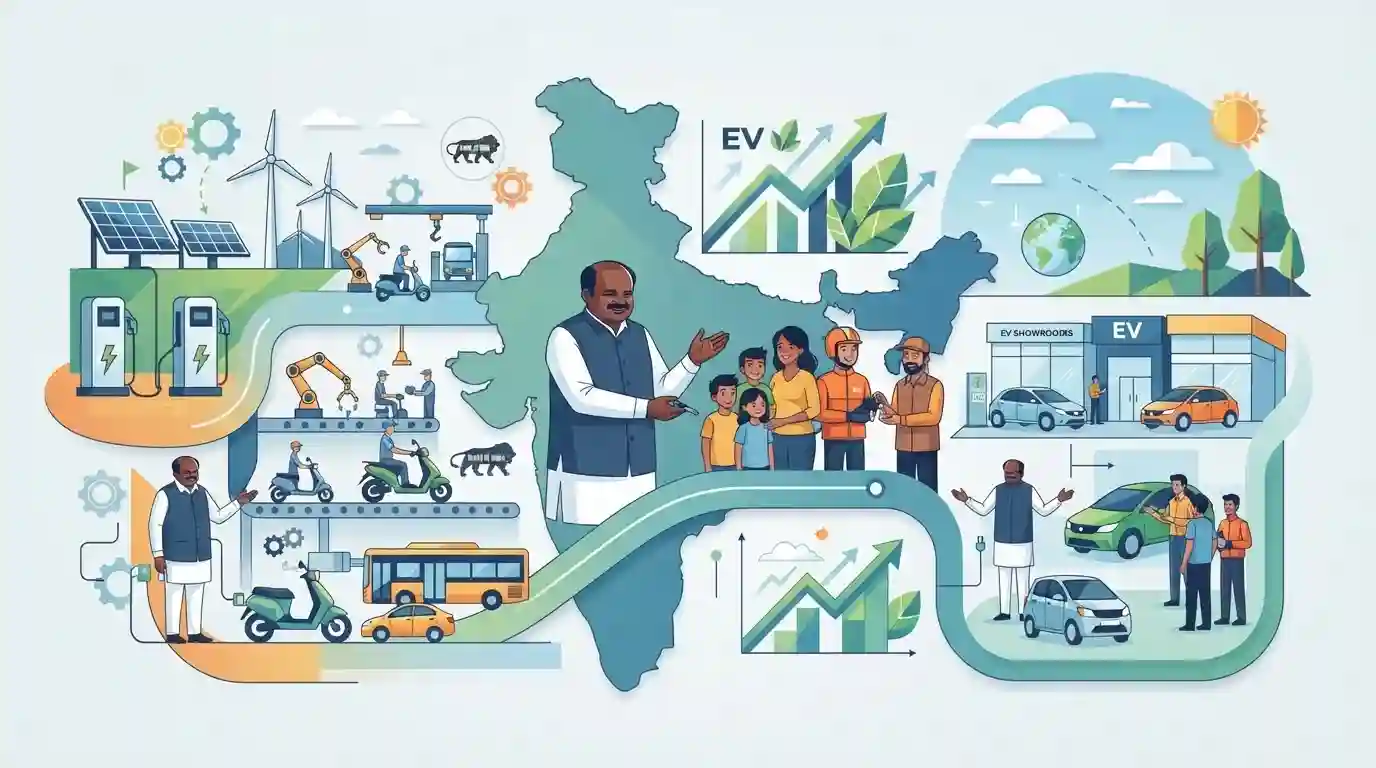
Union Minister H.D. Kumaraswamy interacted with EV beneficiaries and distributors across the country, showcasing India's transformative journey towards sustainable, self-reliant electric mobility and highlighting the growth of green transport manufacturing and adoption under supportive government frameworks.
Key Points
- Union Minister H.D. Kumaraswamy interacted with EV beneficiaries and distributors, highlighting India's transition to sustainable electric mobility.
- Emphasized self-reliance (Aatmanirbhar Bharat) and indigenous manufacturing in the electric vehicle (EV) sector.
- Discussed the role of progressive government policies, subsidies, and consumer adoption in scaling up green transportation.
- Highlighted the significance of reducing carbon emissions and dependence on fossil fuels through sustainable transport infrastructure.
Important Terms
FAME India Scheme

A flagship government initiative launched by the Ministry of Heavy Industries to incentivize the adoption and domestic manufacturing of electric and hybrid vehicles in India.
UPSC context
GS Paper III (Infrastructure: Energy and Transport / Environment); tests knowledge of government subsidies and policies promoting green mobility.
Ministry of Heavy Industries
The central government ministry responsible for promoting capital goods and engineering industries, overseeing public sector enterprises, and implementing policies for electric vehicle promotion like the FAME scheme.
UPSC context
GS Paper II/III (Governance / Industrial Policy & Manufacturing Growth); tests understanding of ministries driving industrial self-reliance and manufacturing.
Prelims Trap
FAME India is the sole central government scheme governing electric vehicle manufacturing and adoption in India.
Aspirants often assume FAME is the only EV policy, ignoring newer iterations like EMPS or state-specific manufacturing incentives.
Static Concepts Connected
What are the primary government interventions and subsidy frameworks supporting Electric Vehicles in India?
- FAME Scheme: Launched to promote faster adoption and manufacturing of hybrid and electric vehicles, offering upfront demand incentives.
- EMPS (Electric Mobility Promotion Scheme): Introduced by the Ministry of Heavy Industries to bridge the gap and sustain EV promotion following FAME.
- PLI Manufacturing: PLI schemes for Advanced Chemistry Cell (ACC) battery storage and Automobile & Auto Components to boost domestic manufacturing.
Cross-Topic Patterns
EV Transition + Critical Minerals Dependency
EV battery manufacturing depends heavily on Lithium, Cobalt, and Nickel, linking clean transport directly to critical mineral supply chains and strategic foreign policy.
Green Subsidies + Fiscal Federalism
Heavy subsidies for EV adoption intersect with fiscal federalism and state-level EV policies, creating diverse regional incentives across India.

EV transition + FAME / EMPS subsidies + critical minerals dependency will likely appear as a multi-statement prelims question.
Linked PYQs · 2
Linked PYQs · 2
- 2025PrelimsGS1
Consider the following types of vehicles : I. Full battery electric vehicles II. Hydrogen fuel cell vehicles III. Fuel cell-electric hybrid vehicles How many of the above are considered as alternative powertrain vehicles?
- 2022MainsGS3
Do you think India will meet 50 percent of its energy needs from renewable energy by 2030 ? Justify your answer. How will the shift of subsidies from fossil fuels to renewables help achieve the above objective ? Explain.
