Semicon India roadmap and domestic semiconductor manufacturing
Source:PIB ↗
Why It Matters
The transition to Semicon 2.0 marks a critical policy evolution in India's quest for technological self-reliance, critical component manufacturing, and securing global supply chains in high-tech industries.
Summary
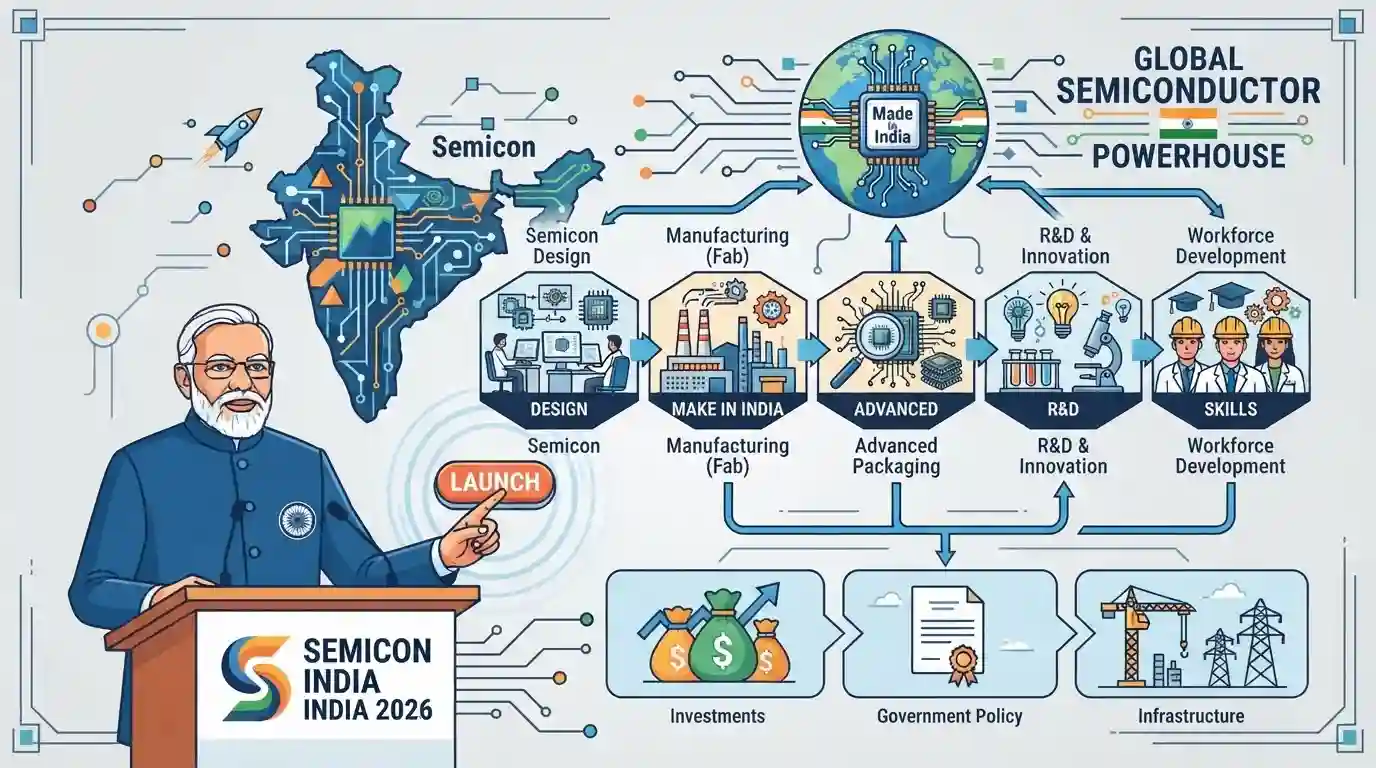
Prime Minister Narendra Modi inaugurated SEMICON India 2026, unveiling India's ambitious roadmap for 'Semicon 2.0', which scales up support across design, manufacturing, advanced packaging, R&D, and workforce development to establish India as a global semiconductor powerhouse.
Key Points
- Prime Minister Narendra Modi inaugurated SEMICON India 2026 and unveiled the roadmap for 'Semicon 2.0'.
- Semicon 2.0 expands support for semiconductor design, manufacturing, packaging, research & development (R&D), and talent development in India.
- The initiative aims to consolidate India's position as a global hub for electronics and semiconductor manufacturing, securing critical supply chains.
Important Terms
Semicon 2.0

An ambitious expansion of India's semiconductor strategy scaling up support across chip design, advanced manufacturing, packaging, R&D, and workforce development to establish India as a global semiconductor powerhouse.
UPSC context
UPSC GS Paper III (Science & Technology / Industrial Policy): Tests understanding of indigenous technology missions, manufacturing roadmaps, and high-tech self-reliance.
India Semiconductor Mission
A flagship government initiative under the Ministry of Electronics and Information Technology (MeitY) designed to build a vibrant semiconductor and display ecosystem in India.
UPSC context
UPSC GS Paper III (Economy / S&T): Evaluates institutional mechanisms, government policy support, and strategic investments for critical technologies.
Production Linked Incentive (PLI) scheme
A financial incentive scheme introduced by the Indian government to boost domestic manufacturing, attract large investments, and create global supply chain champions across critical sectors like electronics and semiconductors.
UPSC context
UPSC GS Paper III (Indian Economy - Growth & Industrial Policy): Tests the efficacy of state-backed manufacturing incentives and export promotion.
SEMICON India 2026
A premier global summit hosted in India to convene industry leaders, policymakers, and innovators to discuss advancements, investments, and collaborations in the semiconductor ecosystem.
UPSC context
UPSC GS Paper III (S&T / International Relations): Highlights India's emergence as a preferred destination for global high-tech partnerships and semiconductor supply chain diversification.
Static Concepts Connected
What are the key pillars and institutional frameworks driving India's Semiconductor Mission?
- Nodal Agency: Established as an Independent Business Division within Digital India Corporation (DIC) to steer India's semiconductor strategy.
- Financial Support: Provides 50% fiscal support of project cost for semiconductor fabs, display fabs, and compound semiconductor facilities.
- Design Linked Incentive: Focuses on supporting domestic companies across the entire value chain: design, testing, packaging, and wafer manufacturing.
Cross-Topic Patterns
Industrial Policy & High-Tech Supply Chains
Semicon 2.0 intersects with the National Quantum Mission and DLI schemes, highlighting how state-backed capital expenditure targets high-tech frontier manufacturing to reduce import dependencies.
Fiscal Outlays vs. Strategic Technological Autonomy
The massive financial outlay of ₹1,27,500 crore tests fiscal consolidation boundaries while attempting to secure strategic autonomy in electronics supply chains.

Semicon 2.0's financial outlay and six strategic pillars (especially design startups and advanced packaging) will likely feature in Mains GS3.
Linked PYQs · 2
Linked PYQs · 2
- 2025MainsGS3
India aims to become a semiconductor manufacturing hub. What are the challenges faced by the semiconductor industry in India? Mention the salient features of the India Semiconductor Mission.
- 2025MainsGS3
Discuss the rationale of the Production Linked Incentive (PLI) scheme. What are its achievements? In what way can the functioning and outcomes of the scheme be improved?
