Shahzad Bhatti Network Designation as Terrorist Group Under UAPA
Source:PIB ↗
Why It Matters
It demonstrates the practical application of anti-terror legislation like the UAPA by the Union Government to dismantle cross-border terror networks and uphold national security.
Summary
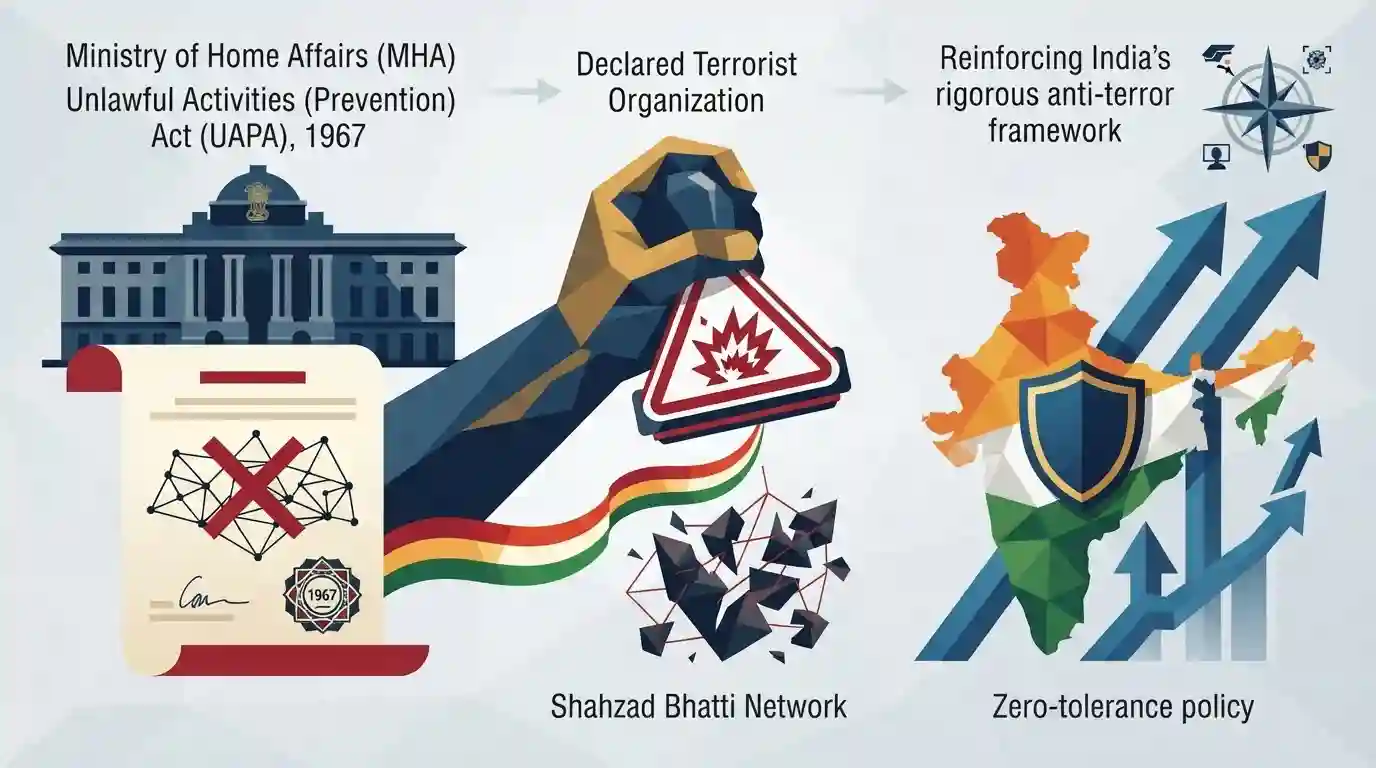
The Ministry of Home Affairs (MHA) has declared the Shahzad Bhatti Network as a terrorist organization under the Unlawful Activities (Prevention) Act (UAPA), 1967, reinforcing India's rigorous anti-terror framework and zero-tolerance policy against cross-border terrorism and subversive networks.
Key Points
- The Ministry of Home Affairs (MHA) has designated the Shahzad Bhatti Network as a terrorist organization under the Unlawful Activities (Prevention) Act (UAPA), 1967.
- The decision aligns with the Union Government's zero-tolerance policy towards terrorism under Prime Minister Narendra Modi and Union Home Minister Amit Shah.
- The network and its associates have been involved in cross-border terror activities, radicalization, and threatening India's sovereignty and integrity.
Important Terms
Unlawful Activities (Prevention) Act (UAPA) 1967

India's primary anti-terror legislation enacted to provide for the more effective prevention of certain unlawful activities of individuals and associations, and for dealing with terrorist activities.
UPSC context
GS Paper III (Internal Security) — crucial for understanding India's legal framework against terrorism, cross-border crimes, and security challenges.
Shahzad Bhatti Network
A criminal syndicate and terrorist network involved in cross-border smuggling of arms, explosives, and narcotics, and in inciting youth to engage in terrorist activities against India.
UPSC context
GS Paper III (Internal Security) — tests awareness of emerging external security threats and state measures like UAPA notifications.
Ministry of Home Affairs (MHA)
The central government ministry responsible for the maintenance of internal security, domestic policy, border management, and the administration of anti-terror laws like the UAPA.
UPSC context
GS Paper II / III (Polity & Governance / Internal Security) — tests institutional roles in policy implementation and security administration.
Static Concepts Connected
What are the key provisions and powers under the Unlawful Activities (Prevention) Act (UAPA), 1967?
- Central Power: Empowers the Central Government to declare an association unlawful or designate individuals/entities as terrorists via notification.
- Detention Limits: Allows detention without a chargesheet for up to 180 days (extendable) and restricts statutory bail provisions.
- Global Reach: Extraterritorial application allows investigation of crimes committed outside India affecting Indian interests.
Cross-Topic Patterns
Narco-terrorism and Transnational Crime Syndicates
Cross-border criminal syndicates are increasingly used for proxy terror, linking internal security challenges with organized crime and money laundering (PMLA).
UAPA 2019 Amendments and Individual Terrorist Designations
Individual terrorist designations under the 2019 UAPA amendment bypass long delays in banning formal corporate-style entities.

Expect a statement-based question comparing UAPA provisions for designating individuals vs organizations and judicial review mechanisms.
Linked PYQs · 3
Linked PYQs · 3
- 2019MainsGS3
Indian Government has recently strengthened the anti-terrorism laws by amending the Unlawful Activities (Prevention) Act (UAPA), 1967 and the NIA Act. Analyze the changes in the context of prevailing security environment while discussing the scope and reasons for opposing the UAPA by human rights organizations.
- 2024MainsGS3
Explain how narco-terrorism has emerged as a serious threat across the country. Suggest suitable measures to counter narco-terrorism.
- 2022MainsGS3
Discuss the types of organised crimes. Describe the linkages between terrorists and organised crime that exist at the national and transnational levels.
