World Circular Economy Forum Outcomes and Resource Efficiency
Source:PIB ↗
কেন এটি গুরুত্বপূর্ণ
The article underscores global policy shifts towards circular economies, aligning directly with India's commitments to sustainable development, resource efficiency, and climate action under GS Paper III.
সারসংক্ষেপ
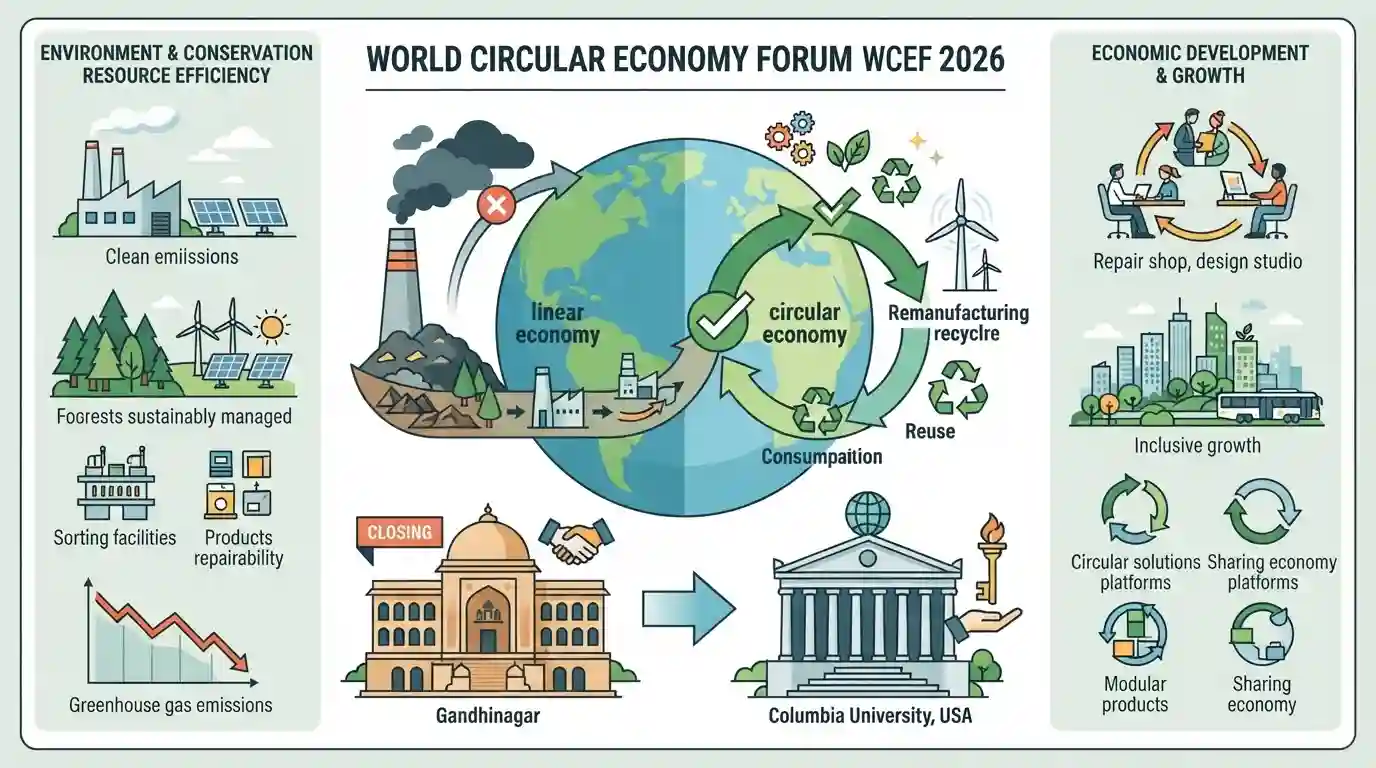
The World Circular Economy Forum (WCEF) 2026 concluded in Gandhinagar, emphasizing the transition from a linear to a circular economy to achieve inclusive growth, resource efficiency, and lower greenhouse gas emissions. It served as a global platform for scalable circular solutions, with Columbia University, USA, named to host WCEF 2027.
মূল বিষয়
- The World Circular Economy Forum (WCEF) 2026 concluded in Gandhinagar, India, focusing on accelerating inclusive and scalable circular economy solutions.
- WCEF 2026 highlighted resource efficiency, sustainable production and consumption patterns, and reduction of greenhouse gas emissions.
- Columbia University, USA, was announced as the host for WCEF 2027.
গুরুত্বপূর্ণ শব্দ
World Circular Economy Forum (WCEF)

A global initiative launched in 2017 by Finland's innovation fund Sitra that brings together global leaders, businesses, and experts to scale up circular economy solutions and resource efficiency.
UPSC context
GS Paper III (Environment, Conservation, and Resource Efficiency). Important for questions on global platforms, sustainable development goals, and circular economy transitions.
Columbia University
A premier US research institution selected to host the World Circular Economy Forum (WCEF) in 2027 following the 2026 edition in Gandhinagar, India.
UPSC context
Prelims/Current Affairs. Highlights global institutional cooperation and academic engagement in international environmental governance and sustainability frameworks.
প্রিলিমস ফাঁদ
WCEF is a legally binding treaty body established under the United Nations Environment Programme (UNEP).
Aspirants often assume WCEF is a statutory UNEP or UNFCCC body because of its global climate focus, whereas it was initiated by Sitra (Finnish Innovation Fund).
সংযুক্ত স্থির ধারণা
What is the difference between a Linear Economy and a Circular Economy?
- Linear Model: Take-make-dispose model based on extraction of finite resources, generating large volumes of unmanaged waste.
- Circular Model: Regenerative system keeping products, components, and materials at their highest utility and value at all times.
- Core Objective: Decouples economic growth from resource consumption through reduce, reuse, recycle, and refurbish strategies.
আন্তঃবিষয় প্যাটার্ন
Circular Economy + LiFE Mission + G20
WCEF discussions directly feed into India's G20 Resource Efficiency Dialogue and Lifestyle for Environment (LiFE) mission, linking multilateral forums with grassroots behavioural nudges.
Critical Minerals + Circular Supply Chains
Transitioning from linear extraction to circular resource use mitigates import dependencies for critical minerals, intersecting industrial policy and net-zero strategies.

Expect statement-based questions on WCEF origins (Sitra/Finland), host country milestones, and core principles of circular models.
সংযুক্ত PYQ · 2
সংযুক্ত PYQ · 2
- 2025MainsGS3
Mineral resources are fundamental to the country's economy and these are exploited by mining. Why is mining considered an environmental hazard? Explain the remedial measures required to reduce the environmental hazard due to mining.
- 2025PrelimsGS1
Consider the following statements : Statement I: Circular economy reduces the emissions of greenhouse gases. Statement II: Circular economy reduces the use of raw materials as inputs. Statement III : Circular economy reduces wastage in the production process. Which one of the following is correct in respect of the above statements?
