CSIR Indigenous Technologies Transfer for Sustainable Manufacturing
Source:PIB ↗
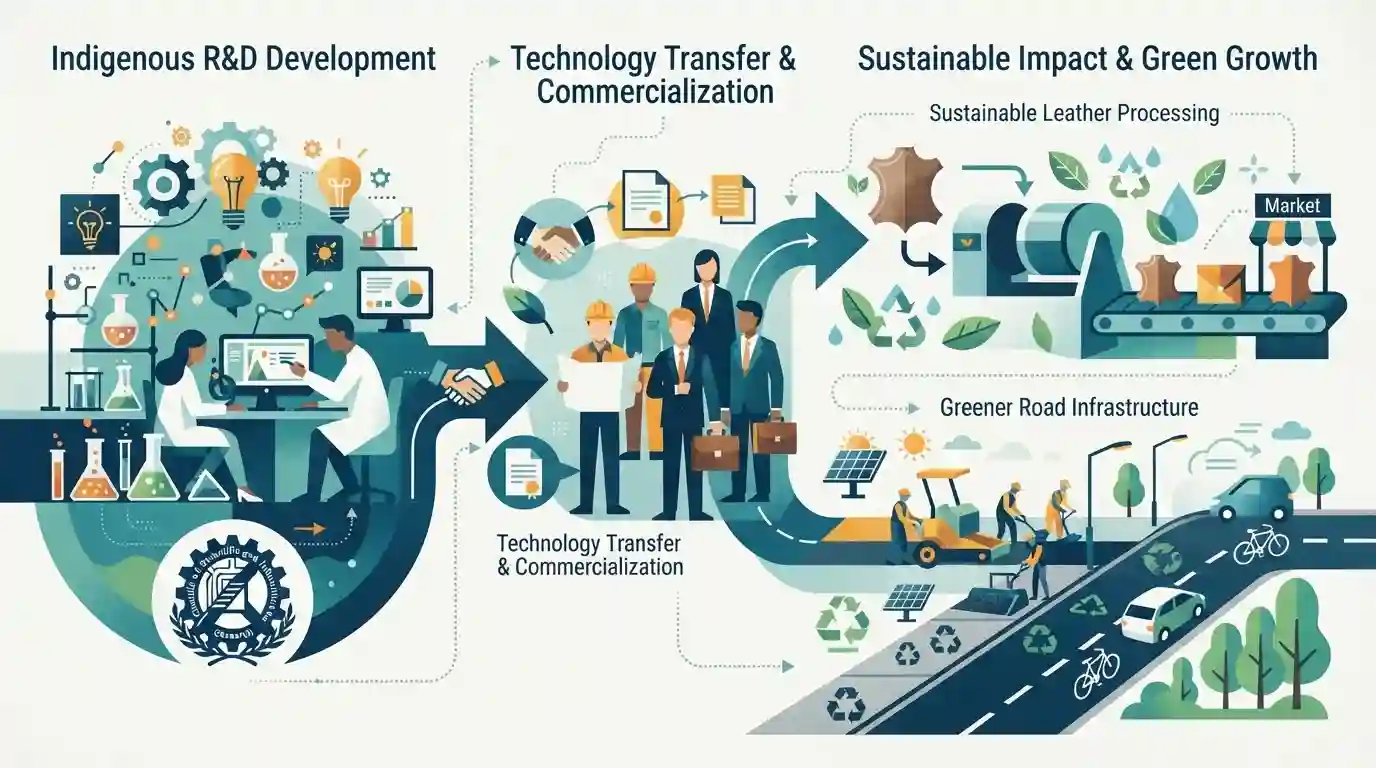
Why It Matters
It illustrates the practical translation of publicly funded laboratory research into commercial industrial applications, supporting India's goals of sustainable manufacturing, green infrastructure, and Atmanirbhar Bharat.
Summary
The Council of Scientific and Industrial Research (CSIR) has transferred indigenous technologies relating to sustainable leather processing and greener road infrastructure to industrial stakeholders, highlighting the role of R&D commercialization in promoting green growth and sustainable development.
Key Points
- The Council of Scientific and Industrial Research (CSIR) transferred key technologies focused on sustainable leather processing and greener, safer road construction to industry partners.
- These technologies aim to promote environmental sustainability, reduce industrial carbon footprints, and enhance resource efficiency in manufacturing and infrastructure development.
- The initiative underscores the importance of public-funded research institutions collaborating with private enterprises for commercialization and translation of lab-scale innovations to field deployment.
Important Terms
Council of Scientific and Industrial Research (CSIR)

India’s premier research and development organization comprising a network of national laboratories, funded by the Ministry of Science and Technology, focusing on diverse scientific and industrial domains.
UPSC context
GS Paper III (Science & Technology - Awareness in IT, Space, Biotech, Nanotechnology, and R&D). Tests knowledge of India's scientific institutions and technology commercialization.
Static Concepts Connected
What is the administrative structure, mandate, and governing role of the Council of Scientific and Industrial Research (CSIR) in India?
- Autonomous body: Established in 1942, CSIR functions as an autonomous body under the Ministry of Science and Technology, Government of India.
- President: The Prime Minister of India serves as the ex-officio President of the CSIR Society.
- Lab network: It operates a nationwide network of 37 national laboratories covering diverse scientific domains from aerospace to biotechnology.
Cross-Topic Patterns
Industrial Decarbonization Meets Urban Infrastructure Waste Management
CSIR's green road technologies (like steel slag utilization) simultaneously address solid waste management challenges under urban governance and highway infrastructure goals.
Green Technologies and Export Competitiveness (CBAM)
Leather sector decarbonization directly affects India's export competitiveness under tightening EU carbon border adjustment mechanisms (CBAM).

CSIR labs (CLRI, CRRI) and their commercialization mandates frequently appear in prelims match-the-following questions.
Linked PYQs · 1
Linked PYQs · 1
- 2015MainsGS3
What are the areas of prohibitive labour that can be sustainably managed by robots ? Discuss the initiatives that can propel research in premier research institutes for substantive and gainful innovation.
