Kishau Multipurpose Project Agreement Signed for Water Management
Source:PIB ↗
આ શા માટે મહત્વનું છે
The signing of the Kishau Multipurpose Project agreement by multiple states highlights the significance of cooperative federalism, consensus-building, and coordinated water resource management in resolving complex inter-state infrastructure and resource-sharing challenges.
સારાંશ
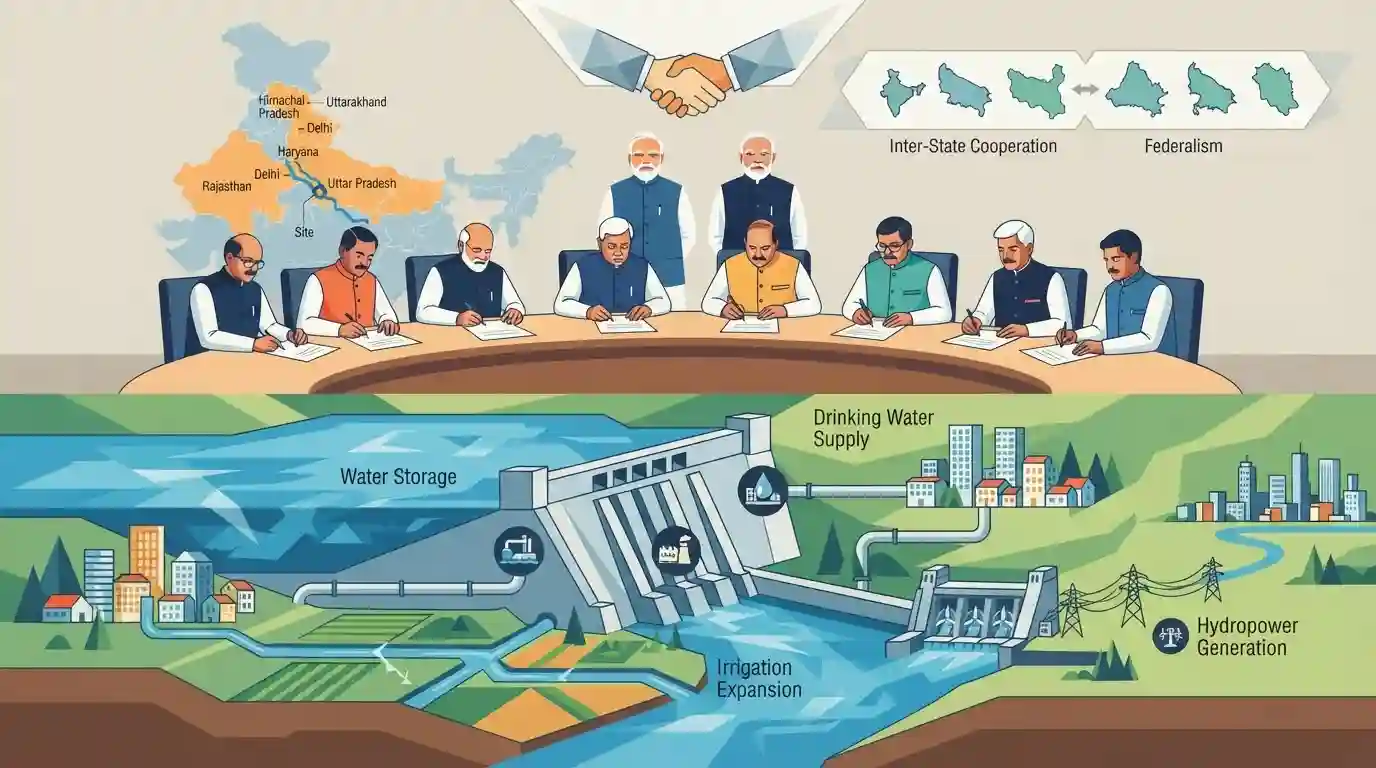
The agreement for the Kishau Multipurpose Project was signed by the Chief Ministers of Uttar Pradesh, Uttarakhand, Himachal Pradesh, Rajasthan, Delhi, and Haryana in New Delhi, in the presence of Union Home Minister Amit Shah and Jal Shakti Minister C. R. Patil. The multipurpose project is designed to optimize water storage, supply drinking water, expand irrigation capacity, and generate hydropower, showcasing cooperative federalism among riparian and beneficiary states.
મુખ્ય મુદ્દા
- Chief Ministers of Uttar Pradesh, Uttarakhand, Himachal Pradesh, Rajasthan, Delhi, and Haryana signed the Kishau Multipurpose Project agreement in the presence of Union Home Minister and Minister of Cooperation Shri Amit Shah and Union Jal Shakti Minister Shri C. R. Patil.
- The project aims to enhance water resource management, boost irrigation, and generate hydropower across multiple northern states.
- Demonstrates an instance of cooperative federalism and inter-state consensus building facilitated by the central government for large-scale infrastructure projects.
મહત્વપૂર્ણ શબ્દો
Kishau Multipurpose Project agreement

A major infrastructure initiative on the Tons river (Yamuna tributary) involving six riparian states to regulate water storage, supply drinking water, expand irrigation, and generate hydropower.
UPSC context
UPSC Mains GS Paper III: Infrastructure, Water Resource Management, and Inter-State River Water Disputes.
Ministry of Jal Shakti
The nodal central ministry responsible for formulating policies and guidelines for India's water resources development, river rejuvenation, and drinking water sanitation.
UPSC context
UPSC Mains GS Paper II/III: Government policies and interventions for water governance and infrastructure management.
Ministry of Home Affairs and Cooperation
Central government departments overseeing internal security, centre-state relations, and the promotion of cooperative federalism and grassroots cooperative societies.
UPSC context
UPSC Mains GS Paper II: Polity and Governance, Federalism, and Centre-State administrative cooperation.
સંલગ્ન સ્થિર ખ્યાલો
What are the constitutional and statutory provisions for handling inter-state water disputes in India?
- Constitutional Provision: Article 262 empowers Parliament to provide for the adjudication of any dispute or complaint with respect to the use, distribution, or control of waters of any inter-state river or river valley.
- Statutory Backing: Parliament enacted the Inter-State River Water Disputes (ISRWD) Act, 1956, and the River Boards Act, 1956, to manage such disputes and planning.
- Judicial Bar: Supreme Court jurisdiction is barred under Article 262 in respect of any dispute relating to waters referred to tribunals under the ISRWD Act.
What is the financial and administrative significance of 'National Project' status in water resources?
- Funding Pattern: Projects located on trans-state rivers that meet specific criteria receive 90% funding from the Central Government and 10% from beneficiary states.
- Core Objective: Aimed at expediting irrigation potential and drinking water supply projects of national importance that were languishing due to state financial constraints.
આંતર-વિષય પેટર્ન
Inter-State Water Disputes vs Cooperative Federalism
Inter-state water disputes under Article 262 often face federal friction; cooperative consensus on trans-state projects like Kishau highlights changing dynamics in cooperative federalism.
National Projects & Centrally Sponsored Infrastructure Financing
National Project funding models (90:10 Centre-State splits) are increasingly used to accelerate critical infrastructure in trans-Himalayan and Yamuna basin states.

Inter-state river projects with multi-state beneficiaries and 'National Project' status are high-yield for UPSC prelims matching & statements.
સંલગ્ન PYQ · 2
સંલગ્ન PYQ · 2
- 2015MainsGS2
The concept of cooperative federalism has been increasingly emphasized in recent years. Highlight the drawbacks in the existing structure and the extent to which cooperative federalism would answer the shortcomings.
- 2020MainsGS3
Suggest measures to improve water storage and irrigation system to make its judicious use under depleting scenario.
