Ayurveda Integration and Global Evidence in Public Health Policy
Source:PIB ↗
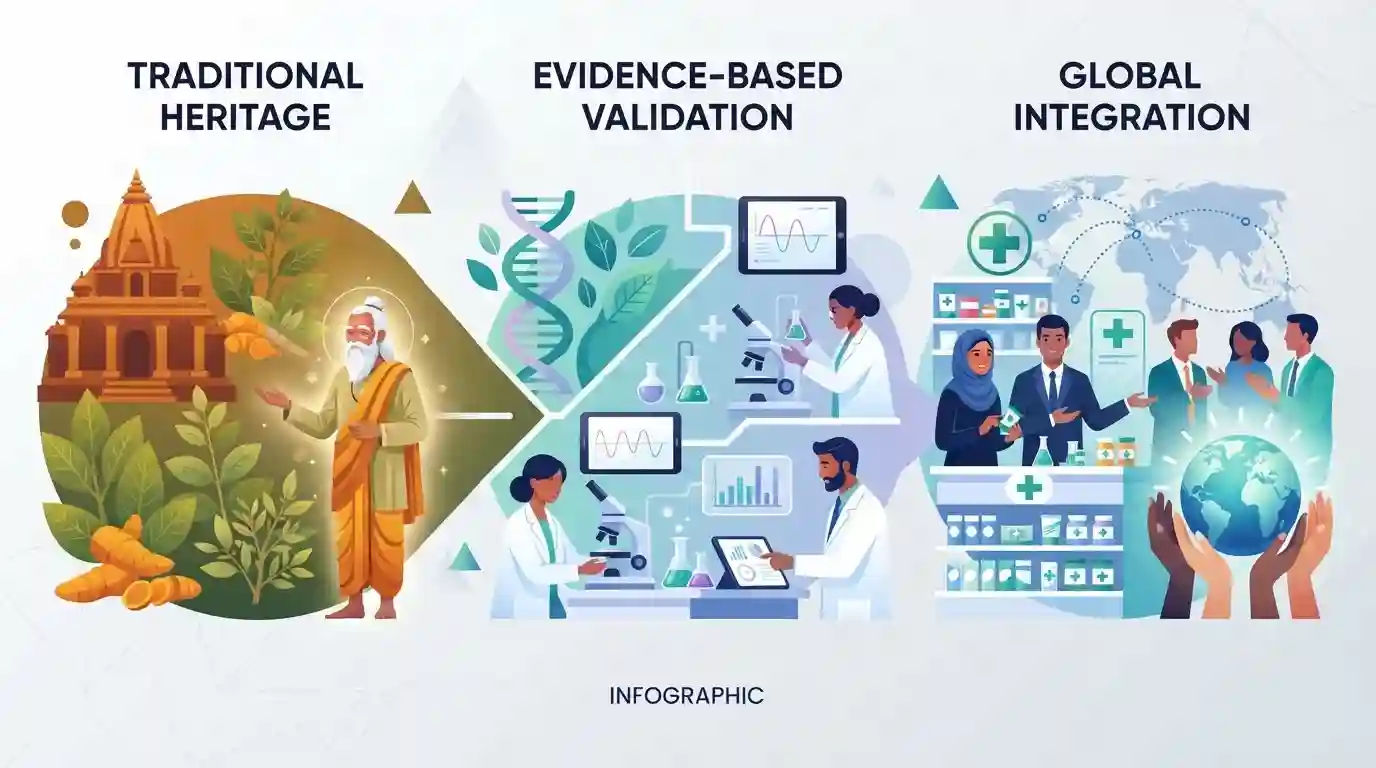
Why It Matters
Crucial for understanding India's soft power, public health policy, and the integration of traditional systems into modern healthcare frameworks.
Summary
The article discusses the evolving role of Ayurveda at the crossroads of traditional heritage, modern evidence-based validation, and global public health. It highlights the importance of scientific research, standardisation, and global integration to make traditional healthcare systems more accessible and trusted worldwide.
Key Points
- Ayurveda is increasingly positioned at the intersection of traditional wisdom, modern scientific validation, and global public health frameworks.
- Integrating traditional systems like Ayurveda requires robust clinical evidence, standardisation, and global regulatory harmonisation.
- Global health initiatives increasingly recognise traditional and complementary medicine for preventive care and holistic wellness.
Important Terms
Ministry of Ayush

The Government of India ministry responsible for developing, standardising, and promoting research in Ayurveda, Yoga and Naturopathy, Unani, Siddha, and Homoeopathy.
UPSC context
UPSC Paper II (Health Policy and Governance) and Paper III (Science & Technology): tests institutional frameworks for traditional medicine integration and standardisation.
World Health Organization (WHO)
The specialized United Nations agency for international public health that develops global standards, strategies, and evidence-based frameworks for traditional, complementary, and integrative medicine.
UPSC context
UPSC Paper II (International Relations & Global Health): evaluates global health governance, multilateral health standardisation, and international initiatives in traditional healthcare.
Prelims Trap
The WHO Global Centre for Traditional Medicine serves as a statutory regulatory and licensing authority for traditional drugs globally.
Aspirants often assume the WHO GCTM in Jamnagar is a regional regulatory body rather than a global knowledge and research centre.
Static Concepts Connected
What are the institutional pillars and global initiatives supporting Traditional Medicine in India?
- WHO GCTM: The WHO Global Centre for Traditional Medicine (GCTM) is established in Jamnagar, Gujarat, as a global knowledge hub for traditional medicine.
- TKDL Protection: Traditional Knowledge Digital Library (TKDL) protects Indian systems from bio-piracy by documenting formulations in international patent languages.
- NMPB Mandate: National Medicinal Plants Board (NMPB) promotes conservation, sustainable harvest, and cultivation of medicinal plants used in Ayurveda.
Cross-Topic Patterns
Traditional Medicine & Health Diplomacy
The WHO Global Centre for Traditional Medicine in Jamnagar tests India's diplomatic capacity to anchor multilateral standard-setting in South-South cooperation.
Ayurveda Validation & IP Rights
Shifting from anecdotal heritage to randomized controlled trials connects traditional knowledge protection (Biodiversity Act/TKDL) with modern patent law and global pharmaceutical standards.

WHO GCTM Jamnagar + Ayurveda standardisation likely to appear as a statement-based prelims question on global health hubs.
Linked PYQs · 3
Linked PYQs · 3
- 2023PrelimsGS1
Consider the following statements: Statement-I: India's public sector health care system largely focuses on curative care with limited preventive, promotive and rehabilitative care. Statement-II: Under India's decentralized approach to health care delivery, the States are primarily responsible for organizing health services. Which one of the following is correct in respect of the above statements?
- 2020MainsGS2
In order to enhance the prospects of social development, sound and adequate health care policies are needed particularly in the fields of geriatric and maternal health care. Discuss.
- 2024MainsGS2
In a crucial domain like the public healthcare system the Indian State should play a vital role to contain the adverse impact of marketisation of the system. Suggest some measures through which the State can enhance the reach of public healthcare at the grassroots level.
