Great Indian Bustard Conservation and Project Cheetah Progress
Source:PIB ↗
Why It Matters
The article highlights critical species recovery and habitat restoration programs for critically endangered species like the Great Indian Bustard and landscape-level initiatives like Project Cheetah, aligning directly with UPSC GS3 syllabus requirements on biodiversity and wildlife conservation.
Summary
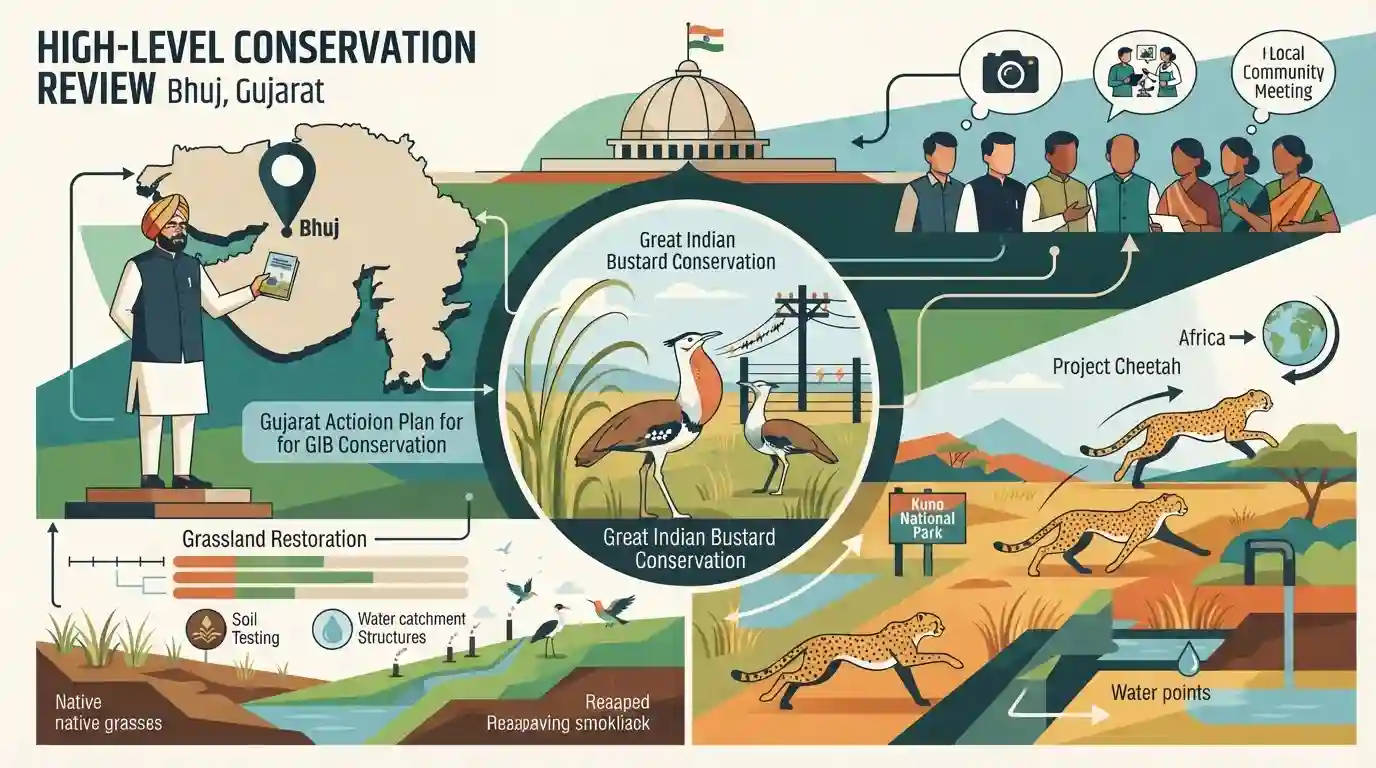
Union Environment Minister Bhupender Yadav reviewed wildlife conservation initiatives, including Great Indian Bustard (GIB) conservation, grassland restoration, and Project Cheetah, in Bhuj, Gujarat, alongside releasing the Gujarat Action Plan for GIB Conservation.
Key Points
- Union Environment Minister Shri Bhupender Yadav reviewed the progress of Great Indian Bustard (GIB) conservation, grassland restoration, and Project Cheetah during a meeting in Bhuj, Gujarat.
- The Gujarat Action Plan for GIB Conservation was officially released to strategize habitat protection and species recovery.
- Discussions emphasized the integration of grassland restoration with wildlife reintroduction programs, reflecting comprehensive biodiversity management in arid and semi-arid landscapes.
Important Terms
Project Cheetah

India's ambitious initiative for the intercontinental translocation and reintroduction of cheetahs into the wild, primarily at Kuno National Park, following their extinction in 1952.
UPSC context
UPSC Prelims/Mains (GS Paper III): Biodiversity, species reintroduction, and wildlife conservation management in India.
Gujarat Action Plan for GIB Conservation
A science-based roadmap released to secure safe habitats and establish a viable population of the critically endangered Great Indian Bustard in Gujarat.
UPSC context
UPSC Prelims/Mains (GS Paper III): State-level environmental policies, critically endangered species protection, and habitat restoration strategies.
Great Indian Bustard Conservation Programme
A species recovery program aimed at breeding and protecting the critically endangered Great Indian Bustard through habitat restoration, predator-proof fencing, and captive breeding.
UPSC context
UPSC Prelims/Mains (GS Paper III): Environmental conservation, endangered species management, and wildlife protection acts.
Ministry of Environment, Forest and Climate Change
The nodal apex ministry in the central government responsible for planning, promoting, and coordinating environmental and forestry policies and wildlife conservation programs across India.
UPSC context
UPSC Prelims/Mains (GS Paper II/III): Institutional framework for environmental governance and national policy formulation.
Static Concepts Connected
What are the key statutory bodies and legal protections for endangered species like the Great Indian Bustard in India?
- Schedule I Protection: Wildlife Act: The Great Indian Bustard is protected under Schedule I of the Wildlife (Protection) Act, 1972, affording it the highest level of legal protection against hunting and trade.
- IUCN Status: IUCN Status: Classified as Critically Endangered on the IUCN Red List, primarily due to habitat loss from agricultural expansion and mortality from overhead power transmission lines.
- Statutory Oversight: NTCA Oversight: Project Cheetah is overseen by the National Tiger Conservation Authority (NTCA), a statutory body established under the Wildlife (Protection) Amendment Act, 2002.
Cross-Topic Patterns
Grasslands as 'Wastelands' vs. Biodiversity Hotspots
Grassland ecosystems are often misclassified as 'wastelands' in official revenue records, undermining conservation efforts for species like the Great Indian Bustard under both environmental and economic policy frameworks.
Project Cheetah and Trans-state Wildlife Corridors
India's reintroduction of cheetahs and bustard conservation efforts highlight how flagship species recovery requires large-scale habitat restoration across multiple states, linking wildlife protection with land-use planning.

GIB IUCN status (Critically Endangered), Schedule I WPA status, and Project Cheetah statutory oversight are high-yield prelims traps.
Linked PYQs · 1
Linked PYQs · 1
- 2020PrelimsGS1
With reference to India's Desert National Park, which of the following statements are correct? 1. It is spread over two districts. 2. There is no human habitation inside the Park. 3. It is one of the natural habitats of Great Indian Bustard. Select the correct answer using the code given below:
