Lumpy Skin Disease Control Measures and Vaccination Review
Source:PIB ↗
ఇది ఎందుకు ముఖ్యం
Lumpy Skin Disease poses a severe threat to livestock health and rural livelihoods in India. Reviewing containment strategies, vaccination, and coordination highlights institutional preparedness and policy measures required to secure the livestock economy.
సారాంశం
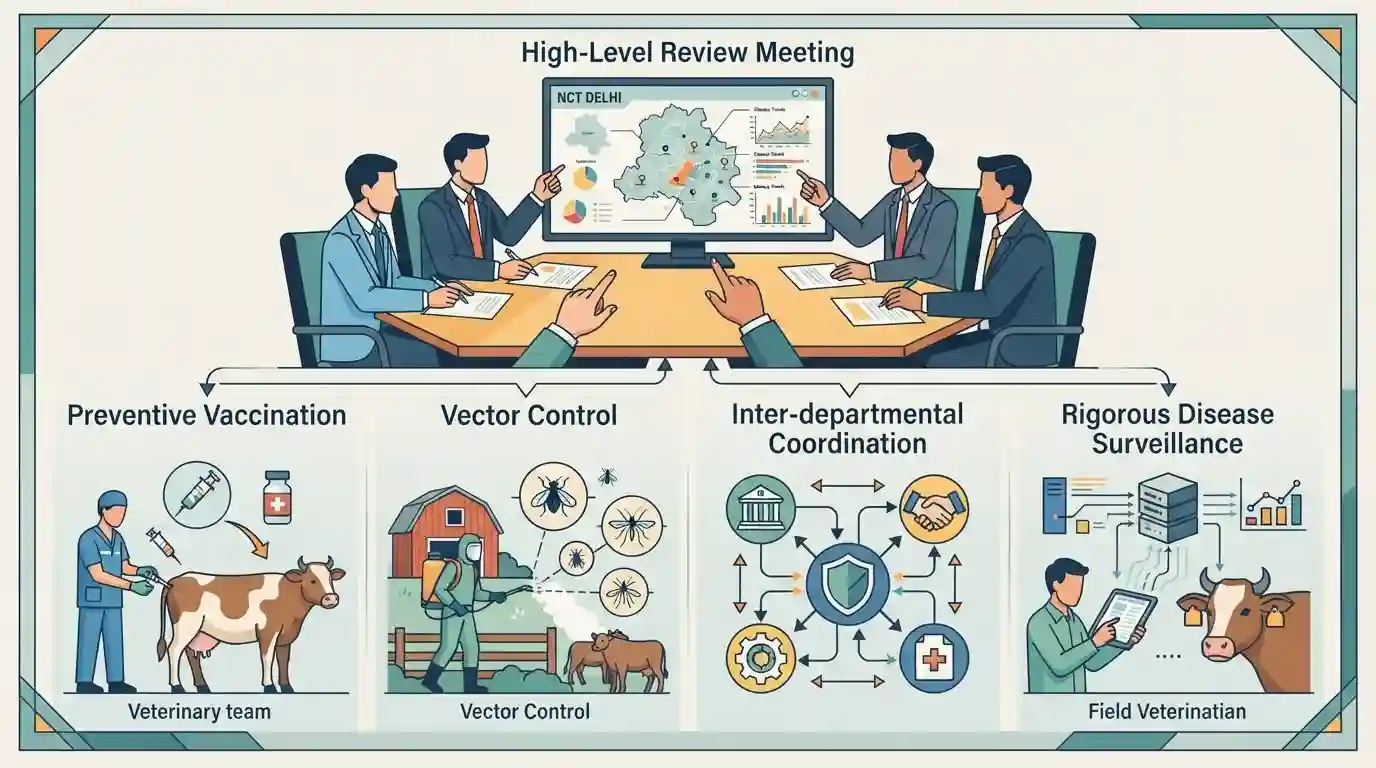
The Department of Animal Husbandry and Dairying (DAHD) held a high-level review meeting to assess the Lumpy Skin Disease (LSD) situation in NCT Delhi, focusing on preventive vaccination, vector control, inter-departmental coordination, and rigorous disease surveillance to protect livestock and farmers' livelihoods.
ముఖ్య అంశాలు
- The Department of Animal Husbandry and Dairying (DAHD) reviewed the Lumpy Skin Disease (LSD) situation in NCT Delhi.
- Emphasised robust coordinated vaccination campaigns, vector control, movement restrictions, and biosecurity measures.
- LSD is a viral disease affecting cattle and buffaloes, causing economic loss through reduced milk yield, weight loss, and hide damage, transmitted primarily by blood-feeding vectors.
- Stressed active surveillance and inter-departmental collaboration between municipal and state veterinary authorities.
ముఖ్యమైన పదాలు
Livestock Health and Disease Control Programme

A centrally sponsored program under the Ministry of Fisheries, Animal Husbandry and Dairying aimed at controlling animal diseases like FMD and Lumpy Skin Disease through vaccination, surveillance, and veterinary infrastructure.
UPSC context
UPSC GS Paper III (Agriculture / Animal Husbandry): Important Government schemes, livestock health, and disease management in India.
Department of Animal Husbandry and Dairying (DAHD)
The central department under the Ministry of Fisheries, Animal Husbandry and Dairying responsible for formulating policies to develop livestock, dairy sectors, and manage animal health.
UPSC context
UPSC GS Paper III (Agriculture / Institutional Governance): Mandate and functioning of key central ministries and animal welfare departments.
Lumpy Skin Disease (LSD)
A transboundary viral disease affecting cattle and buffaloes, characterized by fever, skin nodules, and reduced milk yield, transmitted primarily by blood-feeding insects.
UPSC context
UPSC GS Paper III (Science & Technology / Agriculture): Animal diseases, biosecurity, viral outbreaks, and impacts on rural livelihoods.
ప్రిలిమ్స్ ఉచ్చు
Lumpy Skin Disease is a zoonotic viral infection that poses direct public health risks through the consumption of infected milk or meat.
Aspirants often assume animal viral diseases causing severe economic losses are zoonotic and transmissible to humans via milk or meat. LSD is strictly non-zoonotic.
అనుసంధానమైన స్థిర భావనలు
What are the key features and transmission vectors of Lumpy Skin Disease (LSD)?
- Viral Agent: Capripoxvirus genus causes LSD, specifically affecting cattle and water buffaloes.
- Vector Transmission: Mosquitoes, biting flies, and ticks act as mechanical vectors for blood-borne transmission.
- Zoonotic Status: LSD is completely non-zoonotic and does not transmit to humans via milk or meat consumption.
- Susceptibility: Exotic and cross-bred cattle are significantly more susceptible than indigenous Indian cattle breeds.
అంతర-అంశ నమూనాలు
Animal Diseases & Rural Livelihood Security
LSD outbreaks impact rural agrarian economies and milk cooperatives, creating fiscal stress that intersects with rural livelihood security under poverty alleviation schemes.
Veterinary Health & Public Health Convergence
Preventive vaccination campaigns and vector control mirror public health mosquito-borne disease management frameworks (like National Vector Borne Disease Control Programme).

LSD transmission vectors, non-zoonotic nature, and susceptibility differentials (exotic vs. indigenous) suit statement-based Prelims MCQs.
అనుసంధాన PYQలు · 2
అనుసంధాన PYQలు · 2
- 2012PrelimsGS1
Vultures which used to be very common in Indian countryside some years ago are rarely seen nowadays. This is attributed to
- 2015MainsGS3
Livestock rearing has a big potential for providing non-farm employment and income in rural areas. Discuss suggesting suitable measures to promote this sector in India.
