India China Bilateral Meeting on Border Peace during BRICS Summit
Source:PIB ↗
આ શા માટે મહત્વનું છે
The high-level engagement between India and China shapes regional stability, trade dynamics, and strategic security in South Asia and the broader Indo-Pacific, making it a core topic for international relations under GS Paper II.
સારાંશ
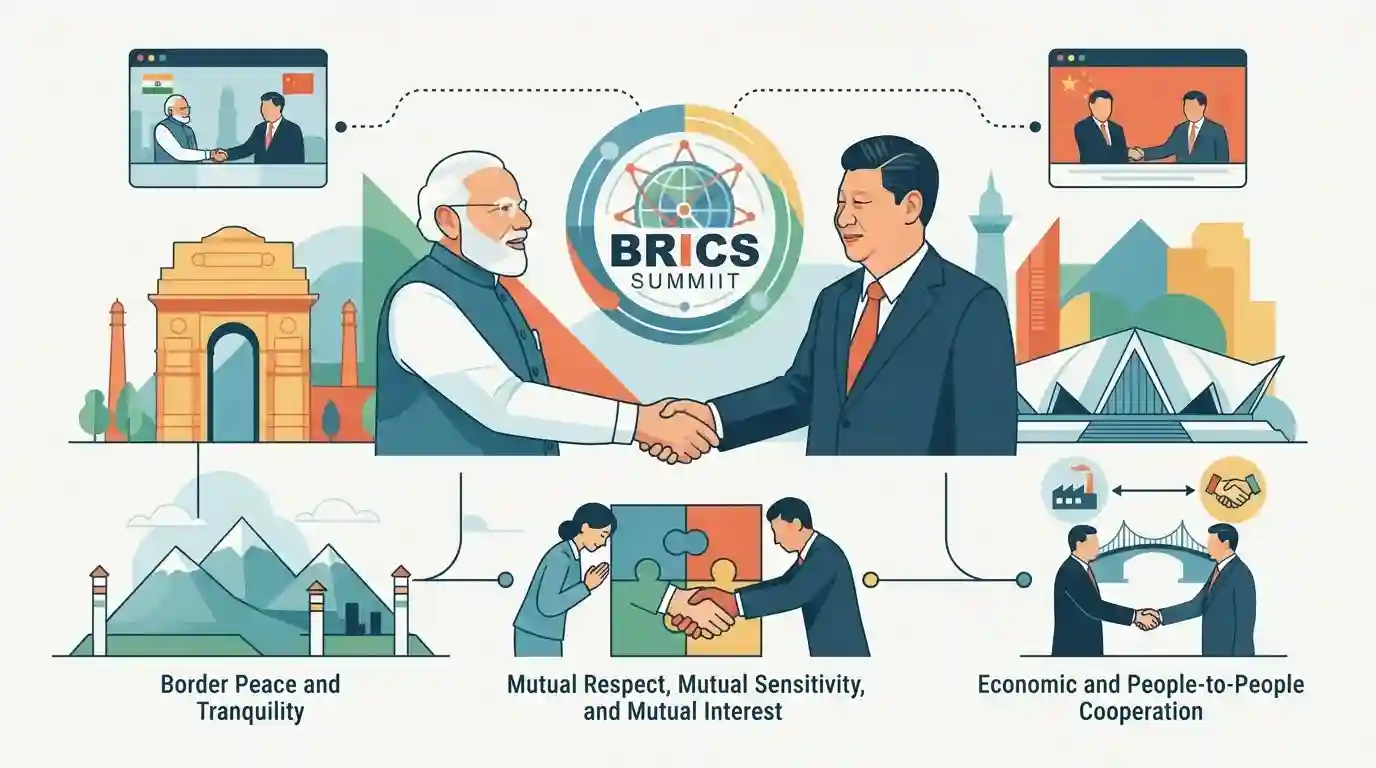
Prime Minister Narendra Modi met Chinese President Xi Jinping during the BRICS Summit in New Delhi. The leaders reviewed bilateral progress since their Tianjin meeting, reaffirming that border peace and tranquility are critical for stable India-China relations. They emphasized managing differences without letting them escalate into disputes, guided by mutual respect, mutual sensitivity, and mutual interest, alongside enhancing economic and people-to-people cooperation.
મુખ્ય મુદ્દા
- Prime Minister Narendra Modi and Chinese President Xi Jinping held a bilateral meeting on the sidelines of the BRICS Summit in New Delhi.
- PM Modi emphasized that peace and tranquility in the border areas are fundamental for the normalization and development of bilateral ties.
- Both leaders agreed that bilateral relations should be guided by 'three mutuals': mutual respect, mutual sensitivity, and mutual interest.
- Discussions covered expanding economic cooperation, addressing trade imbalances, resuming direct flights, and easing visa facilitation to boost people-to-people exchanges.
મહત્વપૂર્ણ શબ્દો
BRICS

An intergovernmental economic and geopolitical grouping of major emerging economies, originally comprising Brazil, Russia, India, China, and South Africa, which aims to promote multilateral cooperation and reform global financial governance.
UPSC context
UPSC Mains Paper II: Important International institutions, agencies and fora - their mandate, structure, and relevance for India's foreign policy objectives.
Shanghai Cooperation Organisation
A permanent Eurasian political, economic, and security alliance focused on regional stability, counter-terrorism, and trade cooperation among member states including India, China, Russia, and Central Asian nations.
UPSC context
UPSC Mains Paper II: Bilateral, regional and global groupings and agreements involving India and/or affecting India's strategic and geopolitical interests.
પ્રિલિમ્સ ટ્રેપ
border peace and tranquility indicate a final settlement of the boundary dispute
Aspirants often assume a formal boundary settlement or a permanent resolution has been reached, whereas leaders only reaffirm the need for peace and tranquility as a prerequisite for normalization.
સંલગ્ન સ્થિર ખ્યાલો
What are the key institutional mechanisms and diplomatic milestones in modern India-China relations?
- Special Representatives Talks: Established in 2003 as a dialogue mechanism between Special Representatives to resolve the boundary question.
- Informal Summits: Informal summits (Wuhan 2018, Mamallapuram 2019) designed for unscripted strategic communication at the highest political level.
- BPA Agreements: A series of pacts (1993, 1996, 2005, 2013) aimed at maintaining peace and tranquility along the Line of Actual Control.
આંતર-વિષય પેટર્ન
BRICS Diplomacy + Border Security Interdependence
India-China border diplomacy runs parallel to multilateral engagements in BRICS and SCO, testing strategic autonomy alongside economic interdependence in global platforms.

India-China 'three mutuals' and border stability mechanics frequently appear in multi-statement IR questions testing bilateral agreements.
સંલગ્ન PYQ · 2
સંલગ્ન PYQ · 2
- 2014MainsGS2
With respect to the South China sea, maritime territorial disputes and rising tension affirm the need for safeguarding maritime security to ensure freedom of navigation and over flight throughout the region. In this context, discuss the bilateral issues between India and China.
- 2012MainsGS2
Do you think that China's emergence as one of the largest trading partners of India has adversely affected the settlement of the outstanding border problem?
