National Conference on Construction Workers Welfare and Skilling
Source:PIB ↗
हे का महत्त्वाचे आहे
Construction workers constitute a major share of India's informal and vulnerable workforce. Strengthening the BOCW framework is critical for ensuring inclusive growth, social security, occupational safety, and better livelihoods for millions.
सारांश
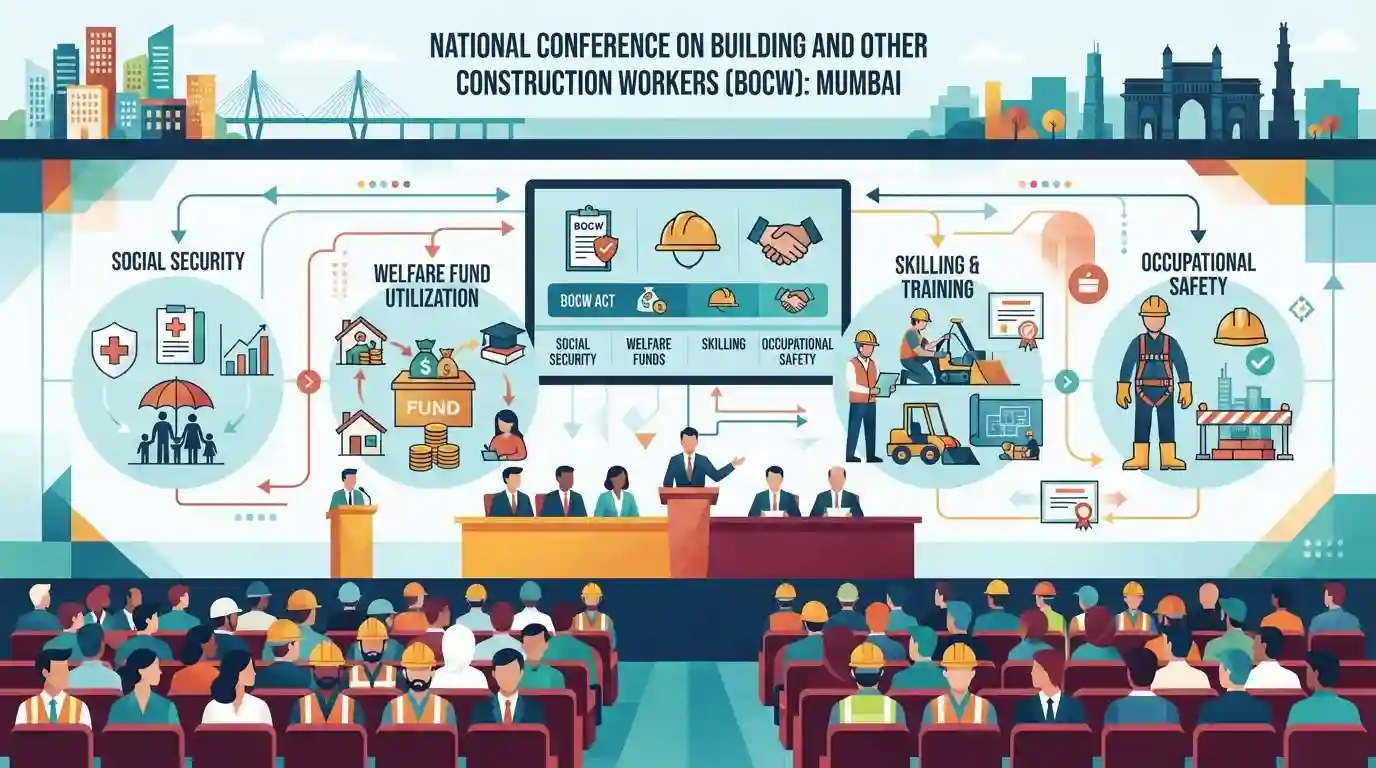
The National Conference on Building and Other Construction Workers (BOCW) concluded in Mumbai, bringing together key stakeholders to deliberate on improving social security, welfare fund utilization, skilling, and occupational safety for millions of construction workers across India.
मुख्य मुद्दे
- The National Conference on Building and Other Construction Workers (BOCW) concluded in Mumbai, focusing on bolstering the welfare and skilling ecosystem for construction workers in India.
- Discussions centered on better implementation of the BOCW Act, enhancing social security benefits, and integrating welfare funds with national databases like the e-Shram portal.
- Emphasis was placed on upskilling and reskilling construction workforce to match modern construction technology and safety standards.
- Collaborative efforts between states and the central government were stressed to ensure seamless portability of welfare benefits across state boundaries.
महत्त्वाच्या संज्ञा
Building and Other Construction Workers (BOCW) Act

A 1996 central legislation regulating employment, working conditions, safety, and health of construction workers, funded via a cess on construction projects managed by State Welfare Boards.
UPSC context
UPSC GS Paper II & III: Social sector welfare, labour rights, vulnerable sections, and implementation of statutory labour reforms in India.
e-Shram portal
A comprehensive national database launched by the Ministry of Labour and Employment to register unorganized workers and seamlessly deliver social security benefits.
UPSC context
UPSC GS Paper III: Inclusive growth, digital governance initiatives, and social security frameworks for the unorganized labour workforce.
Ministry of Labour and Employment
The central government ministry responsible for formulating labour policies, enforcing labour laws, and protecting the welfare of workers in the organized and unorganized sectors.
UPSC context
UPSC GS Paper II: Institutional framework, governance, and policy implementation related to employment and social welfare in India.
पूर्वपरीक्षा सापळा
the cess on construction projects is levied and collected directly by the Ministry of Labour and Employment.
Aspirants often assume the cess under the BOCW Act is collected by the Central Government, whereas it is levied and collected by respective State Governments/UTs through State Welfare Boards.
संबंधित स्थिर संकल्पना
What are the key financing and operational mechanisms under the BOCW Act, 1996?
- Cess Collection: Cess Levy: Levied at 1% to 2% of the cost of construction incurred by an employer, as mandated by the BOCW Welfare Cess Act.
- Welfare Boards: State Boards: Managed by State Building and Other Construction Workers Welfare Boards to provide accident, medical, and educational benefits.
- Worker Criteria: Eligibility: Applicable to workers aged 18 to 60 who have completed at least 90 days of building or other construction work in a year.
आंतर-विषय नमुने
Labour Welfare + Inter-state Migrant Portability
Migrant construction workers face hurdles accessing welfare benefits across state borders, directly linking labour welfare to federal cooperative mechanisms and the One Nation, One Card framework.
Labour Codes + Federal Fiscal Architecture
The transition of legacy labour acts into the Code on Social Security, 2020 demonstrates how federal consolidation attempts to resolve implementation bottlenecks in state-level cess funds.

BOCW cess utilization rates and e-Shram integration are prime candidates for a matching or multi-statement prelims question.
संबंधित PYQ · 2
संबंधित PYQ · 2
- 2023MainsGS3
Most of the unemployment in India is structural in nature. Examine the methodology adopted to compute unemployment in the country and suggest improvements.
- 2021PrelimsGS1
With reference to casual workers employed in India, consider the following statements : 1. All casual workers are entitled for Employees Provident Fund coverage. 2. All casual workers are entitled for regular working hours and overtime payment. 3. The government can by a notification specify that an establishment or industry shall pay wages only through its bank account. Which of the above statements are correct?
