NSKFDC Concessional Finance for Sanitation Workers Empowerment
Source:PIB ↗
Why It Matters
This topic is critical for understanding inclusive growth, social justice, and state welfare interventions targeted at vulnerable and historically marginalized communities such as sanitation workers.
Summary
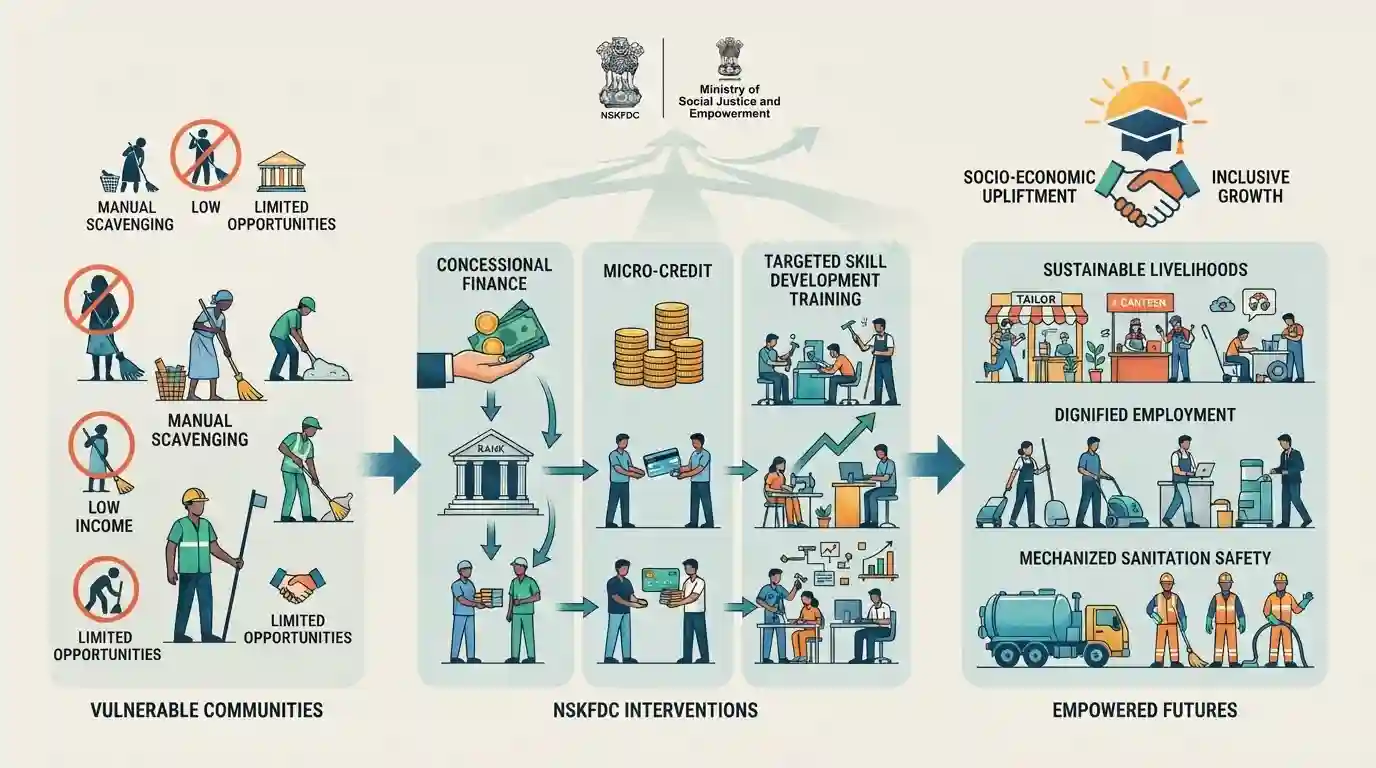
The National Safai Karamcharis Finance and Development Corporation (NSKFDC) under the Ministry of Social Justice and Empowerment continues to advance the socio-economic empowerment of sanitation workers and their dependents. By offering concessional finance, micro-credit, and targeted skill development training, NSKFDC helps transition vulnerable communities toward sustainable livelihoods, dignified employment, and mechanized sanitation safety, aligning with national welfare goals.
Key Points
- NSKFDC is playing a pivotal role in uplifting sanitation workers and their dependents through concessional financing and targeted skill development programs.
- Efforts are aligned with moving away from hazardous manual scavenging towards mechanized and safe sanitation (e.g., via the NAMASTE scheme).
- Financial assistance is provided at subsidized interest rates for education, self-employment ventures, and professional upgrading.
- Skill development initiatives aim to provide alternative livelihood options and dignified employment opportunities to marginalized communities.
Important Terms
National Safai Karamcharis Finance and Development Corporation (NSKFDC)

A Government of India undertaking under the Ministry of Social Justice and Empowerment providing concessional finance, micro-credit, and skill development to uplift sanitation workers and manual scavengers.
UPSC context
GS Paper II (Social Justice/Vulnerable Sections): Tests institutional mechanisms, welfare financing, and government corporations for marginalized communities.
National Action for Mechanised Sanitation Ecosystem (NAMASTE)
A joint initiative by the Ministry of Social Justice and Empowerment and the Ministry of Housing and Urban Affairs aimed at zero fatalities in sanitation work and transitioning workers to mechanized cleaning.
UPSC context
GS Paper II (Welfare Schemes/Urban Governance): Tests government interventions for eradicating hazardous manual scavenging and ensuring worker safety.
Ministry of Social Justice and Empowerment
The nodal ministry responsible for formulating and implementing policies, welfare schemes, and institutional support for marginalized, vulnerable, and socially disadvantaged groups in India.
UPSC context
GS Paper II (Governance/Social Justice): Tests understanding of government ministries overseeing inclusive growth and affirmative action.
Static Concepts Connected
What is the mandate and institutional status of the National Safai Karamcharis Finance and Development Corporation (NSKFDC)?
- Status & Ministry: It is a fully owned Government of India undertaking under the Ministry of Social Justice and Empowerment, incorporated in 1997.
- Apex Financing: It acts as an apex institution for extending concessional finance and micro-credit to sanitation workers, ragpickers, and their dependents.
- Mechanization Drive: It actively funds the transition from hazardous manual scavenging to safe, mechanized cleaning through schemes like Swachhta Udyami Yojana.
Cross-Topic Patterns
Welfare Finance + Occupational Safety Integration
NSKFDC financing works alongside the PM-DAKSH and NAMASTE schemes to institutionalize dignity and occupational safety for manual scavenging communities.

NSKFDC mandate, NAMASTE scheme objectives, and apex corporation financing channels are prime targets for matching statements.
Linked PYQs · 2
Linked PYQs · 2
- 2017MainsGS2
To ensure effective implementation of policies addressing water, sanitation and hygiene needs the identification of the beneficiary segments is to be synchronized with the anticipated outcomes." Examine the statement in the context of the WASH scheme.
- 2020PrelimsGS1
Which part of the Constitution of India declares the ideal of Welfare State?
