Biosimilars Regulation and Biopharma Vision in India
Source:PIB ↗
ఇది ఎందుకు ముఖ్యం
Biosimilars represent the future of advanced medicine and therapeutics. Ensuring stringent quality control and regulatory oversight while scaling up indigenous manufacturing is critical for India's public health goals and its ambition to become a global biopharma hub.
సారాంశం
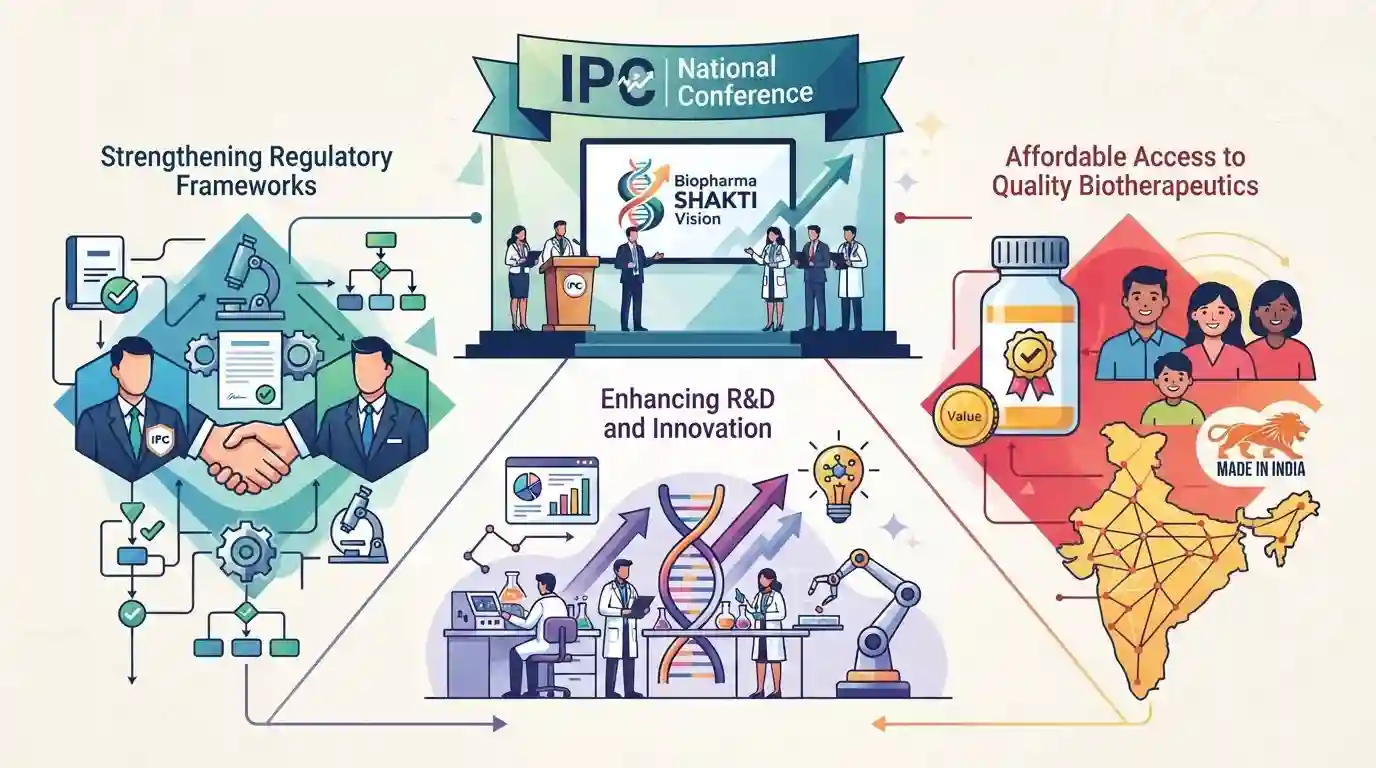
The Indian Pharmacopoeia Commission (IPC) hosted a National Conference on the Quality and Safety of Biosimilars under the Biopharma SHAKTI Vision. The event highlighted India's strategic push to strengthen regulatory frameworks, enhance R&D, and ensure affordable access to high-quality biotherapeutics and biosimilars.
ముఖ్య అంశాలు
- The Indian Pharmacopoeia Commission (IPC) organized a National Conference focusing on the quality, safety, and efficacy of biosimilars.
- The initiative aligns with India's Biopharma SHAKTI Vision to boost indigenous biopharmaceutical research, manufacturing, and regulatory standards.
- Emphasis was laid on robust clinical evaluation, post-market surveillance, and affordability of life-saving biological medicines.
- Collaboration between academia, industry, and regulators is underlined to position India as a global hub for quality biotherapeutics.
ముఖ్యమైన పదాలు
Biopharma SHAKTI Vision

A strategic government vision aimed at accelerating India's biopharmaceutical sector by fostering domestic R&D, regulatory alignment, quality assurance, and affordable global access to biosimilars and biotherapeutics.
UPSC context
GS Paper III (S&T / Biotechnology) & GS Paper II (Health); tests India's industrial growth, self-reliance (Atmanirbhar Bharat), and biopharma policy initiatives.
Indian Pharmacopoeia Commission (IPC)
An autonomous institution under the Ministry of Health and Family Welfare responsible for setting official standards of quality, purity, and strength for drugs, pharmaceuticals, and health products sold in India.
UPSC context
GS Paper II (Governance / Health) & GS Paper III (S&T); tests statutory drug regulation, standard-setting, and public health governance in India.
Ministry of Health and Family Welfare
The central government ministry responsible for policy formulation, funding, and regulation of public health infrastructure, medical education, and pharmaceutical standard-setting bodies like the IPC in India.
UPSC context
GS Paper II (Governance and Social Sector Schemes); tests administrative framework, healthcare delivery, and regulatory oversight of pharmaceuticals.
ప్రిలిమ్స్ ఉచ్చు
Biosimilars can be approved through the standard generic drug bioequivalence testing pathway without requiring specialized clinical evaluation.
Aspirants often confuse generic small-molecule drugs with complex biosimilars. Biosimilars require rigorous clinical evaluation for efficacy and safety, not just bioequivalence, and are regulated via specialised CDSCO-DBT guidelines.
అనుసంధానమైన స్థిర భావనలు
What is the statutory status, mandate, and role of the Indian Pharmacopoeia Commission (IPC)?
- Administrative Control: Autonomous institution under the Ministry of Health and Family Welfare, Government of India.
- Core Mandate: Publishes official standards (Indian Pharmacopoeia) for drugs, medicines, and healthcare products manufactured and marketed in India.
- Reference Standards: Sets official reference standards like Indian Pharmacopoeia Reference Substances (IPRS) to ensure quality control of drugs.
అంతర-అంశ నమూనాలు
Biopharma SHAKTI + National Bio-Pharma Mission
India's regulatory push for biosimilars under Biopharma SHAKTI complements the National Bio-Pharma Mission, linking public-funded R&D with stringent IP standards.
Biosimilars regulation + TRIPS flexibilities
The rigorous approval pathway for biosimilars under CDSCO and DBT reflects India's dual mandate of affordable healthcare and global export compliance under TRIPS flexibilities.

Expect a statement-based prelims question on IPC's statutory role, Ministry affiliation, and the distinction between generic drugs and biosimilars.
అనుసంధాన PYQలు · 3
అనుసంధాన PYQలు · 3
- 2025MainsGS3
Examine the scope of the food processing industries in India. Elaborate the measures taken by the government in the food processing industries for generating employment opportunities.
- 2025MainsGS3
India aims to become a semiconductor manufacturing hub. What are the challenges faced by the semiconductor industry in India? Mention the salient features of the India Semiconductor Mission.
- 2026PrelimsGS1
The Bureau of Indian Standard (BIS) recently introduced a national standard to test and assess bomb disposal system. Which of the following statements with regard to this system is/are correct? 1. The new standard is known as IS 19445 : 2025. 2. It will improve interoperability of equipment across agencies. 3. It was developed by TBRL, DRDO in collaboration with the 30th Central Scientific Research Institute, Russia. Select the answer using the code given below :
