Drylands Restoration via Digital Infrastructure and Communities
Source:PIB ↗
Why It Matters
It addresses the critical intersection of land degradation, community-led resource management, and the use of Digital Public Infrastructure (DPI) in drylands, aligning directly with India's commitments to combat desertification and promote sustainable agriculture under GS Paper III.
Summary
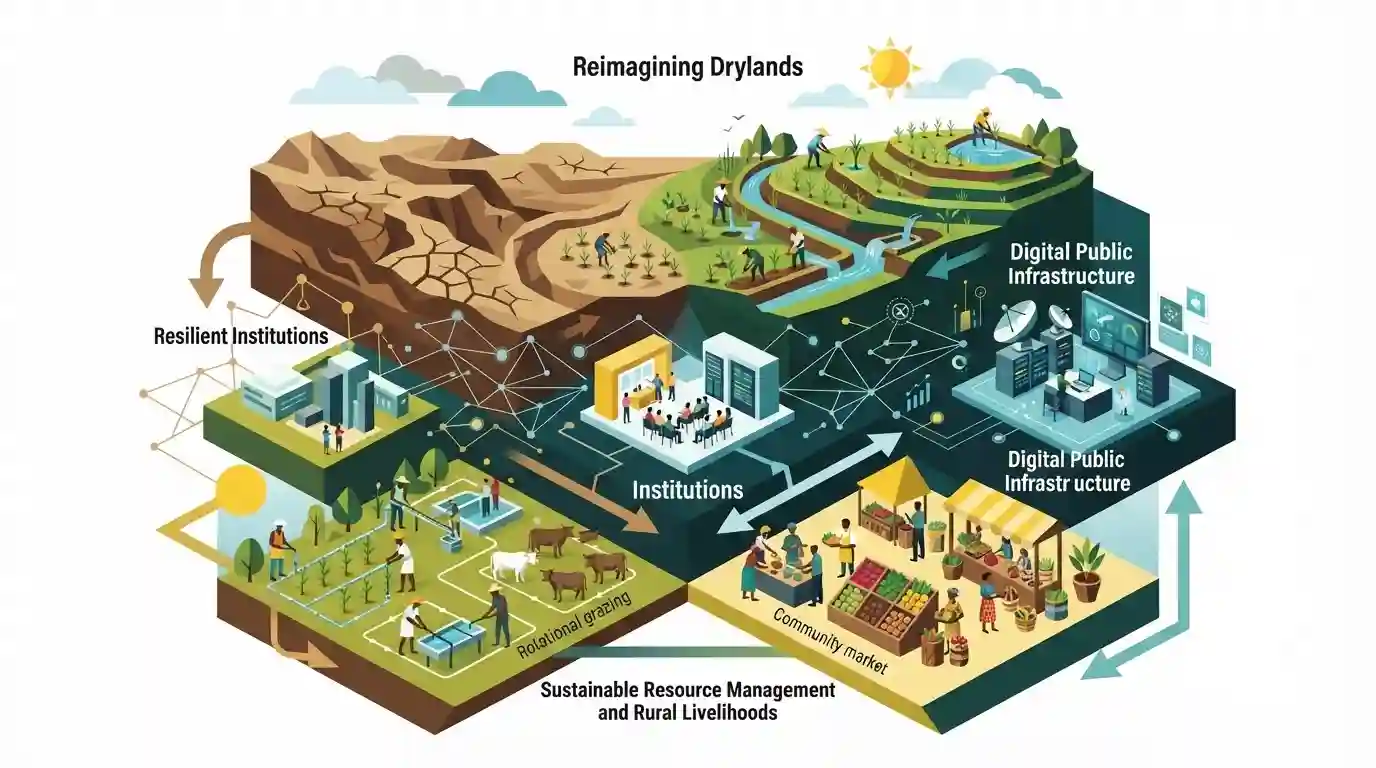
The Secretary of the Department of Land Resources (DoLR) highlighted the need to reimagine drylands through resilient institutions, digital public infrastructure, and active community participation to address land degradation, promote sustainable resource management, and enhance rural livelihoods.
Key Points
- Drylands require a reimagined approach focusing on resilient institutions, digital public infrastructure (DPI), and community action rather than traditional top-down methods.
- The Department of Land Resources emphasized integrating modern technology and grassroots participation to combat land degradation and desertification.
- Sustainable land management in drylands is critical for climate resilience, food security, and rural livelihoods in India.
Important Terms
Department of Land Resources (DoLR)

A department under the Ministry of Rural Development responsible for land management, watershed development, land reforms, and modernization of land records via initiatives like the Digital India Land Records Modernization Programme (DILRMP).
UPSC context
UPSC GS Paper III (Agriculture, Land Reforms, Resource Management). Tests knowledge of institutional frameworks dealing with land degradation, drylands, and rural development.
Prelims Trap
India's commitment to restore all 97.85 million hectares of degraded land by 2030 under UNCCD.
Aspirants often confuse India's UNCCD target (26 million hectares by 2030) with total degraded land area (approx 97.85 million hectares as per the ISRO atlas).
Static Concepts Connected
What are the key institutional mechanisms and international conventions combating desertification in India?
- UNCCD Commitment: India is a signatory to the United Nations Convention to Combat Desertification (UNCCD) and has committed to restoring 26 million hectares of degraded land by 2030.
- Mapping Agency: The Desertification and Land Degradation Atlas of India is published periodically by the Space Applications Centre (SAC), ISRO.
- Flagship Scheme: WDC-PMKSY is the flagship central scheme dedicated to the development of rainfed and degraded lands through watershed management approaches.
Cross-Topic Patterns
Digital Public Infrastructure + Land Restoration
Integrating DPI into rural watershed management connects the India Stack governance model with climate action and land restoration targets under the UNCCD.
Dryland Management + Climate Change Adaptation
Combating desertification directly supports the Bonn Challenge and India's nationally determined contributions for climate adaptation in rainfed agrarian belts.

UNCCD Bonn Challenge commitments (26 Mha by 2030) + WDC-PMKSY / REWARD project architecture frequently appear in matching-list prelims.
Linked PYQs · 2
Linked PYQs · 2
- 2025MainsGS3
Examine the factors responsible for depleting groundwater in India. What are the steps taken by the government to mitigate such depletion of groundwater?
- 2023PrelimsGS1
Which one of the following best describes the concept of 'Small Farmer Large Field'?
