Critical Minerals for Energy Security and Industrial Growth
Source:PIB ↗
কেন এটি গুরুত্বপূর্ণ
Critical minerals are the backbone of modern green technologies, defence systems, and high-tech manufacturing. Understanding India's strategies to secure mineral supply chains is crucial for GS3 (Economy, Energy, and Infrastructure).
সারসংক্ষেপ
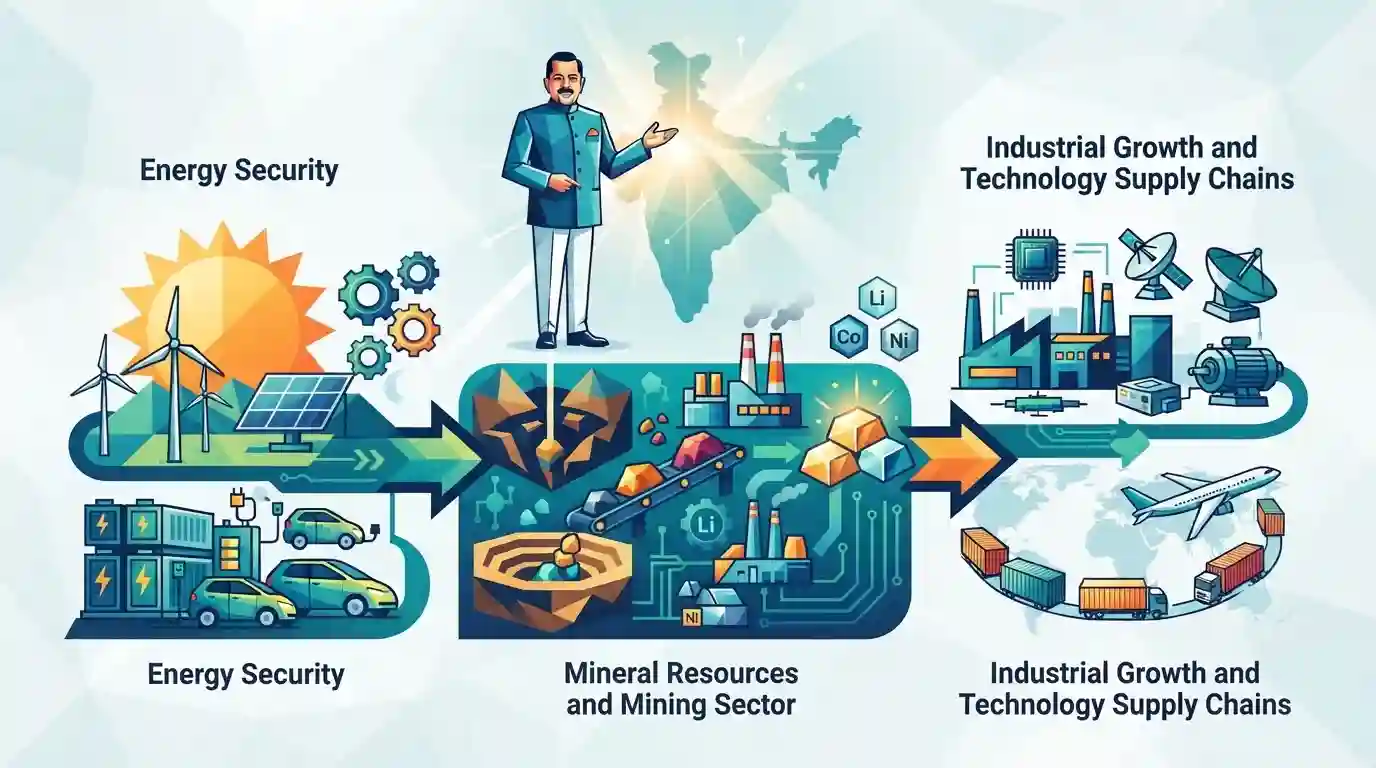
Union Minister Dr Jitendra Singh highlighted the critical role of critical and strategic minerals in driving India's energy security, industrial growth, and national security, stressing the need for self-reliance and resilient supply chains.
মূল বিষয়
- Union Minister Dr Jitendra Singh emphasized that critical minerals are fundamental to India's energy security, industrial competitiveness, and national security.
- Critical minerals like lithium, cobalt, and rare earth elements are indispensable for clean energy transitions, electric vehicles, and high-tech electronics.
- India is scaling up domestic exploration, technological development, and international partnerships to secure resilient supply chains and reduce import dependence.
গুরুত্বপূর্ণ শব্দ
National Critical Mineral Mission

A flagship initiative designed to ensure a secure, resilient supply chain for critical and strategic minerals by boosting domestic exploration, processing, recycling, and international asset acquisition.
UPSC context
UPSC GS Paper III: Important international and domestic resource security, economic growth, and clean energy transition policies.
Mines and Minerals (Development and Regulation) Act
The principal legislation governing the mining sector in India, regulating the exploration, development, and extraction of major and minor minerals across states.
UPSC context
UPSC GS Paper III: Core statutory framework, mineral concessions, resource governance, and regulatory reforms in India.
Ministry of Science and Technology
A central ministry responsible for formulating policies, promoting scientific research, and advancing technology ecosystems, strategic sectors, and innovation capabilities across India.
UPSC context
UPSC GS Paper III: Science and Technology — policy, developments, applications, and indigenous technological advancements.
Department of Atomic Energy
A specialized government department tasked with the research, development, and utilization of atomic energy for electricity generation and national security applications.
UPSC context
UPSC GS Paper III: Nuclear technology, strategic minerals, and national security infrastructure.
সংযুক্ত স্থির ধারণা
What are the key institutional mechanisms and legislative amendments governing critical minerals in India?
- MMDR Act 2023: The MMDR Amendment Act 2023 empowered the Central Government to auction mining leases for 24 critical and strategic minerals.
- KABIL Mandate: KABIL (Khanij Bidesh India Ltd) is a joint venture PSU tasked with identifying, acquiring, and developing mineral assets abroad.
- National Mission: The National Critical Mineral Mission focuses on end-to-end capabilities from domestic exploration to recycling and stockpiling.
আন্তঃবিষয় প্যাটার্ন
Critical Minerals and Minilateral Diplomacy
Critical minerals supply chains connect domestic industrial policy (Make in India) with minilateral diplomacy like the US-led Minerals Security Partnership and Quad groupings.
Energy Transition vs. Supply Chain Vulnerability
Rapid transition to electric vehicles and renewables under NDCs directly increases geopolitical vulnerability to monopolistic rare earth suppliers like China.

Expect a statement-based prelims question pairing the National Critical Mineral Mission's 30 minerals with KABIL's overseas asset mandates.
সংযুক্ত PYQ · 3
সংযুক্ত PYQ · 3
- 2026PrelimsGS1
Which of the following statements about Rare Earth Elements (REEs) and Critical Minerals is/are correct ? 1. Modern technological innovations including Artificial Intelligence, robotics and space exploration extensively utilise Rare Earth Elements (REEs). 2. China has the highest share in mining of REEs followed by India. 3. The Government of India launched the National Critical Mineral Mission (NCMM) in 2025 to establish a robust framework for self-reliance in the critical mineral sector. 4. Rare Earth Elements are a set of 13 metallic elements. Select the answer using the code given below :
- 2022PrelimsGS1
With reference to India, consider the following statements: 1. Monazite is a source of rare earths. 2. Monazite contains thorium. 3. Monazite occurs naturally in the entire Indian coastal sands in India. 4. In India, Government bodies only can process or export monazite. Which of the statements given above are correct?
- 2020PrelimsGS1
Consider the following minerals : 1. Bentonite 2. Chromite 3. Kyanite 4. Sillimanite In India, which of the above is/are officially designated as major minerals?
