Drylands Transformation Requires Science Policy and Market Support
Source:PIB ↗
কেন এটি গুরুত্বপূর্ণ
The article addresses critical themes of dryland agriculture, sustainable land management, and resource efficiency in the face of climate change, which are central to GS Paper 3 (Agriculture and Environment).
সারসংক্ষেপ
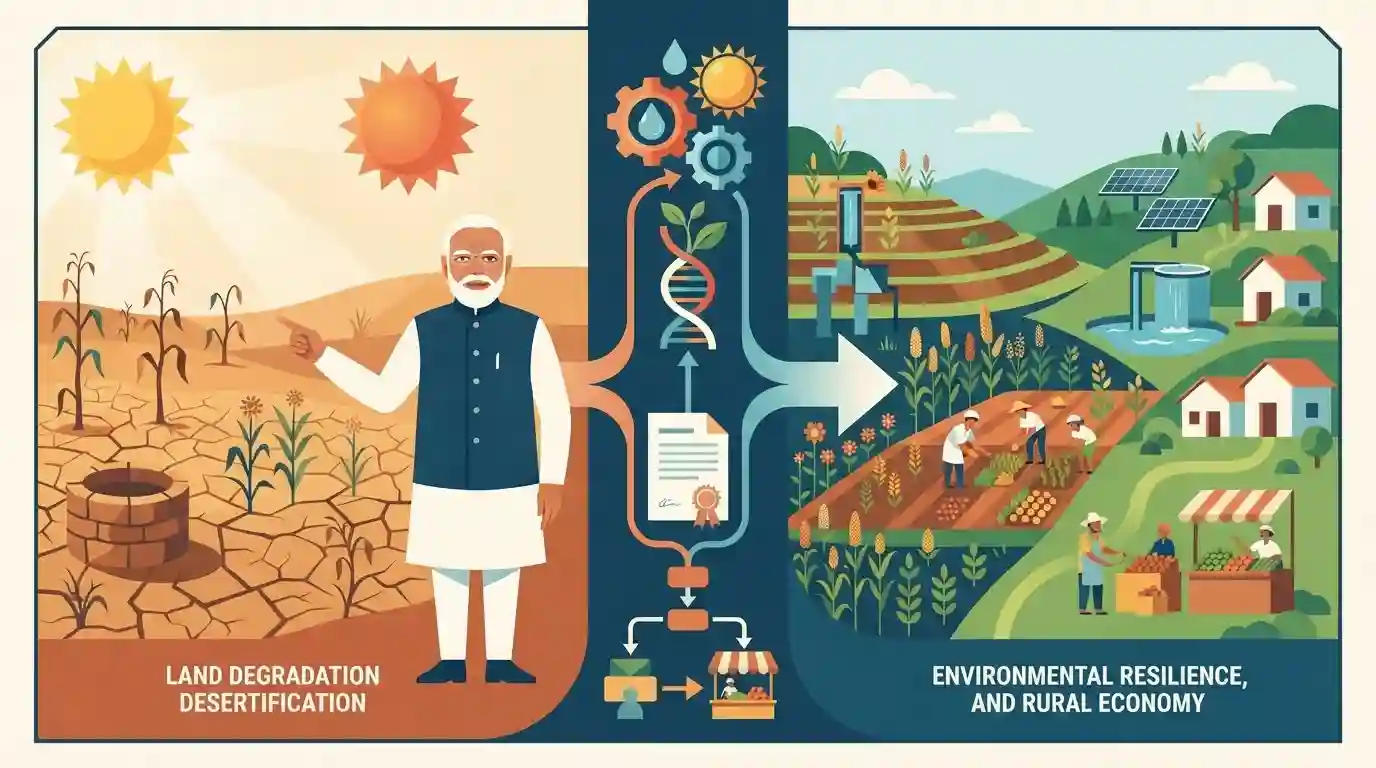
Union Minister Shri Shivraj Singh Chouhan highlighted the strategic importance of drylands, stating that with the right application of science, policy interventions, and market support, drylands can become significant assets for India's agricultural growth, environmental resilience, and rural economy.
মূল বিষয়
- Union Minister Shri Shivraj Singh Chouhan emphasized that drylands can be transformed into agricultural strengths through science, appropriate policy frameworks, and robust market support.
- Focus on leveraging dryland potential to enhance farmers' incomes, ensure food security, and combat land degradation and desertification.
- Integration of modern science, water conservation, resilient crop varieties, and market linkages is vital for sustainable dryland development.
গুরুত্বপূর্ণ শব্দ
Drylands

Regions characterized by arid, semi-arid, and dry sub-humid conditions where water scarcity limits agricultural productivity and natural vegetation, requiring specialized crop science and water management.
UPSC context
UPSC CSE GS Paper III (Environment, Agriculture): Tests knowledge of sustainable agriculture, drought resilience, and land management in fragile ecosystems.
Land Degradation Neutrality
A state where the amount of degraded land resources remains stable or decreases, balancing losses with equivalent gains to halt land degradation by 2030.
UPSC context
UPSC CSE GS Paper III (Environment & Ecology): Crucial for international conventions like UNCCD and SDG Target 15.3.
Union Ministry of Agriculture and Farmers Welfare
The apex Union ministry responsible for agricultural policy formulation, research coordination, crop production schemes, and ensuring food security and farmer welfare in India.
UPSC context
UPSC CSE GS Paper II & III (Polity & Governance / Agriculture): Tests institutional framework for farm sector development and policy implementation.
সংযুক্ত স্থির ধারণা
What are the core strategies for dryland agriculture development and moisture conservation in India?
- Definition & Scope: Focuses on regions receiving low or erratic rainfall without assured irrigation facilities.
- Moisture Conservation: Adoption of ridge-to-valley approach, farm ponds, contour bunding, and micro-irrigation to maximize soil moisture retention.
- Resilient Crops: Deployment of drought-tolerant and short-duration crop varieties developed by institutions like ICAR-CRIDA.
- Key Scheme (NICRA): National Initiative on Climate Resilient Agriculture (NICRA) acts as a flagship network project addressing climate variability.
আন্তঃবিষয় প্যাটার্ন
Land Degradation & SDG 15 Goals
Dryland agriculture initiatives directly support climate change commitments under SDG 15 (Life on Land) and India's national action plans for land degradation neutrality.
Climate Resilient Agriculture & NICRA Linkages
NICRA and CRIDA interventions bridge agricultural scientific research with rural livelihood security, mirroring technology-led missions in rainfed horticulture.

Dryland farming and NICRA/CRIDA frameworks frequently feature in prelims matching questions on agricultural institutions and schemes.
সংযুক্ত PYQ · 3
সংযুক্ত PYQ · 3
- 2025MainsGS3
Examine the factors responsible for depleting groundwater in India. What are the steps taken by the government to mitigate such depletion of groundwater?
- 2025MainsGS3
Elaborate the scope and significance of supply chain management of agricultural commodities in India.
- 2024MainsGS3
What are the major challenges faced by Indian irrigation system in recent times? State the measures taken by the government for efficient irrigation management.
