First Regional Review Conference on Forest Rights Act Implementation
Source:PIB ↗
Why It Matters
The Forest Rights Act (FRA), 2006 is a landmark legislation addressing historical injustices against forest-dwelling Scheduled Tribes and traditional forest dwellers. Regional review conferences by the nodal Ministry of Tribal Affairs are critical for assessing policy implementation gaps, improving administrative accountability, and empowering Gram Sabhas.
Summary
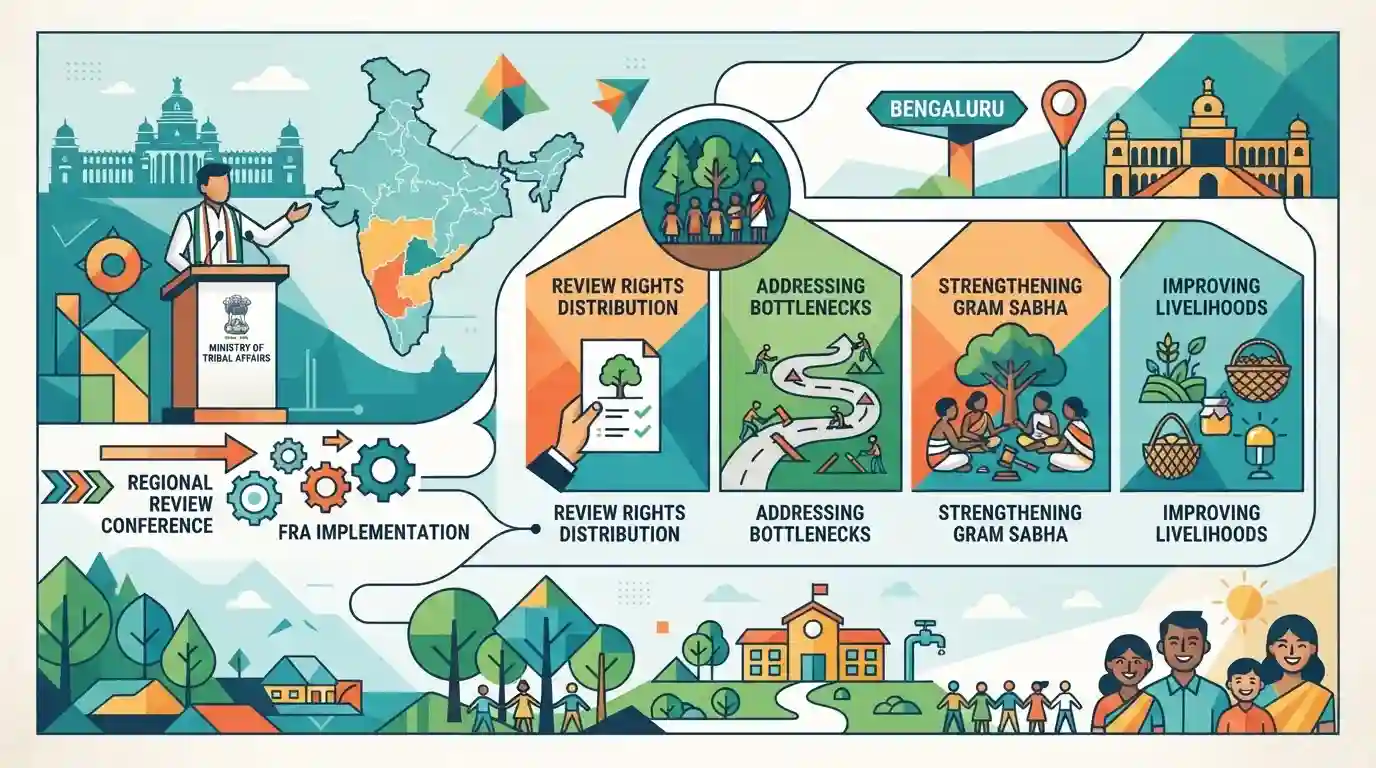
The Ministry of Tribal Affairs held the First Regional Review Conference on the Implementation of the Forest Rights Act (FRA) in Bengaluru to review the status of forest rights distribution, address implementation bottlenecks, strengthen Gram Sabha involvement, and improve livelihood opportunities for forest-dwelling communities.
Key Points
- The Ministry of Tribal Affairs organized the First Regional Review Conference on the Implementation of the Forest Rights Act (FRA) in Bengaluru.
- The conference focused on evaluating the progress of individual and community forest rights recognition across southern and neighboring states.
- Emphasis was placed on strengthening Gram Sabha capacity, accelerating pending claims, and leveraging technology for transparent monitoring of FRA implementation.
- Discussions highlighted the integration of livelihood generation schemes with forest rights, particularly for Minor Forest Produce (MFP).
Important Terms
Scheduled Tribes and Other Traditional Forest Dwellers (Recognition of Forest Rights) Act, 2006 (FRA)

A landmark legislation enacted in 2006 to recognize and vest forest rights and occupation in forest land in forest-dwelling Scheduled Tribes and other traditional forest dwellers, addressing historical injustices.
UPSC context
UPSC GS Paper II (Government Policies & Interventions) and GS Paper III (Environment & Conservation). Tests understanding of tribal welfare and forest governance.
Ministry of Tribal Affairs
The apex nodal ministry under the Government of India responsible for the overall policy, planning, and coordination of programs for the development and welfare of Scheduled Tribes.
UPSC context
UPSC GS Paper II (Vulnerable Sections & Government Policies). Important for questions on institutional frameworks for tribal welfare.
Prelims Trap
The Gram Sabha is the final authority that unilaterally approves and issues land titles without any district-level committee oversight.
The Gram Sabha initiates and determines forest rights at the grassroots level, but final sanctioning and administrative monitoring involve sub-divisional and district-level committees under the Act.
Static Concepts Connected
What is the institutional mechanism and role of the Gram Sabha under the Forest Rights Act, 2006?
- Nodal Agency: Nodal Ministry: The Ministry of Tribal Affairs is the national-level nodal agency responsible for implementing and monitoring the FRA.
- Gram Sabha Role: Initiation Authority: The Gram Sabha is the statutory authority to initiate the process for determining individual and community forest rights.
- Approval Tiers: Three-tier Committees: Implementation involves Gram Sabha, Sub-Divisional Level Committee (SDLC), and District Level Committee (DLC).
- Livelihood Rights: MFP Rights: The Act explicitly recognizes ownership and collection rights over Minor Forest Produce (MFP) for forest dwellers.
Cross-Topic Patterns
FRA implementation and grassroots Panchayati Raj governance
FRA implementation bottlenecks connect governance decentralization under the 5th and 6th Schedules with grassroots administrative capacity and panchayati raj accountability.
FRA, Minor Forest Produce, and Tribal Livelihoods
Integrating Minor Forest Produce (MFP) management with Van Dhan Vikas Kendras connects conservation legislation directly with tribal livelihood generation and rural entrepreneurship.

Expect a statement-based question pairing Gram Sabha's statutory authority under FRA with nodal ministry responsibilities and MFP ownership.
Linked PYQs · 3
Linked PYQs · 3
- 2019PrelimsGS1
Consider the following statements: 1. As per recent amendment to the Indian Forest Act, 1927, forest dwellers have the right to fell the bamboos grown on forest areas. 2. As per the Scheduled Tribes and Other Traditional Forest Dwellers (Recognition of Forest Rights) Act, 2006, bamboo is a minor forest produce. 3. The Scheduled Tribes and Other Traditional Forest Dwellers (Recognition of Forest Rights) Act, 2006 allows ownership of minor forest produce to forest dwellers. Which of the statements given above is/are correct?
- 2021PrelimsGS1
At the national level, which ministry is the nodal agency to ensure effective implementation of the Scheduled Tribes and Other Traditional Forest Dwellers (Recognition of Forest Rights) Act, 2006?
- 2013PrelimsGS1
Under the Scheduled Tribes and Other Traditional Forest Dwellers (Recognition of Forest Rights) Act, 2006, who shall be the authority to initiate the process for determining the nature and extent of individual or community forest rights or both?
