BEE Promotes Commercial Electric Cooking to Advance Energy Transition
Source:PIB ↗
हे का महत्त्वाचे आहे
Understanding India's strategic push towards electrification of cooking appliances is critical for evaluating energy security, import reduction, and carbon emission targets under GS Paper 3.
सारांश
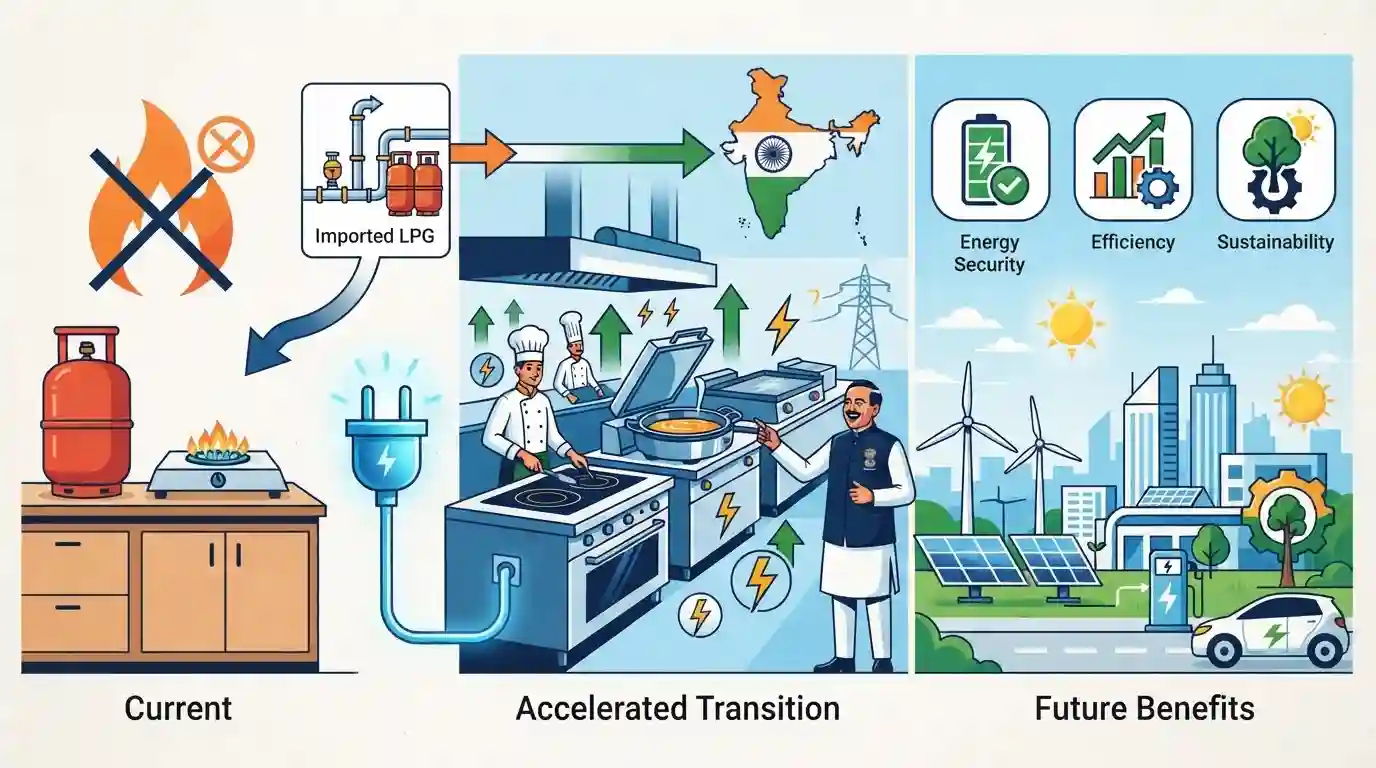
The Bureau of Energy Efficiency (BEE), under the Ministry of Power, showcased commercial electric cooking solutions aimed at accelerating India's transition from LPG to electricity, fostering energy security, efficiency, and sustainability.
मुख्य मुद्दे
- The Bureau of Energy Efficiency (BEE) showcased commercial electric cooking solutions to accelerate India's transition from LPG to electricity.
- The initiative promotes energy-efficient cooking appliances in the commercial sector to reduce import dependence, lower carbon footprints, and enhance energy security.
- Transitioning cooking solutions to electricity aligns with India's broader climate goals and renewable energy expansion.
महत्त्वाच्या संज्ञा
Bureau of Energy Efficiency (BEE)

A statutory body established under the Ministry of Power that promotes energy efficiency and conservation across sectors, implementing programs like star labeling, building codes, and industrial efficiency schemes.
UPSC context
GS Paper III (Environment & Infrastructure): Evaluates institutional frameworks for energy conservation, climate commitments, and energy transition.
Energy Conservation Act
The primary legislation enacted in 2001 (and amended in 2022) that provides the legal framework, institutional setup, and regulatory powers for promoting energy efficiency and conservation in India.
UPSC context
GS Paper III (Infrastructure & Energy): Tests knowledge of statutory frameworks governing India's energy efficiency mandates and carbon credit trading.
Ministry of Power
The Union government ministry responsible for the formulation of national policies, planning, and coordination of power generation, transmission, and distribution in India.
UPSC context
GS Paper II / III (Governance & Infrastructure): Important for understanding public policy, energy security, and power sector reforms.
पूर्वपरीक्षा सापळा
The Bureau of Energy Efficiency is an executive body established under the Ministry of Power.
BEE is a statutory body created under the Energy Conservation Act, 2001, not a non-statutory executive body or established under the Electricity Act.
संबंधित स्थिर संकल्पना
What are the statutory functions and establishment mandate of the Bureau of Energy Efficiency (BEE)?
- Establishment Act: Statutory body established in March 2002 under the provisions of the Energy Conservation Act, 2001.
- Key Functions: Mandated to recommend energy consumption standards, direct designated consumers to appoint certified energy managers, and implement the Energy Conservation Building Code (ECBC).
- Parent Ministry: Operates under the administrative control of the Ministry of Power, Government of India.
आंतर-विषय नमुने
Cooking Electrification + Renewable Energy Integration
Shifting domestic and commercial cooking from imported fossil fuels to grid electricity links national energy security with renewable capacity expansion and subsidy rationalisation.
Energy Efficiency Standards + Commercial Sector Decarbonisation
BEE standards and labeling frameworks bridge the gap between energy efficiency mandates and consumer adoption in commercial sectors.

BEE statutory role under EC Act 2001 and its demand-side management mandate frequently appear in multi-statement prelims questions.
संबंधित PYQ · 3
संबंधित PYQ · 3
- 2023MainsGS3
The adoption of electric vehicles is rapidly growing worldwide. How do electric vehicles contribute to reducing carbon emissions and what are the key benefits they offer compared to traditional combustion engine vehicles?
- 2020MainsGS3
Describe the benefits of deriving electric energy from sunlight in contrast to the conventional energy generation. What are the initiatives offered by our Government for this purpose?
- 2016MainsGS3
Give an account of the current status and the targets to be achieved pertaining to renewable energy sources in the country. Discuss in brief the importance of National Programme on Light Emitting Diodes (LEDs).
