India Russia Bilateral Trade Targets 100 Billion Dollars by 2030
Source:PIB ↗
આ શા માટે મહત્વનું છે
This article highlights the evolving economic contours of India-Russia relations, moving beyond traditional defense ties into broader trade, investment, and supply chain diversification, which has major bearings on India's foreign policy and economic security.
સારાંશ
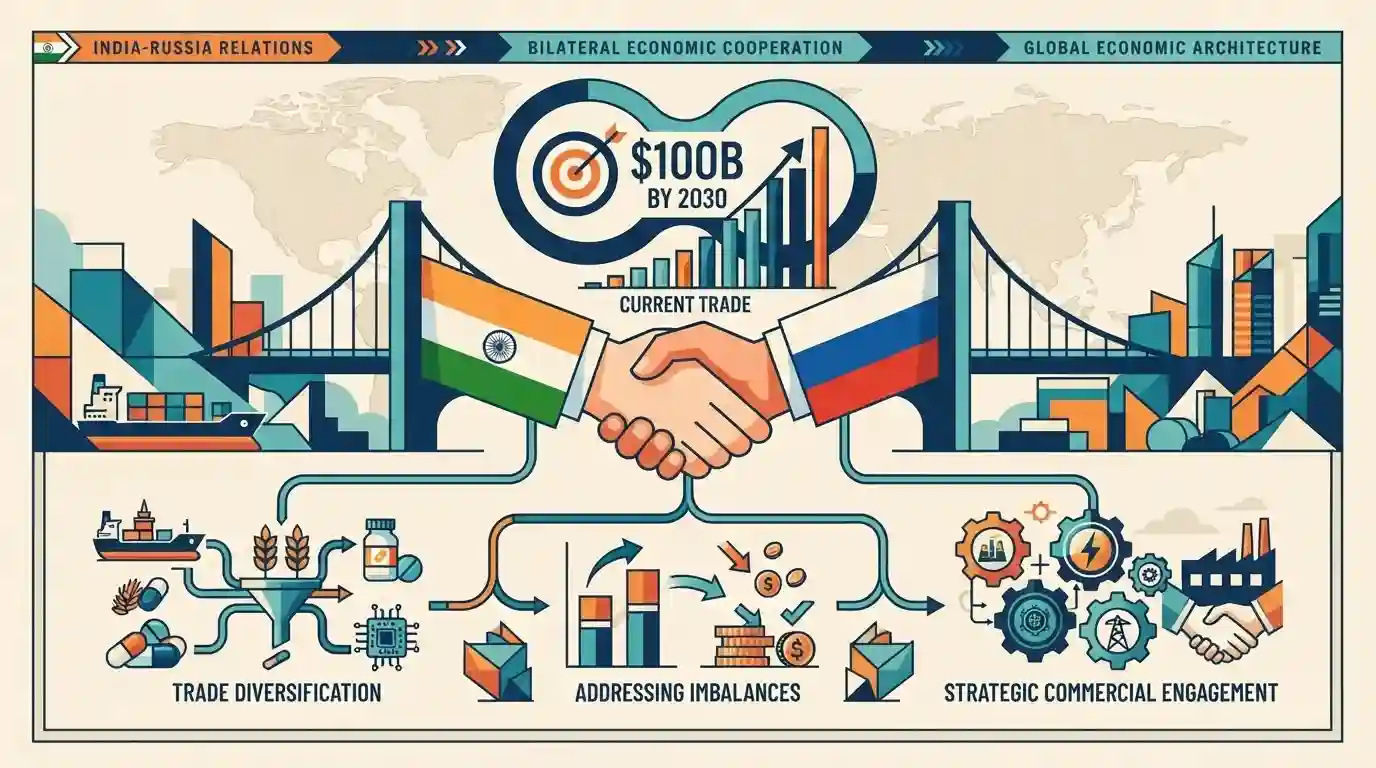
Union Minister of Commerce and Industry Shri Piyush Goyal emphasized the need to deepen India-Russia economic cooperation, setting a target of $100 billion in bilateral trade by 2030 through trade diversification, addressing imbalances, and enhancing strategic commercial engagement.
મુખ્ય મુદ્દા
- Union Minister Piyush Goyal called for accelerating the India-Russia economic partnership to achieve a bilateral trade target of $100 billion by 2030.
- Focus areas include diversifying trade basket, resolving trade imbalances, and enhancing cooperation in areas like agriculture, pharmaceuticals, technology, and energy.
- Emphasized robust institutional frameworks and private-sector engagement to boost bilateral commercial ties.
મહત્વપૂર્ણ શબ્દો
India-Russia $100 Billion Trade Target by 2030

An ambitious bilateral target set by India and Russia to expand their economic cooperation, aiming to scale two-way trade to $100 billion and investments to $50 billion by 2030 through diversification and trade rebalancing.
UPSC context
Important for GS Paper II (International Relations - India-Russia ties) and GS Paper III (Economy - Bilateral trade and global economic architecture).
Eurasian Economic Union (EAEU)
A free trade area comprising Russia, Kazakhstan, Belarus, Armenia, and Kyrgyzstan. India and the EAEU are currently engaged in formal free trade negotiations to expand market access, particularly for MSMEs.
UPSC context
Important for GS Paper II (International Groupings and Agreements) and economic diplomacy questions concerning plurilateral trade pacts.
Bilateral Investment Treaty (BIT)
A treaty currently being fast-tracked between India and Russia to provide legal certainty, protect investments, and support around 40 live priority projects across advanced manufacturing, energy, and infrastructure.
UPSC context
Relevant for GS Paper III (Economy - Foreign Direct Investment, trade agreements, and legal frameworks governing international investments).
International North-South Transport Corridor (INSTC)
A multimodal transit transport system established to connect India, Iran, Azerbaijan, Russia, and Central Asia, aimed at reducing freight costs and transit times to bolster trade corridors.
UPSC context
Important for GS Paper II (Bilateral Relations, Geopolitics) and GS Paper III (Infrastructure, Connectivity, and Trade Logistics).
સંલગ્ન સ્થિર ખ્યાલો
What are the key institutional frameworks and connectivity corridors shaping India-Russia economic relations?
- INSTC Route: INSTC is a multi-modal transport network linking India, Iran, Azerbaijan, and Russia, reducing transit time significantly compared to the Suez Canal route.
- Eastern Corridor: Chennai-Vladivostok Maritime Corridor (Eastern Maritime Corridor) connects India's eastern seaboard to the Russian Far East, cutting transit time for coking coal and crude.
- EAEU Integration: Eurasian Economic Union (EAEU) is a free trade bloc comprising Russia, Kazakhstan, Belarus, Armenia, and Kyrgyzstan, with which India is pursuing a trade agreement.
આંતર-વિષય પેટર્ન
Bilateral Trade Corridors & Geopolitics
The INSTC and Chennai-Vladivostok corridor link bilateral trade targets directly to India's strategic connectivity doctrines and Indo-Pacific counter-balancing frameworks.
EAEU Trade Pacts and Strategic Autonomy
India's trade negotiations with the Russia-led EAEU run parallel to ongoing FTA pursuits with Western blocs, testing strategic autonomy in trade policy.

Expect a statement-based prelims question on India-Russia trade targets ($100B by 2030), EAEU membership, or INSTC route alignment.
સંલગ્ન PYQ · 2
સંલગ્ન PYQ · 2
- 2024MainsGS2
Critically analyse India's evolving diplomatic, economic and strategic relations with the Central Asian Republics (CARs) highlighting their increasing significance in regional and global geopolitics.
- 2025MainsGS3
What are the challenges before the Indian economy when the world is moving away from free trade and multilateralism to protectionism and bilateralism? How can these challenges be met?
