India Strategies to Become Global Hub for Ship Leasing and Finance
Source:PIB ↗
આ શા માટે મહત્વનું છે
This policy thrust addresses India's structural deficit in maritime finance and ship-leasing, transforming India from a consumer of foreign shipping services into a global hub for ship ownership and financial services, which is vital for secure and cost-effective international trade.
સારાંશ
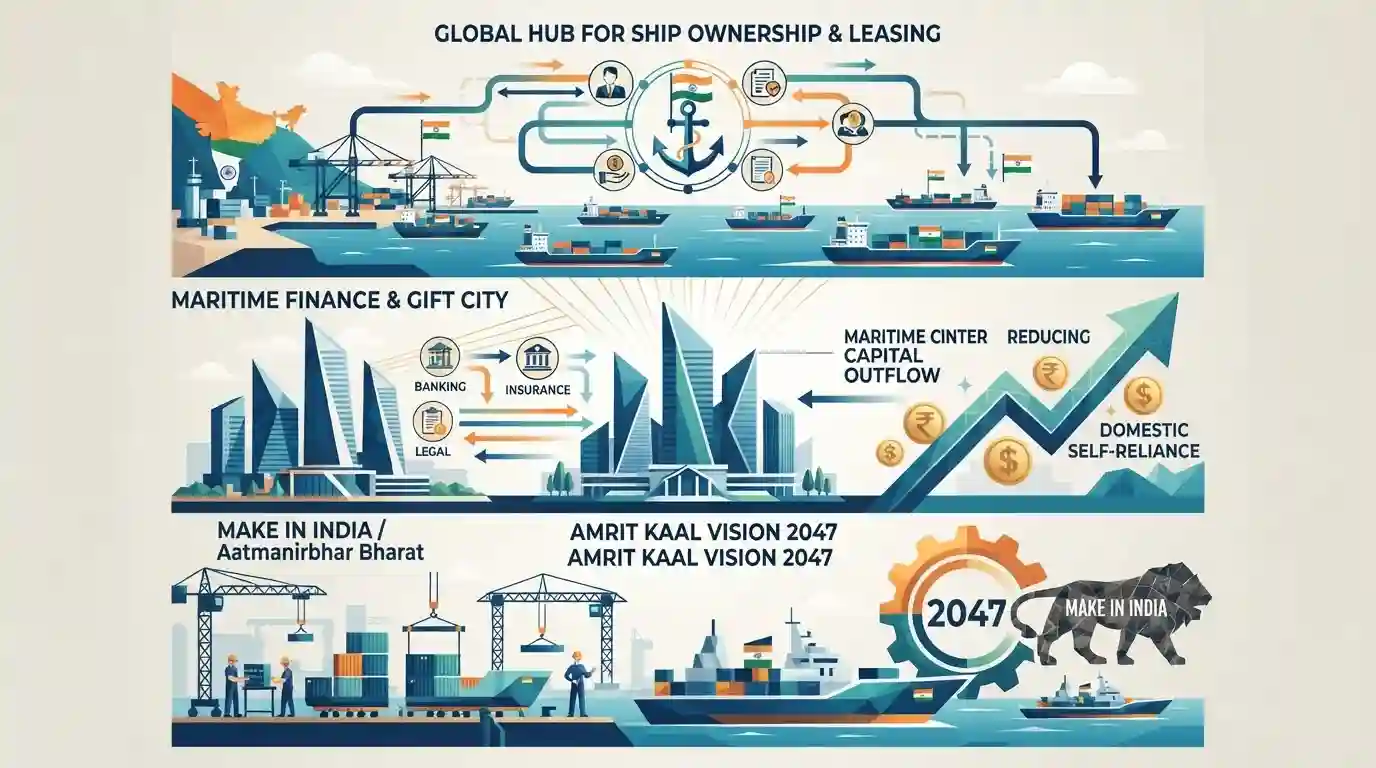
Union Minister Sarbananda Sonowal highlighted India's strategic roadmap to emerge as a global hub for ship ownership, leasing, and maritime finance, leveraging GIFT City to reduce capital outflow and boost domestic self-reliance in the maritime sector under Amrit Kaal Vision 2047.
મુખ્ય મુદ્દા
- Union Minister Sarbananda Sonowal emphasized India's strategic push to become a global hub for ship ownership, leasing, and maritime finance.
- GIFT City (Gujarat International Finance Tec-City) is being leveraged as a core financial gateway to attract international and domestic ship leasing entities.
- The initiative aims to reduce India's heavy reliance on foreign ship-leasing companies, curb capital outflow, and retain maritime revenue domestically.
- Aligned with the broader 'Amrit Kaal Vision 2047' to modernize and make India's maritime sector self-reliant (Aatmanirbhar).
મહત્વપૂર્ણ શબ્દો
Amrit Kaal Vision 2047

A long-term strategic roadmap formulated by the Ministry of Ports, Shipping and Waterways to transform India into a global maritime leader, encompassing over 300 actionable initiatives across port infrastructure, green shipping, and the blue economy by 2047.
UPSC context
UPSC GS Paper III (Infrastructure, Economy). Evaluates India's long-term transport planning, sustainable development goals, and targets for self-reliance in the maritime sector.
GIFT City
India's premier International Financial Services Centre (IFSC) located in Gujarat, which offers a competitive regulatory environment through the IFSCA for global ship ownership, financial leasing, and asset financing.
UPSC context
UPSC GS Paper III (Economy). Tests knowledge of international financial services hubs, capital outflow reduction, and domestic tax-neutral regulatory frameworks.
Ministry of Ports, Shipping and Waterways
The apex central government ministry in India responsible for the formulation and administration of policies, schemes, and regulations regarding major ports, maritime shipping, and inland water transport.
UPSC context
UPSC GS Paper II / III (Governance / Infrastructure). Examines ministerial jurisdiction, institutional frameworks for port-led development, and coastal logistics policy.
પ્રિલિમ્સ ટ્રેપ
All domestic scheduled commercial banks across India are permitted to undertake direct global ship leasing without IFSC restrictions.
Ship leasing is permitted exclusively within GIFT City's IFSCA jurisdiction, not across all domestic bank branches under RBI guidelines.
સંલગ્ન સ્થિર ખ્યાલો
What are the key regulatory functions of the IFSCA under the IFSCA Act, 2019?
- Unified Regulator: Statutory Authority established under the IFSCA Act, 2019, to regulate all financial services, products, and institutions in International Financial Services Centres (IFSCs).
- Single Window: Acts as a single-window regulator for banking, insurance, securities, and financial products like ship leasing and aircraft leasing in India.
- Onshore Hub: Aims to bring international financial transactions onshore, competing with global financial hubs like Singapore, Dubai, and London.
આંતર-વિષય પેટર્ન
IFSC & Domestic Maritime Finance Growth
GIFT City's tax incentives and IFSCA regulatory framework bridge domestic fiscal policy with international maritime finance, intersecting the Economy and Infrastructure syllabus.
Amrit Kaal Vision & Strategic Trade Autonomy
Amrit Kaal Vision 2047 sets long-term logistics targets that connect port infrastructure directly with external trade resilience and strategic autonomy.

GIFT City as an IFSC for ship leasing + IFSCA regulatory powers likely to appear in a multi-statement prelims question.
સંલગ્ન PYQ · 2
સંલગ્ન PYQ · 2
- 2025MainsGS3
Why is maritime security vital to protect India's sea trade? Discuss maritime and coastal security challenges and the way forward.
- 2026PrelimsGS1
In what way(s) does the Vizhinjam International Seaport represent a structural shift in India's maritime trade and logistics policy? 1. By functioning exclusively as a domestic cargo hub to reduce reliance on coastal shipping and eliminate the need for foreign collaborations. 2. By focusing primarily on passenger cruise tourism and heritage shipping to increase Kerala's profile as a maritime heritage destination. 3. By leveraging its natural deep draft and strategic location to reduce dependence on foreign trans-shipment ports, enhance revenue retention, and reposition India in regional maritime trade. Select the answer using the code given below :
