National Commission for Safai Karamcharis Chairperson Appointment
Source:PIB ↗
Why It Matters
Appointments to key statutory commissions like the NCSK highlight the institutional framework designed for the protection and welfare of marginalized and vulnerable communities, which is a core component of Indian Polity and Governance syllabus under GS Paper II.
Summary
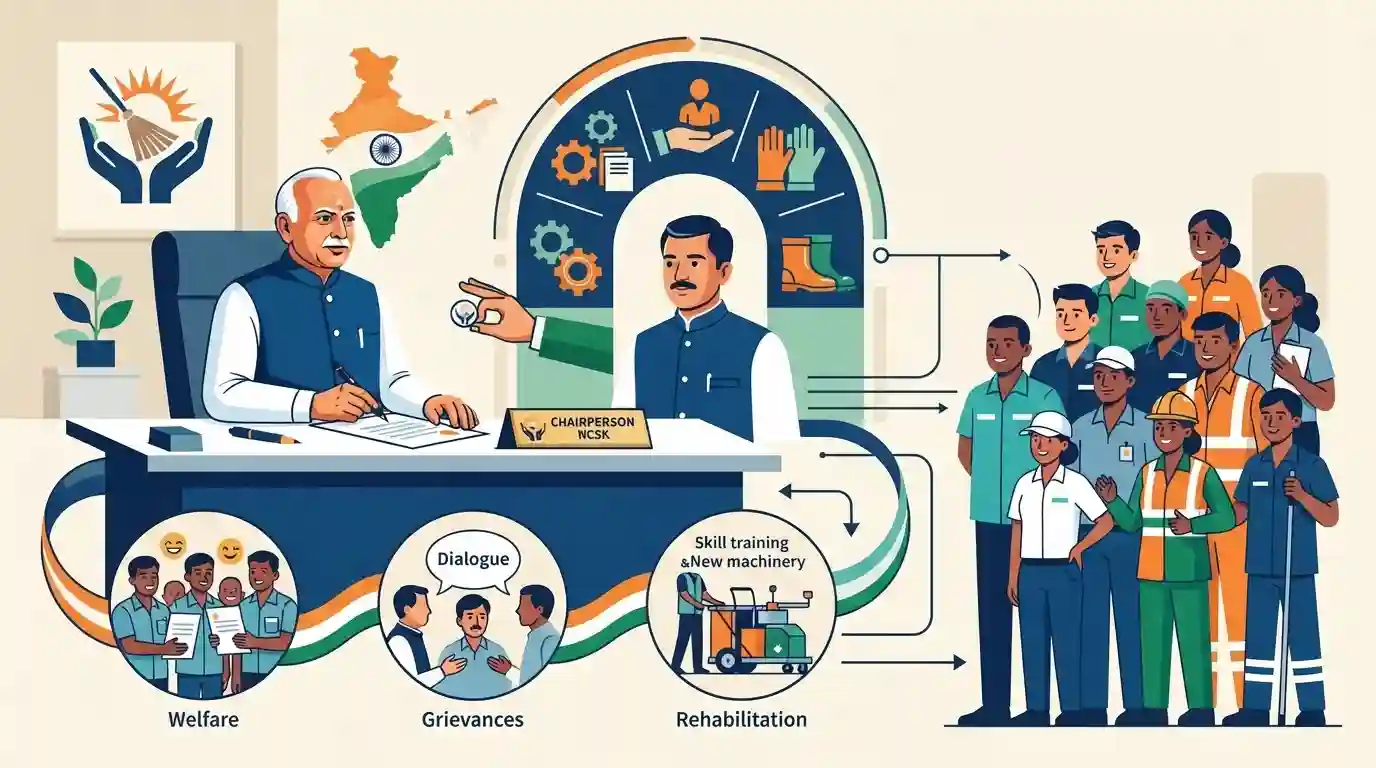
Shri Bhagwat Prasad Makwana has assumed charge as the Chairperson of the National Commission for Safai Karamcharis (NCSK), a crucial body mandated to look into matters concerning the welfare, grievances, and rehabilitation of safai karamcharis in India.
Key Points
- Shri Bhagwat Prasad Makwana assumed charge as the Chairperson of the National Commission for Safai Karamcharis (NCSK) in New Delhi.
- The National Commission for Safai Karamcharis works towards the welfare, upliftment, and socio-economic rehabilitation of safai karamcharis.
- The Commission plays a vital advisory role to the Central Government regarding specific programs and eradication of hazardous manual cleaning practices.
Important Terms
National Commission for Safai Karamcharis (NCSK)

A non-statutory body under the Ministry of Social Justice and Empowerment mandated to study, evaluate, and recommend policies for the welfare, grievances, and socioeconomic rehabilitation of safai karamcharis and manual scavengers in India.
UPSC context
Important for GS Paper II (Vulnerable Sections, Social Justice, Statutory/Non-statutory Bodies). Tests awareness of welfare bodies and manual scavenging eradication.
Prelims Trap
The National Commission for Safai Karamcharis is a statutory body established under a Parliamentary Act.
Aspirants often assume the National Commission for Safai Karamcharis (NCSK) is a statutory or constitutional body, whereas it currently functions as a non-statutory body.
Static Concepts Connected
What is the legal status and jurisdiction of the National Commission for Safai Karamcharis (NCSK)?
- Statutory Status: Initially established under the NCSK Act 1993, its statutory status lapsed in 2004.
- Administrative Control: It currently operates as a non-statutory body under the Ministry of Social Justice and Empowerment.
- Mandate: It evaluates implementation of welfare schemes and investigates grievances regarding manual scavengers.
Cross-Topic Patterns
NCSK vs Constitutional Commissions (Articles 338/338A)
Statutory vs non-statutory status of commissions frequently appears in prelims; candidates often confuse NCSK with constitutional bodies like NCSC or NCST.
Manual Scavenging Eradication & Judicial Directives
Linkages between the 2013 Act, manual scavenging rehabilitation, and Supreme Court directions on mechanized cleaning are recurring themes in governance and social justice.

Prelims question on NCSK status (statutory vs non-statutory) and ministry attachment is a high-yield trap area.
Linked PYQs · 2
Linked PYQs · 2
- 2022MainsGS2
Discuss the role of the National Commission for Backward Classes in the wake of its transformation from a statutory body to a constitutional body.
- 2023PrelimsGS1
Consider the following organizations/bodies in India: 1. The National Commission for Backward Classes 2. The National Human Rights Commission 3. The National Law Commission 4. The National Consumer Disputes Redressal Commission How many of the above are constitutional bodies?
