Lumpy Skin Disease Control Strategy and Livestock Health Management
Source:PIB ↗
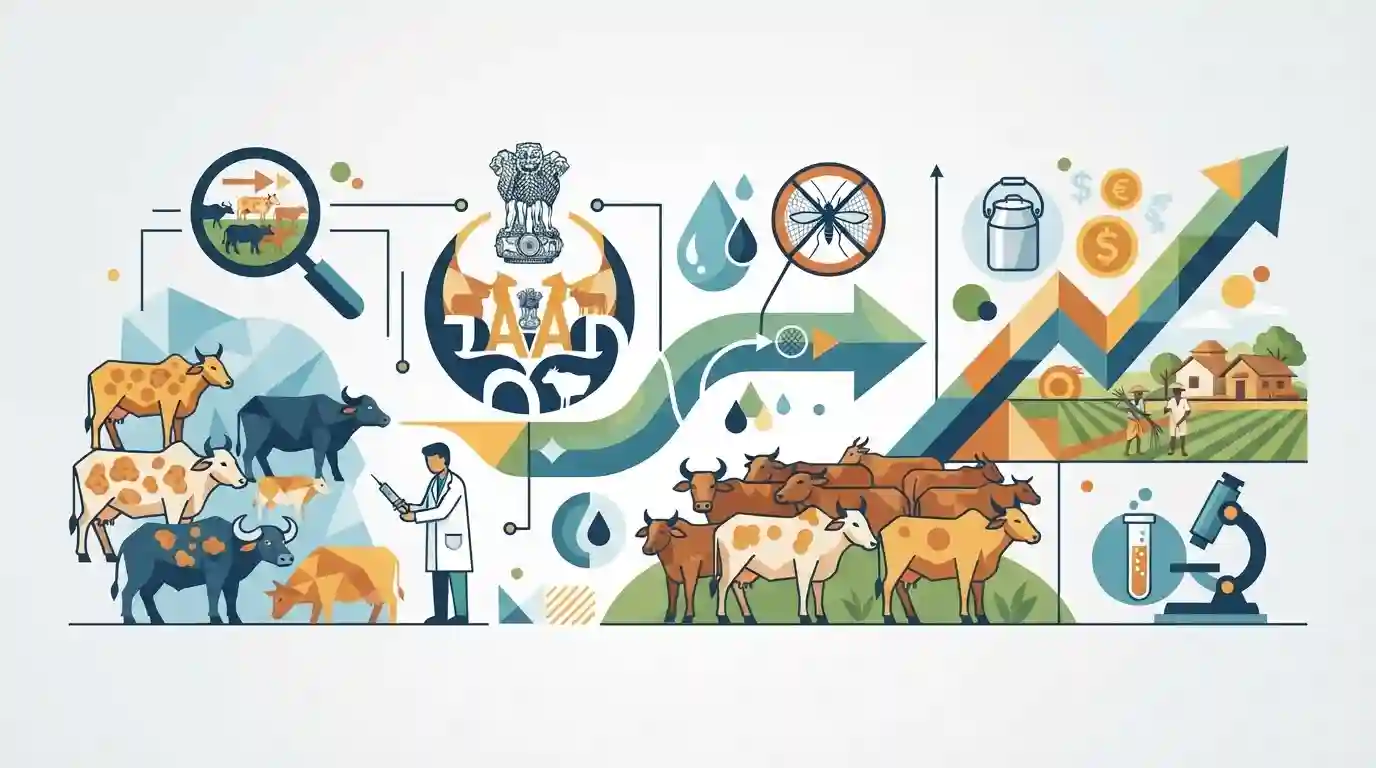
Why It Matters
Livestock rearing is a critical pillar of rural economy and non-farm employment in India. Outbreaks of animal diseases like Lumpy Skin Disease threaten dairy output, farmers' incomes, and food security, making institutional surveillance and vaccination strategies crucial for UPSC GS3 aspirants.
Summary
The Department of Animal Husbandry and Dairying (DAHD) has intensified efforts to control and prevent Lumpy Skin Disease (LSD) in cattle and buffaloes through strengthened surveillance, mass vaccination campaigns, and vector control measures. As LSD poses a significant threat to India's dairy sector and rural livelihoods, the government is utilizing initiatives under the Livestock Health and Disease Control Programme alongside research support to safeguard animal health and agricultural economic stability.
Key Points
- The Department of Animal Husbandry and Dairying (DAHD) has stepped up surveillance, vaccination, and disease-control measures to contain Lumpy Skin Disease (LSD) across the country.
- LSD is a contagious viral disease affecting cattle and buffaloes, causing economic losses to dairy farmers through reduced milk yield, weight loss, and mortality.
- Proactive steps include nationwide vaccination drives, rigorous vector management, advisory support to state governments, and research collaboration with institutions like ICAR-NRCE.
- Effective animal disease control is vital for securing rural livelihoods, protecting the dairy economy, and ensuring sustainable livestock growth under the Livestock Health and Disease Control Programme.
Important Terms
Livestock Health and Disease Control (LH&DC) Programme

A flagship centrally sponsored scheme of the Central Government aimed at mitigating livestock risks through prophylactic vaccination, enhanced disease surveillance, and better veterinary infrastructure.
UPSC context
UPSC Paper III (Agriculture/Economy): Evaluates government interventions for livestock disease management, rural livelihoods, and animal husbandry development.
Department of Animal Husbandry and Dairying (DAHD)
The apex governing body under the Ministry of Fisheries, Animal Husbandry and Dairying responsible for formulating national policies, disease control strategies, and dairy development programs in India.
UPSC context
UPSC Paper II/III: Important for institutional frameworks governing animal health, livestock governance, and agricultural administration.
Prelims Trap
Lumpy Skin Disease is a zoonotic pathogen capable of transmission from infected dairy cattle to human handlers.
LSD is a capripoxvirus that is host-specific to cattle and buffaloes; it does not infect humans and is not zoonotic.
Static Concepts Connected
What are the key objectives and funding pattern of the Livestock Health and Disease Control Programme (LHDCP)?
- Core Objective: Central Sector Scheme aimed at controlling major livestock diseases like Foot and Mouth Disease, Brucellosis, and Lumpy Skin Disease.
- Funding Pattern: Centrally funded with varying cost-sharing ratios between the Centre and States (typically 60:40 for most states, 90:10 for North-Eastern and Himalayan states).
- Key Interventions: Supports mass vaccination campaigns, mobile veterinary units, disease surveillance, and establishment of disease-free zones.
Cross-Topic Patterns
LSD management + WTO SPS measures
Transboundary animal diseases like LSD impact milk yield and export competitiveness, linking animal husbandry directly to WTO sanitary and phytosanitary (SPS) measures and agricultural trade frameworks.
Livestock disease + Priority Sector Lending (PSL)
Livestock asset erosion directly destabilizes rural credit repayment capacity and priority sector lending targets for agriculture, bridging animal health and rural banking.

LSD vectors, non-zoonotic nature, and Central sector funding under LHDCP are high-yield areas for Prelims statement-based MCQs.
Linked PYQs · 1
Linked PYQs · 1
- 2015MainsGS3
Livestock rearing has a big potential for providing non-farm employment and income in rural areas. Discuss suggesting suitable measures to promote this sector in India.
