Deep Sea Mining and Critical Mineral Security under Deep Ocean Mission
Source:PIB ↗
આ શા માટે મહત્વનું છે
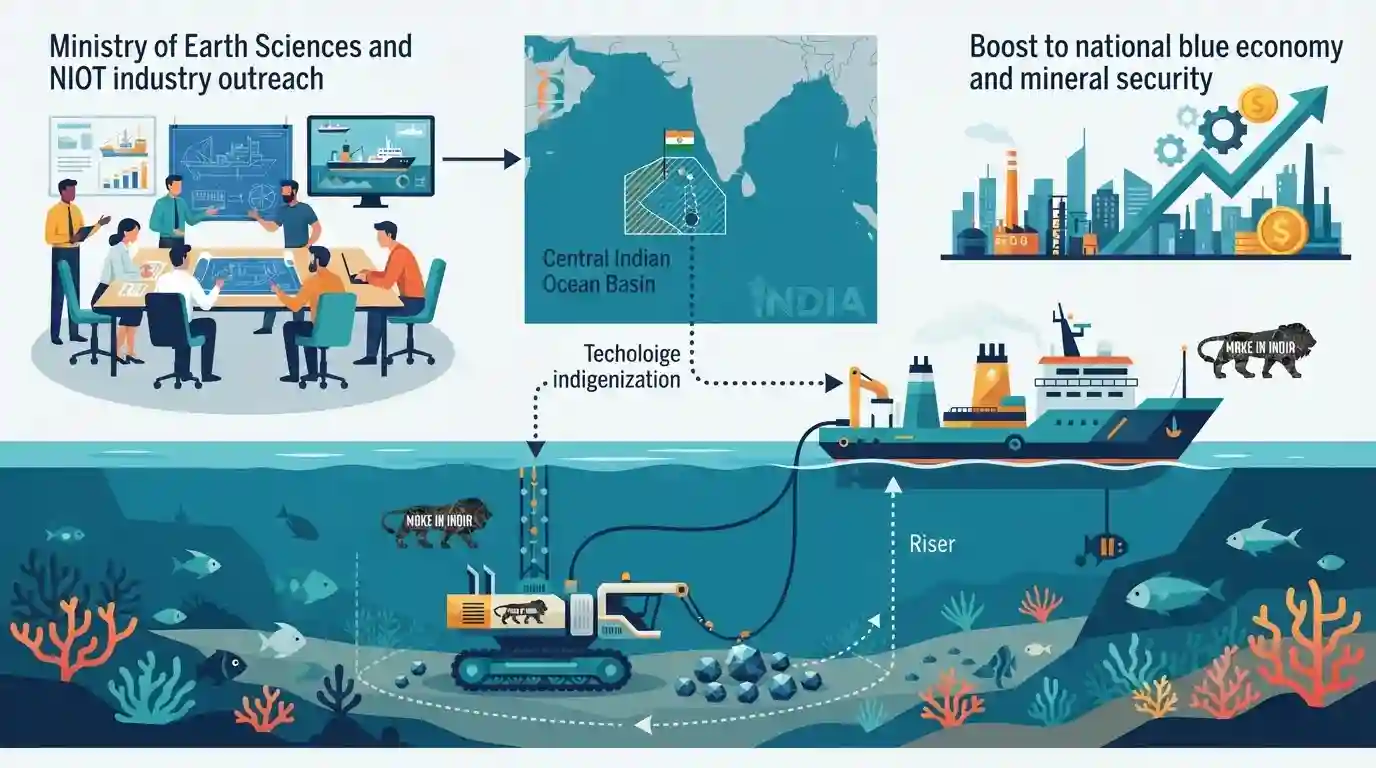
Deep-sea mining is vital for India's transition to green energy and technological self-reliance, as land-based critical mineral reserves deplete. The workshop marks a critical push toward commercializing the Deep Ocean Mission through public-private collaboration.
સારાંશ
The Ministry of Earth Sciences and NIOT conducted an industry outreach workshop focusing on deep-sea mining to boost India's critical mineral security. By leveraging India's allocation in the Central Indian Ocean Basin through the Deep Ocean Mission, the government is engaging private and public industries to develop indigenous technologies for extracting polymetallic nodules, supporting the national blue economy.
મુખ્ય મુદ્દા
- The Ministry of Earth Sciences and National Institute of Ocean Technology (NIOT) hosted an industry outreach workshop on deep-sea mining.
- The initiative aims to harness critical minerals like polymetallic nodules from the Central Indian Ocean Basin to secure India's critical mineral future.
- Emphasized public-private partnerships (PPP) and indigenous technology development to explore deep-sea resources under the Deep Ocean Mission.
- Aligned with India's strategic goals of achieving self-reliance in critical minerals and advancing blue economy objectives.
મહત્વપૂર્ણ શબ્દો
Deep Ocean Mission

An umbrella scheme aimed at exploring deep-sea mineral resources like polymetallic nodules and developing enabling technologies for the blue economy, backed by the Ministry of Earth Sciences.
UPSC context
Relevant for UPSC GS Paper III (Science & Technology - Developments and Applications; Resources & Mineral Security).
National Institute of Ocean Technology (NIOT)
An autonomous research institution under the Ministry of Earth Sciences, based in Chennai, tasked with developing reliable indigenous technologies for ocean resource utilization.
UPSC context
Relevant for UPSC GS Paper III (Science & Technology - Indigenization of Technology and Marine Research).
International Seabed Authority (ISA)
An international organization established under UNCLOS to organize, regulate, and control all mineral-related activities in the international seabed area beyond national jurisdiction.
UPSC context
Relevant for UPSC GS Paper II (International Organizations) and GS Paper III (Law of the Sea, Global Commons).
Ministry of Earth Sciences (MoES)
The nodal union ministry in India responsible for formulating and implementing policies related to oceanography, meteorology, and deep-sea mineral exploration initiatives.
UPSC context
Relevant for UPSC GS Paper II/III (Government Policies, Institutional Structure for Science and Technology).
પ્રિલિમ્સ ટ્રેપ
India has been granted full commercial exploitation rights over 75,000 sq km of the Central Indian Ocean Basin.
India's contract is for exploration, not commercial exploitation, and is regulated by the International Seabed Authority (ISA), not solely national jurisdiction.
સંલગ્ન સ્થિર ખ્યાલો
What are the mandate, governance, and mineral targets of the International Seabed Authority (ISA)?
- Mandate: Established under UNCLOS to organize, regulate, and control all mineral-related activities in the international seabed area.
- Headquarters: Headquartered in Kingston, Jamaica; governs the 'Area' beyond national jurisdiction as the common heritage of mankind.
- Mineral Targets: Focuses on polymetallic nodules, polymetallic sulphides, and cobalt-rich ferromanganese crusts.
આંતર-વિષય પેટર્ન
Deep Sea Mining + UNCLOS & ISA
Deep Ocean Mission exploration rights in the Central Indian Ocean Basin run parallel to UNCLOS maritime boundary delimitations and ISA governance frameworks.
Deep Ocean Mission + Critical Minerals Strategy
Polymetallic nodules directly feed clean energy transitions, linking oceanographic research with critical mineral supply chain resilience.

Expect a statement-based question linking India's ISA exploration rights in the CIOB with the Deep Ocean Mission mandate and ISA regulations.
સંલગ્ન PYQ · 1
સંલગ્ન PYQ · 1
- 2021PrelimsGS1
Consider the following statements : 1. The Global Ocean Commission grants licences for seabed exploration and mining in international waters. 2. India has received licences for seabed mineral exploration in international waters. 3. 'Rare earth minerals' are present on seafloor in international waters. Which of the statements given above are correct?
