Coal sector CSR framework launched for social welfare delivery
Source:PIB ↗
Why It Matters
The article highlights public sector accountability through structured CSR frameworks and targeted healthcare interventions (Thalassemia and congenital heart disease) in mining areas, bridging corporate governance with social welfare delivery.
Summary
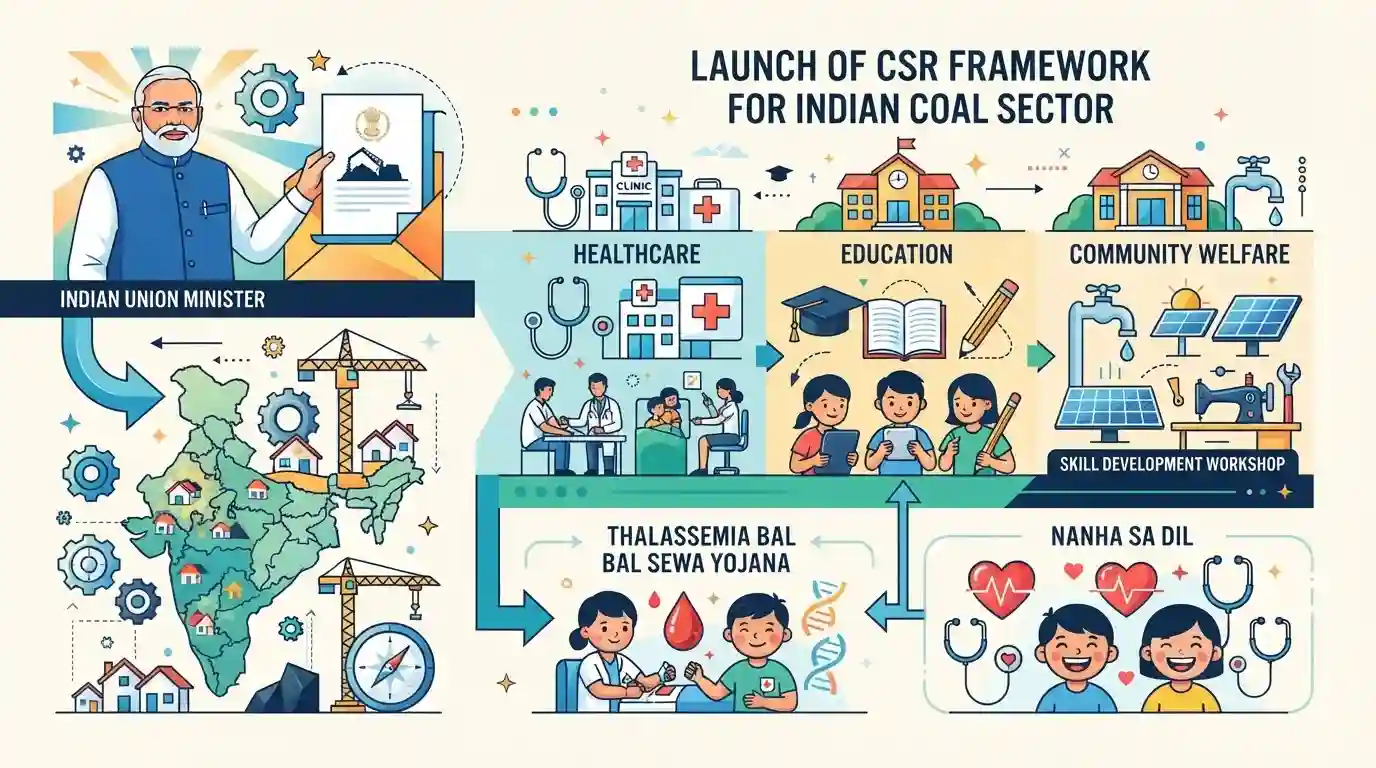
Union Minister of Coal & Mines launched a first-ever sector-wide Corporate Social Responsibility (CSR) framework for Indian coal companies. The framework is designed to optimize and strategicize CSR spending toward healthcare, education, and community welfare in mining-affected regions, highlighting progress under specialized health programs such as Thalassemia Bal Sewa Yojana and Nanha Sa Dil.
Key Points
- Union Minister of Coal & Mines launched the first-ever sector-wide CSR framework for Indian coal companies.
- Celebrated milestones under healthcare initiatives like Thalassemia Bal Sewa Yojana and Nanha Sa Dil, supporting children with thalassemia and congenital heart diseases.
- Aims to channelize Corporate Social Responsibility (CSR) funds more strategically into high-impact social sectors like health, education, and nutrition in coal-bearing regions.
Important Terms
Thalassemia Bal Sewa Yojana

A flagship CSR initiative supported by Coal India Limited to provide financial assistance up to ₹10 lakh for bone marrow transplants to underprivileged children suffering from Thalassemia Major and Aplastic Anaemia.
UPSC context
UPSC Prelims/Mains (GS Paper II - Social Justice/Health): Tests knowledge of government-backed welfare and health interventions for vulnerable children.
Nanha Sa Dil
A Coal India Limited CSR initiative focused on screening, diagnosing, and facilitating free corrective cardiac surgeries for children suffering from Congenital Heart Defects (CHD) in rural and tribal regions.
UPSC context
UPSC Prelims/Mains (GS Paper II - Social Welfare): Tests understanding of public sector undertakings' targeted healthcare interventions and child welfare schemes.
Ministry of Coal
The union ministry responsible for the exploration, management, and overall policy formulation concerning coal and lignite resources in India, including administrative control over public sector undertakings like Coal India.
UPSC context
UPSC Prelims (Governance/Polity): Evaluates institutional framework, ministerial mandates, and implementation of public welfare directives in core industrial sectors.
Coal India Limited
A Maharatna Central Public Sector Enterprise under the Ministry of Coal, functioning as the largest coal-producing company globally and a major driver of sector-wide corporate social responsibility initiatives in India.
UPSC context
UPSC Prelims (Economy/PSUs): Tests awareness of Maharatna status public enterprises, corporate governance, and statutory CSR fund deployment.
Static Concepts Connected
What are the statutory mandates and governance provisions under Section 135 of the Companies Act, 2013?
- Financial Thresholds: Applicability threshold includes companies with net worth of Rs. 500 crore or more, turnover of Rs. 1000 crore or more, or net profit of Rs. 5 crore or more during any financial year.
- Spending Mandate: Qualifying companies must spend at least 2% of their average net profits made during the three immediately preceding financial years on CSR activities.
- Eligible Activities: Schedule VII outlines eligible activities including poverty eradication, healthcare, education, environmental sustainability, and rural development projects.
Cross-Topic Patterns
CSR Funds and District Mineral Foundation (DMF) Convergence
Mining-heavy districts receive large corporate expenditures under statutory obligations, testing the convergence of local district administrations and central PSUs.
Rare Disease Policy and Public Sector Health Interventions
Targeted financial assistance for bone marrow transplants bridges the gap between high-end tertiary healthcare access and vulnerable rural communities.

Sector-wide CSR frameworks for PSUs or specialized health schemes like Thalassemia Bal Sewa Yojana frequently feature in matching questions.
Linked PYQs · 2
Linked PYQs · 2
- 2024MainsGS2
Public charitable trusts have the potential to make India's development more inclusive as they relate to certain vital public issues. Comment.
- 2025MainsGS3
Mineral resources are fundamental to the country's economy and these are exploited by mining. Why is mining considered an environmental hazard? Explain the remedial measures required to reduce the environmental hazard due to mining.
